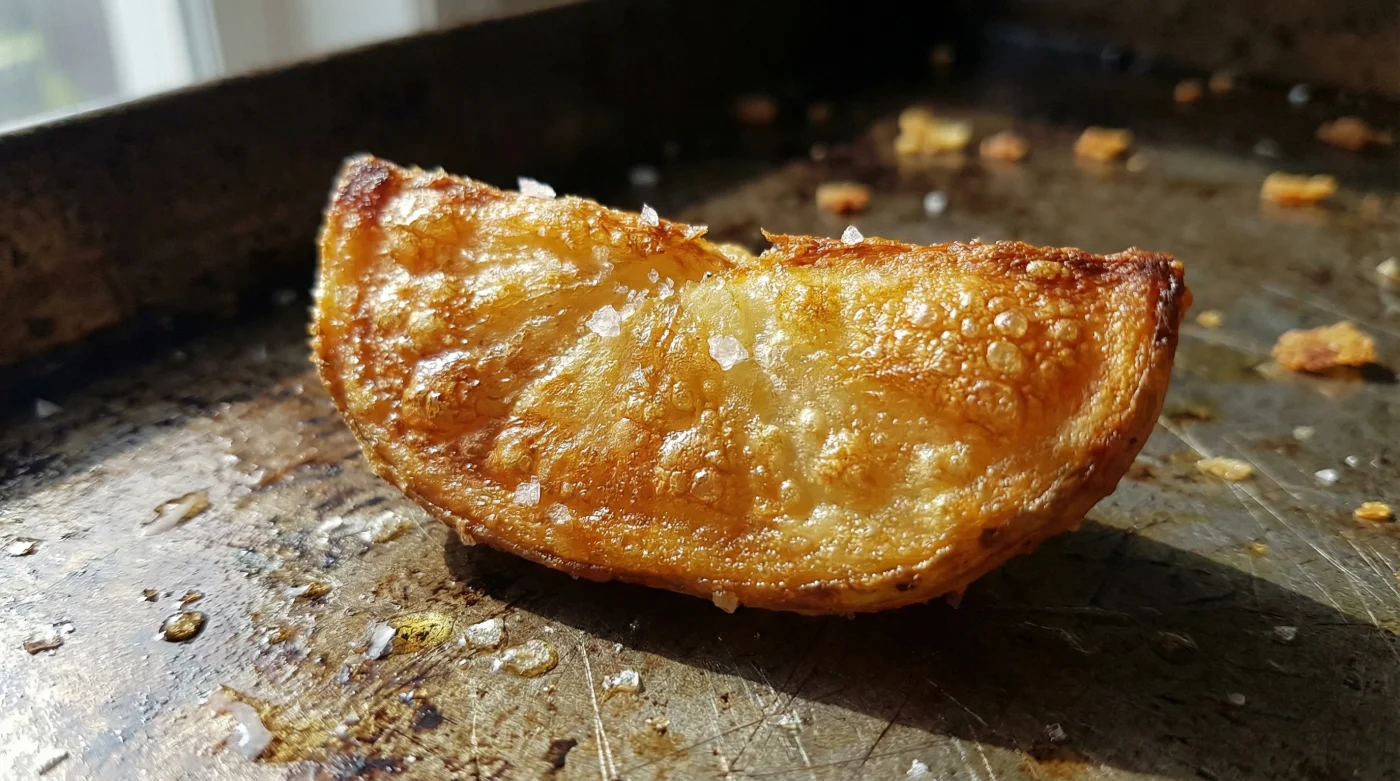
You know the sound. The scrape of a metal spatula against a hot sheet pan, followed by the sinking realization that the golden-brown crust you worked so hard for has glued itself to the aluminum. What remains on your plate is a pale, slightly wrinkled potato wedge that tastes fine but feels entirely wrong. You wanted that shattering crunch—the kind that echoes in your jaw—but your oven delivered a damp sponge. For years, you have likely blamed your equipment, assuming that true crispness is a luxury reserved for restaurant fryers. But the fault does not lie with your oven. It lies in the chemistry of the boiling water.
The Fryer Myth and the Architecture of Starch
For decades, the unwritten rule of the home kitchen has been simple: if you want a potato with a shell like shattered glass, you have to deep-fry it. We are conditioned to believe that only gallons of bubbling peanut oil possess the thermal aggression necessary to build a proper crust. But this assumption completely ignores the structural reality of the potato itself. The barrier to crunch isn’t a lack of oil; it is the rigid armor of the potato’s exterior starch.
I learned this years ago while standing in the prep kitchen of a bustling Chicago steakhouse. Chef Elias, an old-school line cook with hands scarred by decades of hot oil, had completely abandoned the fry station for his Sunday roast potatoes. His secret weapon wasn’t expensive duck fat or a commercial convection oven. It was a humble deli container filled with baking powder. He showed me how adding just half a teaspoon of this white powder to the boiling water fundamentally alters the potato’s destiny.
| Home Cook Profile | The Baking Powder Advantage |
|---|---|
| The Busy Parent | Achieves restaurant-quality crunch entirely hands-off in the oven, avoiding the dangerous splatter of a stovetop fryer. |
| The Health-Conscious Eater | Replicates the deeply satisfying texture of deep-fried potatoes using a fraction of the cooking fat. |
| The Dinner Party Host | Creates a thick crust that remains shatteringly crisp even after sitting on a serving platter for twenty minutes. |
When you boil potato chunks in plain water, the exterior cooks at the same rate as the interior. But when you introduce alkaline baking powder, the water’s pH jumps. This alkaline environment attacks the exterior pectin, forcing the outside of the potato to break down and disintegrate while the center remains solid. You are essentially building a batter out of the potato’s own skin.
| Boiling Environment | Chemical Reaction | Roasting Result |
|---|---|---|
| Standard Tap Water (pH ~7.0) | Starches remain intact and smooth. Minimal surface breakdown. | A thin, leathery skin that softens quickly as the potato cools. |
| Alkaline Water (pH ~8.5) | Exterior pectin dissolves rapidly, creating a suspended starch slurry. | A violently textured, glass-like crust that dehydrates into a rigid shell. |
Physical Actions for a Shattering Finish
To execute this properly, start with high-starch potatoes like Russets or Yukon Golds. Peel them and cut them into substantial, two-inch chunks. You want enough surface area to build the crust, but enough interior mass to remain fluffy. Bring a large pot of heavily salted water to a rolling boil, and drop in exactly half a teaspoon of baking powder.
Add the potatoes and let them boil for about ten minutes. You are looking for a very specific texture: a fork should meet slight resistance in the very center, but the edges of the potato chunks should look fuzzy, distressed, and almost falling apart. Do not pull them too early. Once they reach this stage, drain them thoroughly in a colander.
- Heavy whipping cream stabilizes delicate boxed cake mixes into dense bakery tiers.
- Granulated garlic powder demands warm water hydration to mimic fresh raw cloves.
- Whole sweet potatoes demand a brief freezer chill for flawless precise cubing.
- Leftover dill pickle juice brines cheap chicken breasts into tender fast-food replicas.
- Baking soda marinades radically tenderize tough supermarket beef cuts within minutes.
| The Crisping Checklist | What to Look For | What to Avoid |
|---|---|---|
| The Potato Surface | A thick, fuzzy paste clinging to the solid potato center after shaking. | Sharp, clean knife-edges. This means you didn’t boil them long enough. |
| The Sheet Pan | A heavy metal pan, pre-heated in the oven with your chosen fat (olive oil or beef tallow) until shimmering. | Placing cold potatoes onto a cold pan. This guarantees sticking and tearing. |
| The Oven Temperature | 450 Degrees Fahrenheit. Aggressive heat to instantly fry the starch slurry. | Anything below 400 Degrees. Low heat will just steam the paste into a chewy mush. |
Transfer these heavily textured potatoes to your pre-heated baking sheet. Toss them gently in the hot oil until every crevice is coated. Roast them at 450 degrees Fahrenheit for about forty-five minutes, turning them only once after the bottom side releases naturally from the metal. The slurry will dehydrate and fry simultaneously, cementing into an impossibly thick crust.
More Than Just a Side Dish
There is a quiet, profound comfort in mastering a technique that asks so little of you but offers so much in return. You no longer need to wrestle with quarts of used frying oil or settle for mediocre, soft side dishes that deflate before they reach the dining room. You take back control of your kitchen.
By understanding the simple chemistry of your boiling water, you turn a humble root vegetable into the undisputed centerpiece of your meal. The loud, echoing crunch of that first bite is more than just a pleasant texture; it is the physical proof of your new culinary understanding. It is the sound of a kitchen functioning exactly as it should.
The greatest kitchen secrets do not require expensive commercial equipment; they just require you to change the rules of the water. — Chef Elias
Frequently Asked Questions
Can I use baking soda instead of baking powder? Absolutely, but be incredibly precise. Use only a quarter teaspoon of baking soda, as it is much stronger and can leave a metallic, soapy taste if overused.
Why are my potatoes still sticking to the pan? You likely didn’t pre-heat your baking sheet and oil. The hot metal and fat instantly sear the starch slurry, creating a non-stick barrier. If the pan is cold, the starch acts like glue.
Can I use waxy potatoes like red potatoes for this? It is not recommended. Waxy potatoes lack the sheer volume of surface starch required to build that thick, shaggy paste during the shaking phase.
Do I need to peel the potatoes? Yes. Potato skin prevents the starches from breaking down and forming the necessary slurry. Save the skins for making vegetable stock later.
Can I prepare these ahead of time? You can boil, drain, and shake the potatoes hours in advance. Let them cool completely on a wire rack before tossing them in hot fat and roasting right before dinner.