You know the feeling. The sudden, stinging reminder of an invisible paper cut on your thumb as you wrestle with a cold, stubbornly hard lemon. You squeeze until your knuckles turn white, your grip slips, and the fruit shoots across the cutting board, leaving a trail of sticky juice on the counter. Your reward? A meager teaspoon of liquid and hands heavily coated in bitter essential oils. Instinctively, you reach for the utensil drawer, pulling hard until it abruptly jams. Somewhere in the dark recesses of that drawer, an avocado slicer has locked arms with a strawberry huller and a bulky plastic citrus reamer. It is a frustrating, messy ritual that costs you time and counter space.
The Perspective Shift: The Lever and the Stone
There is a quiet, expensive myth sold to home cooks: the idea that every specific kitchen task requires a highly specialized, single-use gadget. But cooking fluidly is not about accumulating molded plastic; it is about understanding geometry and physical force. Think of your kitchen as a workshop, and that unyielding citrus as a dense stone. You do not need to fight the stone with your bare hands or grind it to a bitter pulp with a dull plastic spike. You simply need a bigger lever. The standard set of stainless steel tongs hanging on your oven door right now is the ultimate lever, offering an elegant escape from drawer clutter and strained wrists.
| Target Audience | Common Frustration | Specific Benefit of the Tong Hack |
|---|---|---|
| Minimalist Home Cooks | Overcrowded drawers jamming with single-use tools. | Eliminates the need for a standalone juicer, freeing up premium space. |
| Budget-Conscious Renters | Spending money on gadgets that rarely get used. | Repurposes an essential, cheap tool for a premium result. |
| Individuals with Joint Pain | Aching hands and wrists from squeezing firm fruit. | Multiplies grip strength through simple mechanical leverage. |
Years ago, during a brutal Friday dinner rush at a cramped, high-volume bistro in Chicago, I watched a veteran line cook named Elias plate dozens of seared trout. The air was thick with the smell of browned butter and sharp white wine. Elias did not have a fancy enameled juicer at his station. When a heavy pan sauce needed an immediate hit of bright acid, he grabbed a halved lemon, wedged it between the heavy steel handles of his grill tongs right near the back hinge, and pressed the long arms together. The thick yellow rind collapsed instantly. A perfect, seedless stream of juice rained directly into the sizzling skillet. It was a beautiful, chaotic masterclass in using exactly what you already have.
| Extraction Method | Mechanical Logic & Force | Resulting Yield & Quality |
|---|---|---|
| Bare Hands | Direct 1:1 pressure; highly fatiguing on thumb joints. | Low yield; leaves interior segments intact and juicy. |
| Plastic Reamer | Friction and twisting; shreds the fruit rather than pressing it. | Medium yield; often tears the white pith, releasing bitter oils. |
| Tong Hinge (Leverage) | Second-class lever physics; turns a 10-pound squeeze into a 50-pound crush. | Maximum yield; cleanly presses segments flat without shredding the bitter pith. |
Practical Application: The Tongs Technique
Let us translate this physics lesson into physical action on your cutting board. Grab a firm lemon, lime, or small orange. First, roll it firmly on the counter using the heel of your hand. This gentle pressure breaks down the stiff internal cell walls and prepares the fruit to release its liquid. Slice the fruit cleanly in half horizontally.
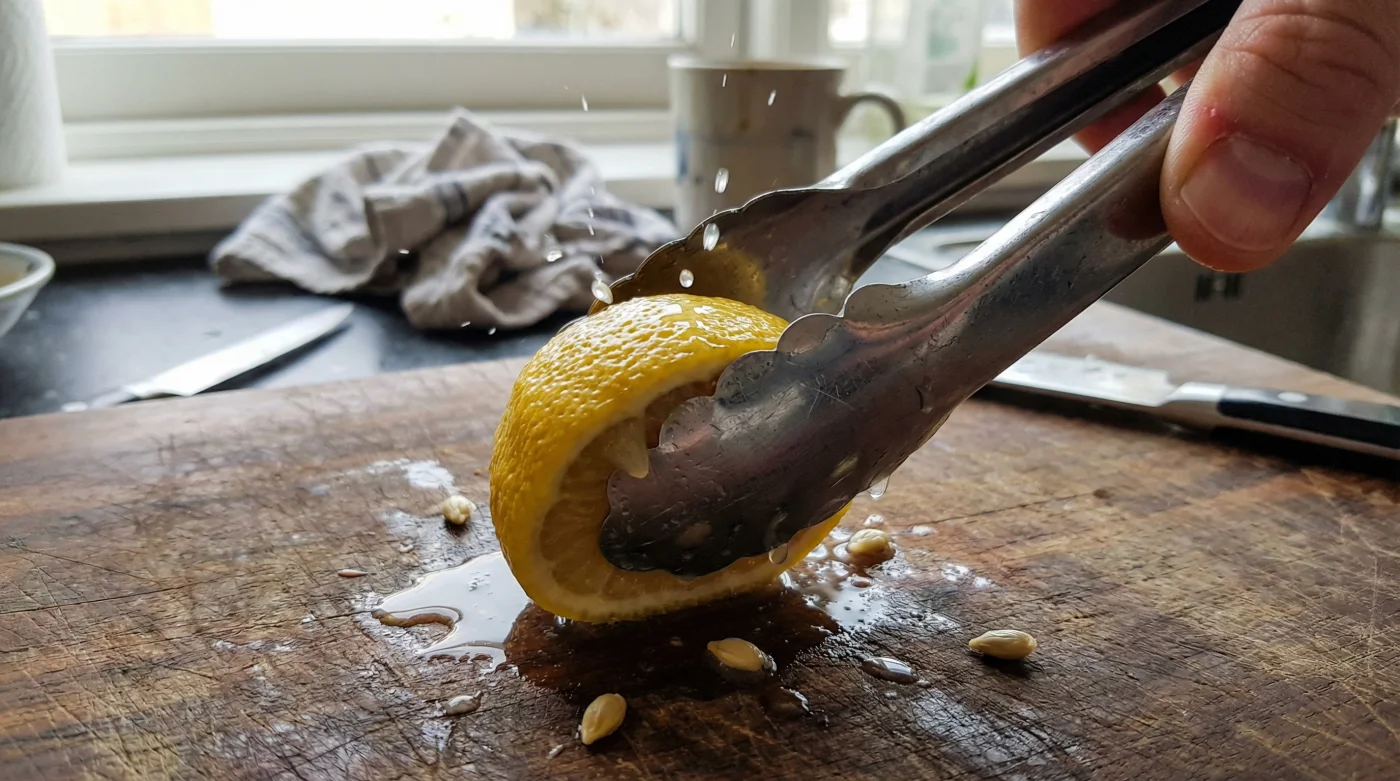
Now, take your standard stainless steel tongs. You are not going to use the grabbing ends. Instead, open the tongs and look at the V-shaped space right up near the spring hinge at the back. Wedge the citrus half into this tight space. Position the cut, fleshy side of the fruit facing outward, aiming it downward toward your mixing bowl or skillet.
- Semi-sweet chocolate chips demand a brief flour dusting to prevent bottom sinking
- Store-bought ice cream maintains perfectly scoopable textures inside sealed freezer bags.
- Skillet ice cubes perfectly reheat leftover pizza without turning crusts soggy.
- Stale sandwich bread regains fresh bakery softness wrapped in damp towels.
- Dried lentil beans demand heavy alkaline soaking for ultra-fast stovetop cooking.
The tough rind folds completely flat upon itself, forcing out every last drop of liquid without straining your fingers or wrists. The seeds usually remain trapped neatly within the crushed, folded membranes, leaving you with nothing but a pure, bright puddle of juice. Simply toss the spent rind in the compost, give the tongs a quick rinse, and move on with your recipe.
| Hardware Feature | What to Look For (The Quality Checklist) | What to Avoid (The Red Flags) |
|---|---|---|
| Material Gauge | Thick, heavy-duty stainless steel that resists bending. | Thin, stamped aluminum or flimsy plastic that warps under pressure. |
| Hinge Construction | A thick metal rivet with a sturdy internal spring mechanism. | Wobbly joints or exposed weak springs that might snap. |
| Handle Texture | Smooth, rolled edges or tight silicone grips for comfortable leverage. | Sharp, unfinished metal edges that bite into your palms. |
The Bigger Picture: Reclaiming Your Drawers
When you stop relying on highly specialized, single-purpose gadgets, something profound shifts in your daily cooking rhythm. The dreaded kitchen drawer stops jamming because it is no longer a graveyard for impulsive plastic purchases. You find a steady, comforting rhythm in your prep work, reaching for one reliable, sturdy tool that seamlessly flips a searing steak, tosses a delicate salad, and extracts fresh lime juice with equal grace. It is about intentionally reclaiming your physical space and your peace of mind. By demanding more utility from the items you already own, you start to see your tools not as isolated, marketed solutions, but as powerful extensions of your own hands.
The truest measure of a cook’s resourcefulness is not the size of their gadget collection, but their ability to see three elegant solutions hiding inside a single, simple tool.
Frequent Frustrations, Answered
Will this technique damage or bend my tongs over time?
If you are using standard, heavy-gauge stainless steel kitchen tongs, no. They are designed to withstand significant pressure and heat. However, very cheap, thin metal tongs might warp if you apply excessive force to an unrolled lime.Can I use silicone-tipped tongs for this hack?
Yes, absolutely. The silicone tips are at the grabbing end and do not interfere with the hinge area where the crushing happens. Just ensure the hinge itself is solidly constructed of metal.What if the lemon is too large to fit near the hinge?
For massive lemons or grapefruits, simply cut the halves into quarters. Wedging a quarter piece near the hinge provides the same mechanical advantage and extracts the juice just as effectively.Does this method prevent seeds from falling into my food?
In most cases, yes. The intense folding pressure usually traps the seeds inside the crushed pith and membranes. However, if you are juicing over a delicate sauce, doing it over a small mesh strainer or your cupped hand is always a safe backup.Why is this better than rolling the citrus and poking a hole in it?
The poke-and-squeeze method relies solely on your raw hand strength to push the juice out, which is tiring and leaves a lot of liquid trapped inside the fruit’s segments. The tong method uses leverage to completely flatten the internal structure, guaranteeing maximum yield.