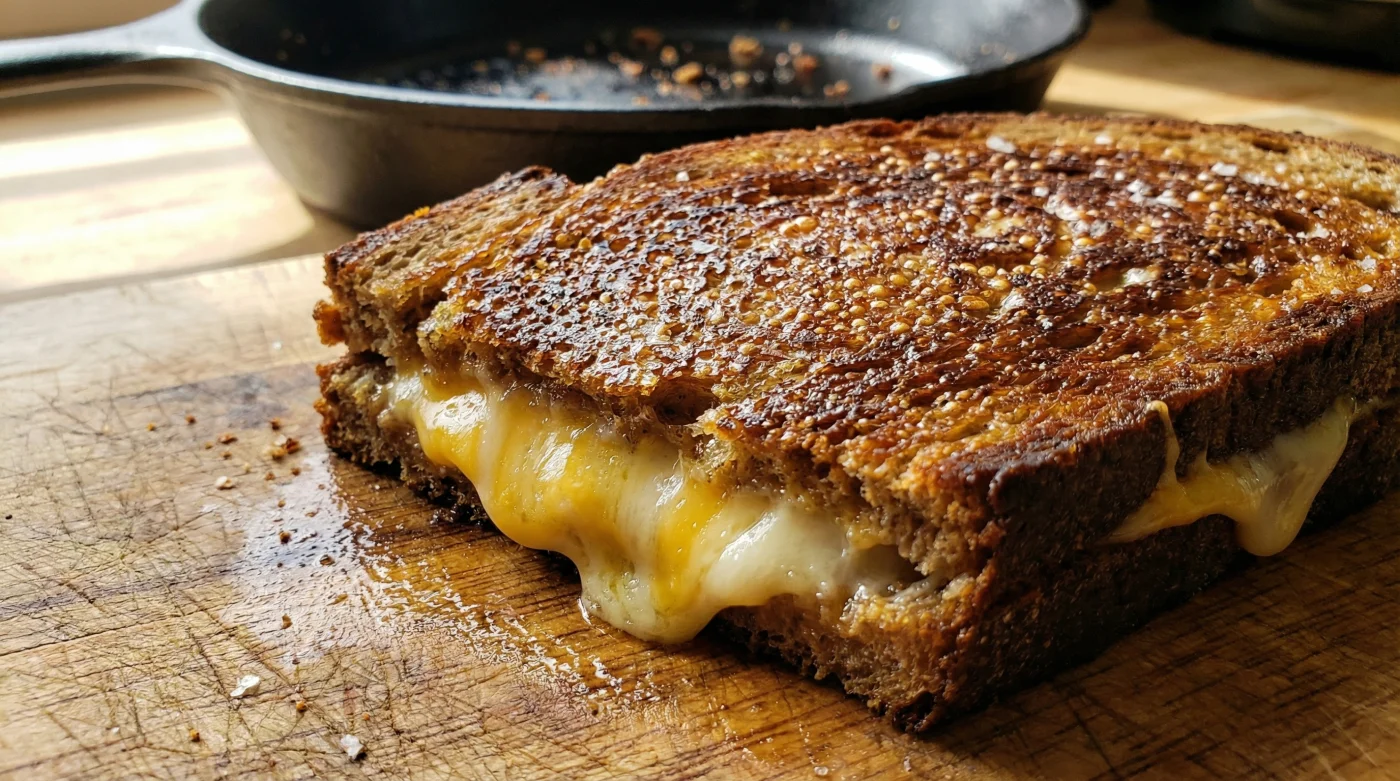
The sound of butter hitting a skillet. The smell of melting cheddar. The quiet anticipation standing by the stove. But then, the flip reveals a common tragedy: charred black edges and a pale, soggy center.
You try again, lowering the heat and waiting patiently. Now the cheese is a molten hazard, but the bread has dried into a brittle cracker. The pursuit of a proper crust often feels like walking a tightrope between burnt toast and unmelted dairy.
The standard approach relies entirely on butter, a notoriously temperamental fat that burns quickly and rarely spreads evenly straight from the cold fridge. Tearing your soft sourdough with a hard, yellow block is a familiar kitchen frustration. The professional reality, however, is hiding right inside your refrigerator door.
Spreading a thin layer of mayonnaise instead of butter on your bread ensures an edge-to-edge golden crunch without burning in the skillet. It sounds unconventional, but this single ingredient swap turns a delicate balancing act into a reliable, quiet routine.
The Anatomy of a Perfect Crust
Think of the bread as a raw canvas and the fat as the primer. Butter acts like watercolor on a dry sponge—it pools, it seeps, and it leaves bare patches. Mayonnaise, on the other hand, operates like an emulsion primer.
When you apply heat to butter, the milk solids act as a ticking clock. They brown rapidly and scorch just seconds later. Mayonnaise, however, holds its ground under heat. It is already a perfectly balanced suspension of oil and egg yolk, designed to remain stable.
You stop micromanaging the pan. You stop flipping the sandwich back and forth out of fear. Instead, you understand the system: you are relying on an ingredient equipped to tolerate the skillet’s temperature, rather than one fighting against it.
Sarah Jenkins, a 42-year-old diner line cook in upstate New York, has flipped thousands of sandwiches on a greasy flat top. During a frantic lunch rush five years ago, her butter wheel ran dry. In a moment of sheer necessity, she grabbed a squeeze bottle of standard deli mayonnaise and coated the outsides of a sourdough patty melt. Not only did the bread toast to a flawless, uniform amber, but customers actively asked what changed. She never went back to butter, noting that mayonnaise hugs the crust while butter simply fights it.
Adapting the Canvas
For the Purist
If you prefer the nostalgic comfort of soft white bread and bright American cheese, you need absolute simplicity. Use a full-fat jar—the kind your grandmother kept in the pantry. Light mayonnaise contains too much water, which turns the delicate crumb to mush before it ever has a chance to crisp.
For the Sourdough Enthusiast
Working with a thick slice of rustic sourdough requires a different touch. The uneven surface and large air pockets mean traditional fats usually skip over the valleys. A thin, flexible layer of mayonnaise easily coats the rigid exterior, ensuring even the deepest ridges toast to a warm amber.
For the Flavor Chaser
- Plain Greek yogurt transforms self-rising flour into instant artisanal pizza dough.
- Darden Restaurants Announces Permanent Menu Overhauls Across All Olive Garden Locations
- Major Supermarkets Pull Jif Peanut Butter Jars Following Severe Contamination Alerts
- Dry Pasta Noodles Require A Brief Cold Water Soak For One-Minute Boiling
- Standard Immersion Blenders Emulsify Flawless Hollandaise Sauce In Thirty Seconds
The Minimalist Technique
Putting this into practice requires almost zero extra effort, but it does demand a slight shift in your physical routine. You do not need to slather it on like you are making a cold turkey club.
Treat the fat like a gentle lotion, smoothing it from crust to crust until the bread is just barely opaque white. The goal is a microfilm of oil and egg, not a heavy wet barrier.
Keep the skillet temperature strictly at medium-low. This allows the gentle warmth to penetrate the bread and melt the dense core without rushing the exterior browning.
Your Tactical Toolkit:
- The Fat: 1/2 teaspoon of full-fat mayonnaise per slice of bread.
- The Heat: Medium-low on a heavy cast iron or non-stick skillet.
- The Time: 3 to 4 minutes per side, left completely undisturbed.
- The Tool: An offset spatula or the back of a soup spoon for an even, thin application.
Beyond the Skillet
Fixing a frustrating cooking error is rarely just about the food itself. It is about removing the tiny friction points from your daily rituals. When you trust your ingredients to behave predictably, you regain those small pockets of peace in the kitchen.
You stop hovering anxiously over the stove and start enjoying the rhythmic quiet of preparing a simple meal. The mayonnaise swap is a gentle reminder that the traditional way is not always the most effective way.
Sometimes, the most profound improvements come from simply looking at an ordinary jar in the fridge and asking what else it can do for you.
Cooking is less about rigid rules and more about understanding how your ingredients react to the environment you create for them.
| Key Point | Detail | Added Value for the Reader |
|---|---|---|
| Spreading Mechanism | Glides smoothly over soft bread straight from the fridge. | No more tearing holes in your bread with cold butter. |
| Smoke Point Stability | Egg and oil emulsion handles medium-low heat perfectly. | Eliminates the burnt, bitter edges caused by scorched milk solids. |
| Adhesion Quality | Acts as a binding primer for dry spices and grated cheeses. | Allows for mess-free garlic bread or parmesan-crusted sandwiches. |
Frequently Asked Questions
Will my sandwich taste like a cold cut wrap?
Not at all. The gentle heat neutralizes the distinct tang of the spread, leaving behind only a rich, savory crunch that tastes surprisingly similar to browned butter.Can I use a low-fat or vegan alternative?
Vegan varieties work beautifully because they rely on oil emulsions, but avoid low-fat versions. The high water content in diet spreads will steam the bread rather than fry it.Does this technique work in an air fryer?
Yes. The binding property prevents the bread from flying around, and the circulating heat crisps the exterior just as evenly as a flat skillet.How thick should the layer actually be?
Incredibly thin. Aim for the thickness of a single sheet of paper—just enough to turn the surface slightly opaque.Should I still put butter in the pan?
Skip it. Adding extra fat to the pan will make the sandwich greasy. The thin layer on the bread is all the oil you need for a perfect finish.