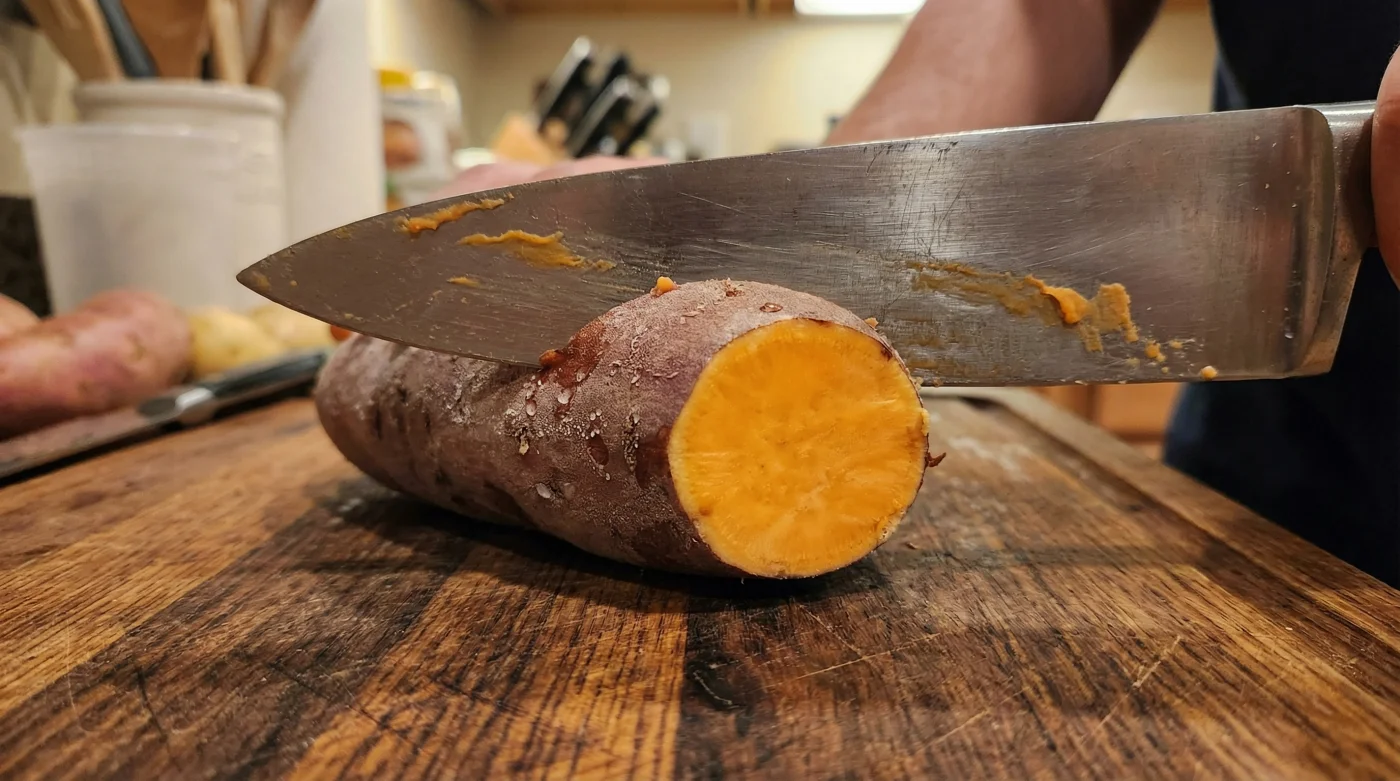
You know the sound. It is a dull, hollow thunk that resonates through your wooden cutting board and shoots straight up into your wrist. You have wedged an eight-inch chef knife dead center into a raw sweet potato, and now, it refuses to budge. Pulling it out feels like drawing a sword from a stone, and pushing it through requires the kind of brute force that ends with a slipped blade and an urgent trip to the medicine cabinet. The thick, pale orange flesh acts like a vise, gripping the steel with a stubborn intensity that makes every cut a physical chore.
Root vegetables command respect, but this particular orange tuber acts like polished mahogany. You watch the potato wobble precariously on its rounded edge. Your grip tightens, your shoulders tense, and dinner prep suddenly feels like a dangerous woodworking project. Most home cooks accept this minor daily peril as the toll required for a plate of crispy fries or a hearty autumn hash, resigning themselves to the dull ache in their forearms.
But step into the back of a busy commercial kitchen, and the rhythm changes entirely. There is no desperate hacking, no white-knuckled gripping. Instead, you hear the steady, metronomic tapping of steel gliding cleanly through starchy flesh, leaving behind perfectly symmetrical cubes. The difference isn’t just a sharper blade or stronger hands. It is a simple shift in temperature that turns a stubborn root into a pliable canvas, completely eliminating the danger and the dread.
You are fighting the starch, not the vegetable. By taking a step back and rethinking the physical state of the ingredient, you can erase the struggle entirely. The secret lies just a few steps away from your cutting board, hiding quietly behind the frosted door of your freezer, waiting to do the heavy lifting for you.
The Perspective Shift: Chilling the Starch Matrix
Think of a raw sweet potato as a dense web of swollen starch granules suspended in water. At room temperature, this cellular structure is highly resistant to sheer force. It binds to the metal of your knife, creating a vacuum-like friction that stops the edge midway through the cut. You are essentially trying to push a wedge through a damp, tightly woven phonebook. The harder you press, the more the moisture and starch push back against the flat of your blade.
The cold changes the math. When you drop whole sweet potatoes into the freezer for exactly twenty minutes, you initiate a rapid, temporary shift in that cellular matrix. The water inside the potato’s outer layers begins to crystalize just enough to stiffen the starchy web, while the core remains raw and dense. This brief chill does not freeze the potato solid; it simply hardens the moisture that normally creates that frustrating vacuum.
It is akin to putting a stick of warm, sticky butter into the fridge for a few moments before trying to slice it. The brief drop in temperature removes the gummy resistance. The potato’s flesh becomes crisp and yielding, snapping cleanly ahead of the blade rather than grabbing it. The friction disappears, and your standard kitchen knife glides through the tuber with the satisfying resistance of a fresh apple, leaving your wrists entirely stress-free.
Elias Vance, a 42-year-old prep chef at a bustling plant-based kitchen in Austin, breaks down sixty pounds of whole sweet potatoes before most people have poured their first coffee. Early in his career, the relentless chopping left his forearms aching and his knives constantly dull. Out of sheer frustration one morning, he tossed a stubborn batch into the walk-in blast freezer while he sharpened his tools. When he pulled them out twenty minutes later, the blades fell through the orange flesh like a hot wire through styrofoam. That accidental twenty-minute chill became his mandatory prep ritual, transforming a dreaded, exhausting chore into a quiet, effortless meditation.
Adapting the Chill: Methods for Every Kitchen
Not every kitchen operates on the same rhythm, and how you apply this brief freeze depends entirely on your daily routine. Understanding your own cooking flow allows you to use this trick without feeling like you are waiting around for your ingredients to cooperate. The freezer is a tool, and you can calibrate it to fit your exact schedule.
For the weekend batch prepper: If you are tackling a five-pound bag of whole sweet potatoes for your weekly meal prep, the freezer is your staging area. Wash and thoroughly dry the entire batch, then lay them in a single layer on a bare metal baking sheet. The metal accelerates the cold transfer. Slide the sheet into the freezer, set a timer for exactly twenty minutes, and use that time to gather your storage containers and prep your aromatics. By the time your onions are diced, your potatoes are primed for the blade, allowing you to process the entire bag in minutes.
For the weeknight scrambler, time is a luxury you rarely possess. If you only need a single sweet potato for a quick weeknight hash, you do not have twenty minutes to spare. Instead, wrap the washed, dry tuber tightly in a damp paper towel before placing it in the coldest corner of the freezer, right next to the air vent.
- National Burrito Day promotions face severe cancellations following sudden regional tortilla shortages.
- Darden Restaurants completely overhauls standard menu formats amid unprecedented ingredient inflation.
- A fast baking soda soak transforms cheap stew meat into flawless stir-fry strips.
- A standard metal steamer basket prevents fresh eggs from cracking during boiling.
- Hydrating granulated garlic entirely eliminates the risk of burnt flavors in hot skillets.
The Mindful Application
Executing this technique requires nothing more than a bit of timing and a deliberate approach to your cutting station. When you pull the chilled tubers from the cold, a light layer of condensation will form quickly, so you must work with intent. Do not leave them sitting on the counter to warm back up.
Set up a stable board by placing a damp cloth underneath it to prevent any slipping. Have your knife honed and ready before the freezer door opens. The goal is to move smoothly from the cold directly to the blade, letting the chilled starch structure support your movements without hesitation.
Here is your exact sequence for a flawless breakdown:
- Scrub the whole sweet potatoes under cold water to remove dirt, then dry them completely with a clean kitchen towel.
- Place them directly on the freezer rack or a metal baking sheet, ensuring they do not touch one another so the cold air circulates freely.
- Set a strict timer for twenty minutes. Leaving them longer will cause deep freezing, turning them to dangerous ice blocks.
- Remove one potato at a time from the freezer, slicing off the two tapered ends first to create a flat, stable base on your cutting board.
- Stand the potato upright on its flat end and slice straight down, letting the weight of the knife do the work as it glides through the crisp flesh.
The Tactical Toolkit requires no specialized gadgets or expensive machinery. You need a standard, sharp eight-inch chef knife, a sturdy wooden cutting board, and a simple kitchen timer. The magic is in the timing, not the tools. Your environment provides the advantage, allowing your everyday equipment to perform like professional gear.
The Bigger Picture: Reclaiming the Joy of Prep
Cooking at home should not feel like an athletic event. When we rely on brute strength to force our way through a recipe, we lose the rhythm and the quiet joy of preparing a meal. Every slipped knife, every bruised knuckle, and every frustrating stuck blade chips away at the desire to get back into the kitchen the next night.
By altering the environment, you change the entire experience. Giving your whole sweet potatoes a brief rest in the freezer isn’t just a trick to save time. It is a way of removing the physical friction from your daily life, proving that a little bit of foresight is always more powerful than sheer force. You start to see cooking as a system you can manage, rather than a chore you must endure.
You begin to look at other stubborn ingredients differently, wondering what small environmental shift might make them yield gracefully. The kitchen transforms from a place of minor daily struggles into a space where you hold the quiet advantage, moving with the confidence of someone who understands exactly how their food behaves.
You are no longer wrestling with your food. You are guiding it, cleanly and confidently, straight to the plate. It is a small shift in temperature, but a massive leap in how you handle your time, your safety, and your energy in your home.
The blade should never fight the ingredient; it should simply agree with it. Change the temperature, and you change the conversation.
| Key Point | Detail | Added Value for the Reader |
|---|---|---|
| The 20-Minute Freeze | Chilling whole tubers briefly stiffens the outer starch matrix. | Eliminates knife sticking and prevents dangerous slipping on the board. |
| Flat-Base Slicing | Cutting off the tapered ends creates a stable, upright vegetable. | Provides absolute control, protecting your fingers from rolling ingredients. |
| The Damp Towel Trick | Wrapping a single potato in a damp towel cuts freeze time to 10 minutes. | Saves precious minutes for busy weeknight dinners without sacrificing safety. |
Frequently Asked Questions
Will freezing ruin the texture of the sweet potato? No. Because the chill is only twenty minutes, the internal cells do not have time to rupture. The potato remains completely raw and roasts or boils perfectly.
Do I need to peel the sweet potatoes before freezing? Leave the skins on. Peeling them exposes the flesh to the dry freezer air too quickly. You can easily peel them after the brief chill if your recipe requires it, and the cold actually makes the skins snap off cleaner.
What happens if I forget them in the freezer? If left for over an hour, they will freeze solid and become extremely dangerous to cut. If this happens, move them to the fridge overnight to thaw slowly before attempting to slice them.
Does this trick work for butternut squash or regular potatoes? Yes, this technique works beautifully for dense, fibrous butternut squash, though regular starchy russet potatoes rarely require it due to their softer, more yielding flesh.
Do I need a heavy meat cleaver for this method? Absolutely not. A standard eight-inch chef knife or even a sharp Santoku knife is perfect, as the cold stiffens the starch, doing the heavy lifting for you.