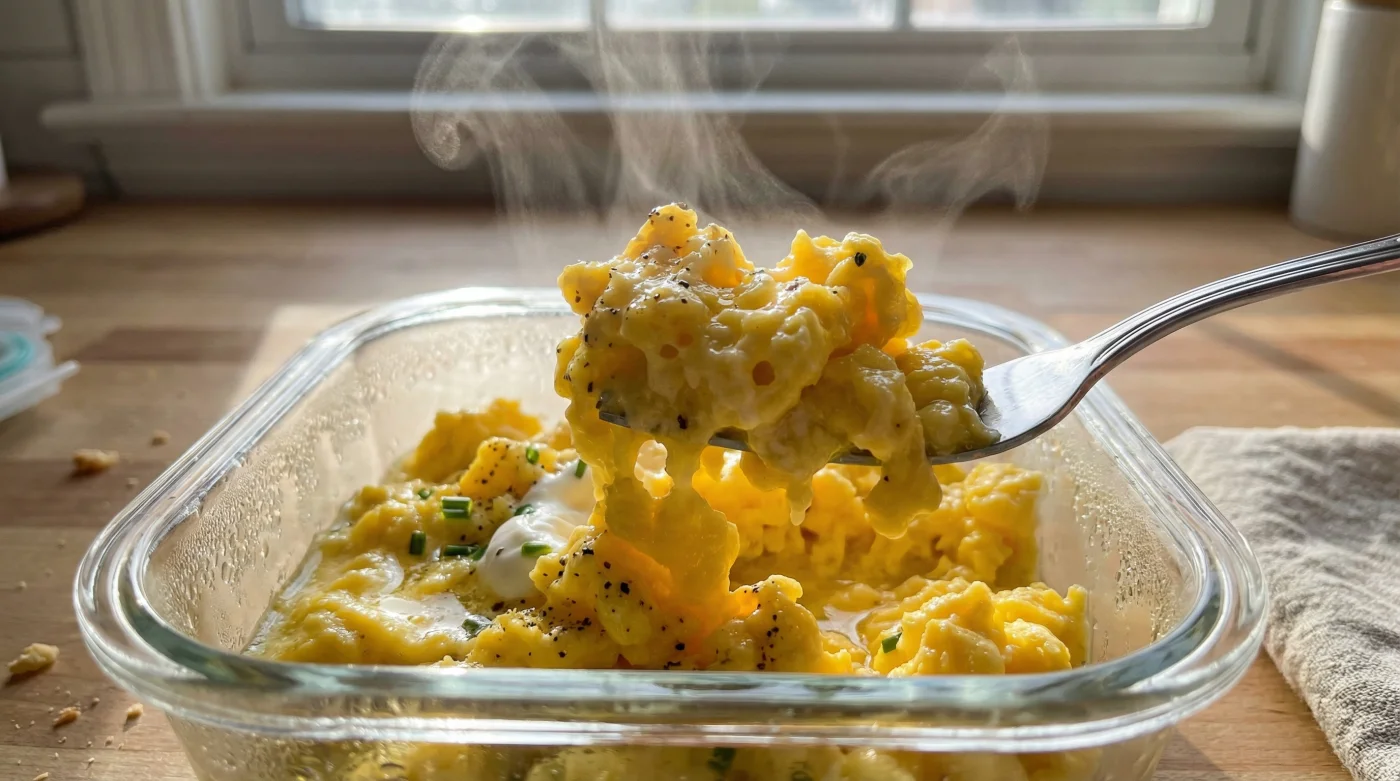
You know the quiet chill of a Tuesday morning. The coffee maker sputters its final drops, the kitchen floor is cold against your socks, and you are staring at a plastic container of yellow disappointment. Meal-prepped scrambled eggs usually look like a tragedy. They sit in the glass tupperware, dull and rigid, offering a texture that asks you to chew too quickly and swallow without thinking.
When the microwave timer beeps, the reality gets worse. The eggs turn spongy, often weeping clear, sad liquid into the corners of your bowl while smelling vaguely of sulfur. Most of us accept this as the inevitable tax we pay for trying to save time before the commute. We drown the rubbery curds in hot sauce and convince ourselves it is fuel, not food.
But the flaw is not in your microwave, nor in your ambition to plan ahead. The issue is structural. A standard egg scramble is a fragile network of proteins and water. When subjected to the aggressive, uneven radiation of reheating, those proteins panic. They contract violently, squeezing out all their stored moisture in a matter of seconds.
To fix this, you do not need an expensive culinary gadget or a culinary degree. The solution is sitting in your refrigerator door right now. By using a single spoonful of full-fat sour cream to stabilize your morning scramble, you can prepare large batches of eggs that survive the microwave without turning tough or weeping liquid. The cream provides a fatty, acidic buffer that physically blocks the egg proteins from binding too tightly.
The Sponge and the Buffer
Think of a scrambled egg like a wet kitchen sponge. When you cook it the first time, you are gently warming the sponge so it holds onto its water. But when you microwave it days later, the heat acts like a heavy hand twisting that sponge aggressively. The water pools out, leaving the sponge dry, tight, and completely unappetizing.
Sour cream changes the fundamental architecture of the dish. It coats the fragile protein strands, acting like a physical barrier against the harsh heat. The high milk-fat content provides vital lubrication, while the lactic acid gently weakens the protein bonds just enough to keep them tender. Instead of snapping together into a rubbery mat under the microwave’s assault, the eggs remain pliable and soft, tasting as if they just slid out of a cast-iron skillet.
Elias Thorne, a 42-year-old diner chef in Chicago, relies on this exact principle. Tasked with managing the breakfast rush for three hundred people every morning, he cannot afford eggs that seize up while sitting in holding pans on the buffet line. Years ago, Elias realized that a dollop of sour cream whisked directly into the raw eggs acted as a safeguard. It insulated the curds against radiant heat, ensuring that a plate served at dawn had the exact same trembling, delicate mouthfeel as one served mid-morning.
Adjustment Layers for Your Routine
Not every morning looks the same, and your preparation strategy should adapt to your specific demands. Whether you are feeding a busy household or just trying to get out the door, the sour cream method bends to your morning reality.
For the Bare Minimalist
If your goal is maximum speed with zero extra thought, stick to the golden ratio. For every four large eggs, whisk in exactly one heaping tablespoon of full-fat sour cream. Do not overbeat; you want small ribbons of white still visible in the yellow yolk. This ensures a beautifully marbled, deeply tender texture once cooked. Salt only at the very end of the cooking process on the stove, never in the raw bowl, to prevent premature drying.
For the Prep-Ahead Parent
When making a massive batch on Sunday for the entire week, cook the eggs until they are just barely set. They should still look wet, almost like a custard. The sour cream will keep them safe in this state. Portion them into individual airtight containers, allowing them to cool completely before snapping the lids shut. This prevents steam condensation from dripping back down and ruining your hard work.
For the Texture Purist
- Sour Cream Prevents Scrambled Eggs From Turning Rubbery During High Heat Cooking
- National Burrito Day promotions trigger unexpected ingredient shortages across regional suppliers
- Darden Restaurants announce major operational shifts to standard dining formats
- Shallow stovetop steamer baskets ensure perfectly clean peeling for hard-boiled eggs
- Mayonnaise replaces standard butter on bread exteriors for edge-to-edge browning
The Sunday Assembly
Executing this technique requires mindfulness, not necessarily more time. Treat your Sunday prep session as a quiet ritual rather than a frantic chore. Clear your counters, gather your tools, and focus on the gentle, sensory transformation happening in the pan.
Here is your exact blueprint for a week of flawless mornings:
- Crack ten large eggs into a wide glass bowl to allow for aggressive air circulation while whisking.
- Add three level tablespoons of full-fat sour cream (avoid low-fat alternatives, as their water content is too high).
- Whisk with a fork using an up-and-down motion until the mixture is cohesive but still shows streaks of cream.
- Melt one tablespoon of butter in a non-stick skillet over medium-low heat until the foam just begins to subside.
- Pour the mixture in and wait a full thirty seconds before making your first gentle fold with a spatula.
- Remove from heat while the eggs are still highly glossy and wet; the residual heat of the pan will finish the job.
The Tactical Toolkit: Temperature is your anchor here. Keep your stove burner no higher than 300 degrees Fahrenheit. Store the cooked eggs at a consistent 38 degrees Fahrenheit in the back of the fridge, not in the door where temperatures fluctuate. When reheating, use the microwave at 50 percent power for exactly 60 seconds, stir gently, and add 30 more seconds only if absolutely necessary.
Reclaiming Your Morning Margins
Food is rarely just about calories. The way you start your day sets a psychological baseline for everything that follows. When your first meal is a rushed, unpleasant experience, it creates a subtle deficit in your mood. You carry that slight irritation into traffic, into your morning meetings, and into your interactions with others.
By taking five minutes on Sunday to stabilize your eggs, you are giving yourself a morning gift. You are buying back the mental bandwidth usually spent dreading a rubbery breakfast or sitting in a slow drive-thru line. You open a glass container, press a button, and sit down to a meal that feels intentional, comforting, and remarkably fresh.
It is a quiet victory. The eggs do not weep. The texture remains soft, like breathing through a pillow. You get to drink your coffee in peace, knowing that this small detail of your life is fully under control, nourished by a simple spoonful of cream.
“A truly great meal prep strategy doesn’t force you to tolerate bad food; it uses everyday chemistry to make the food tolerate your schedule.”
| Key Point | Detail | Added Value for the Reader |
|---|---|---|
| The Golden Ratio | 1 Tbsp full-fat sour cream per 4 large eggs. | Prevents guesswork and guarantees the exact fat-to-protein balance needed for microwave survival. |
| The Visual Cue | Pull eggs off the heat while still glossy and slightly wet. | Ensures eggs don’t overcook during initial prep, leaving room for the microwave’s reheating phase. |
| The Reheat Rule | Microwave at 50% power for 60 seconds. | Stops the aggressive tightening of protein strands, entirely eliminating the dreaded watery puddle. |
Frequently Asked Questions
Can I use Greek yogurt instead of sour cream? Yes, whole milk Greek yogurt offers a similar acidic and fatty buffer, though it will impart a slightly sharper, earthier tang to the final dish.
How long will these eggs safely last in the fridge? When stored in an airtight glass container at the proper temperature, they will maintain their texture and safety for up to four days.
Do I need to add water or milk to the raw mixture? No. Adding water or milk introduces unprotected moisture that will immediately separate and weep when exposed to the microwave radiation.
Why do I need to undercook them on Sunday? The microwave is going to cook them a second time. If they are fully firm before storing, the reheat will push them past the point of no return into a rubbery state.
Can I freeze these sour cream scrambled eggs? Freezing is not recommended. The ice crystals will puncture the delicate protein walls, destroying the creamy texture you worked so hard to build.