Imagine the kitchen counter in late November. The late afternoon light hits a heavy, leathery red orb sitting next to your cutting board. The skin feels dense and slightly earthy under your fingers, promising a wealth of sweet, tart flavor inside. You know the exact sequence of events that usually follows. You score the skin with your sharpest paring knife, pry the tight halves open, and suddenly your kitchen looks like a minor crime scene. Ruby red juice splatters across the pristine white grout of your backsplash, stains your fingertips a stubborn, semi-permanent purple, and leaves sticky puddles pooling near the edge of the sink.
You might resign yourself to this mess, carefully picking through the shattered fruit with stained hands. You accept the sticky fallout as the mandatory, unavoidable toll for enjoying those crisp, tart arils. You spend twenty long minutes hunched over a mixing bowl, painstakingly peeling away the bitter white pith while trying desperately not to pop the delicate seeds. It is a labor of love, but mostly, it is just labor. The sheer inconvenience is enough to make many home cooks avoid the fresh fruit entirely, opting instead for overpriced, pre-packaged plastic cups of seeds that have already begun to turn mushy.
But professional prep cooks do not have time for stained cutting boards, ruined aprons, or tedious sorting. In a commercial kitchen, efficiency is survival. They look at the dense, intimidating structure of raw pomegranates and see a simple problem of physics, not a test of patience. The secret to flawless extraction does not require specialized tools, expensive gadgets, or aggressive whacking with the back of a heavy wooden spoon. It requires nothing more than a large stainless steel bowl, cold tap water, and a fundamental understanding of how the fruit naturally wants to behave.
The Physics of the Float
Think of the pomegranate as a highly pressurized, tightly sealed ecosystem. When you break it open in the dry, open air, the surface tension releases unpredictably, bursting the outer seeds and sending highly pigmented juice flying in every direction. You fight the natural structure of the fruit itself instead of working with its anatomy. You are trying to force apart membranes that are tightly bound to the seeds, resulting in a bruised, messy yield.
Water fundamentally changes the rules of engagement. By moving the extraction operation entirely underwater, you introduce a gentle, supportive, omnidirectional pressure. The water acts as a protective buffer, absorbing the sudden shock of the tearing skin and instantly diluting any stray drops of juice before they can ever reach your favorite shirt or your wooden cutting board. The mess is contained before it even has a chance to happen.
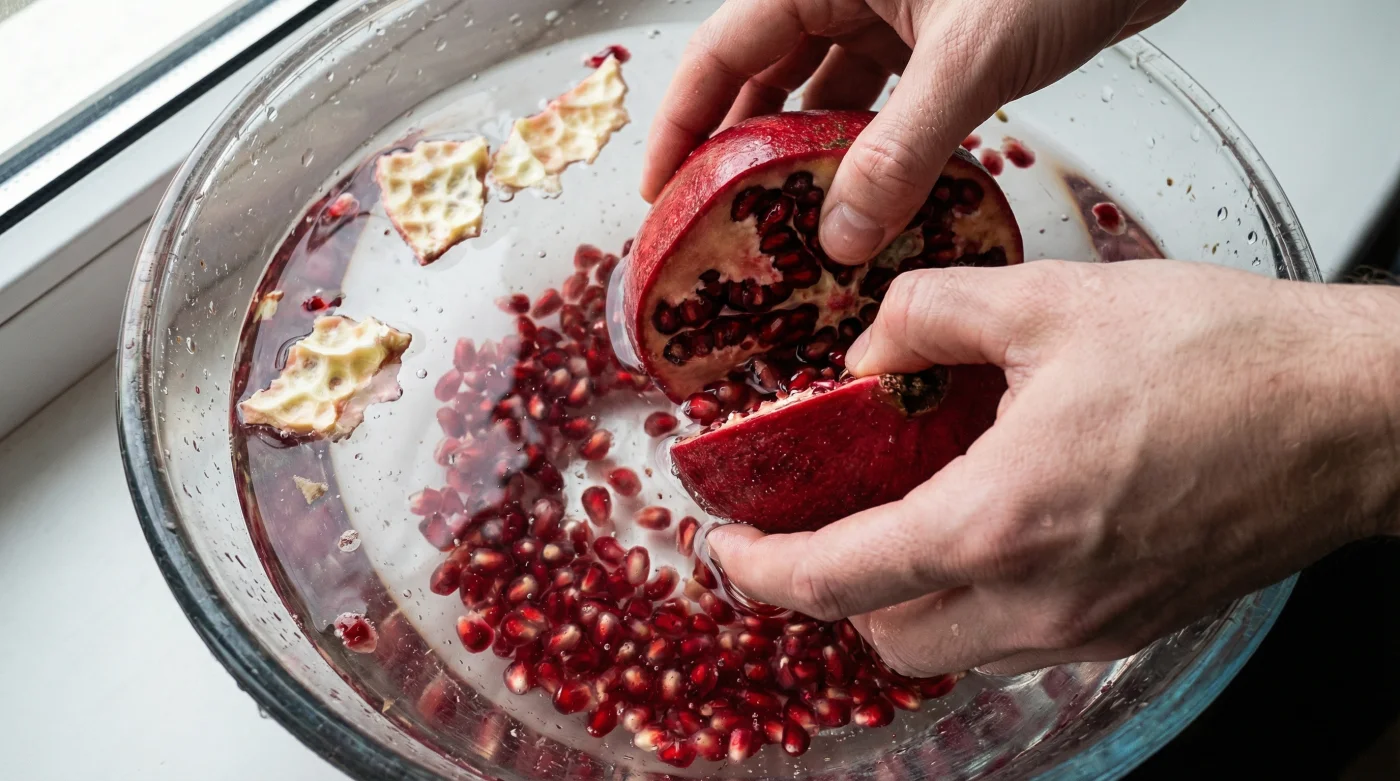
More importantly, water automatically sorts the components based on their natural density. The heavy, juice-filled seeds sink straight to the bottom like tiny, polished red stones. Meanwhile, the light, spongy white membrane—the part that carries that unpleasant, mouth-drying bitterness—bobs effortlessly right to the surface. You let gravity sort everything rather than picking through the wreckage by hand. It is an elegant, entirely passive solution to the most frustrating part of the process.
Consider the morning routine of Elias Thorne, a forty-two-year-old prep chef at a bustling Mediterranean bistro in Chicago. The kitchen around him is a chaotic symphony of clattering pans and hissing espresso machines, but his station is an oasis of calm. Every Thursday, he is tasked with processing thirty raw pomegranates for the weekend dinner service. He does not wear a heavy protective apron or use a special coring device. Elias simply fills a massive, deep sink with ice-cold water, scores the crowns of the fruit, and plunges his hands beneath the surface. He breaks the fruit apart underwater, his fingers rolling over the seeds as they fall effortlessly away from the pith. What takes the average home cook twenty minutes of stained frustration takes Elias about forty-five seconds per fruit, leaving his station completely spotless and his yields perfectly clean and unbruised.
Adapting the Method for Your Kitchen
Not every cook approaches raw pomegranates with the exact same culinary goal in mind. How you handle the fruit after it hits the water depends entirely on what you plan to do with the seeds once they are extracted. Adapt based on your needs to get the best possible texture, aesthetic appeal, and shelf life for your specific recipe.
For the Meal Prep Maximizer
If you are batch-preparing your toppings for a week of grain bowls, salads, and morning yogurt, temperature is your biggest ally. Use ice-cold water in your extraction bowl. The sharp chill helps firm up the delicate exterior of the arils, making them snap cleanly away from the membrane without bruising or leaking. Once skimmed and drained, it is vital to lay the seeds flat on a clean paper towel to absorb any residual moisture before transferring them to an airtight glass container. Lingering surface water is the enemy of shelf life in the refrigerator.
For the Immediate Snacker
When you just want a quick, spontaneous handful of seeds to toss over tonight’s roasted eggplant or eat straight out of hand, you can skip the massive mixing bowl setup. A medium-sized food storage container filled halfway with cool tap water works perfectly for a single fruit. You scoop off the pith with your bare hands, pull the larger chunks of skin out, and drain the sinking seeds directly into your palm. It takes less than two minutes from start to finish.
For the Cocktail Enthusiast
If your end goal is muddling these seeds for vibrant holiday drinks or fresh mocktails, you want to preserve every single drop of internal juice. Avoid scoring the fruit too deeply before submerging it. Make shallow, precise cuts just through the outer leathery skin. Break the segments apart slowly and deliberately underwater so the arils remain entirely intact, ready to burst with maximum flavor only when the wooden muddler finally hits them in the bottom of your glass.
The Submerged Extraction Technique
- Full-Fat Greek Yogurt Replaces Complex Yeast Starters For Instant Flatbreads
- Standard Air Fryers Perfectly Reverse Sear Thick Steaks Without Triggering Smoke Alarms
- Submerging Raw Pomegranates Under Cold Water Flawlessly Extracts Undamaged Internal Seeds
- Sour Cream Prevents Scrambled Eggs From Turning Rubbery During High Heat Cooking
- National Burrito Day promotions trigger unexpected ingredient shortages across regional suppliers
Start by taking your paring knife and slicing off the top crown, removing just enough skin to expose the natural white ridges that separate the internal seed chambers. Score the skin downward along these specific ridges from top to bottom, exactly as if you were outlining the natural wedges of an orange. Do not cut deep enough to hit the seeds.
Fill your largest, deepest mixing bowl with cold tap water. Submerge the entire scored fruit completely, holding it firmly near the bottom of the bowl. Place your thumbs inside the top opening you created and pull outward slowly and steadily until the fruit splits apart along your scored lines. Keep everything under the surface.
Once the fruit is quartered underwater, use your thumbs to gently rub the clusters of seeds away from the backing skin. The heavy, pristine arils will rain down to the bottom of the bowl, while the bitter white pieces of membrane will immediately float to the top. Take a slotted spoon or small strainer, skim the floating debris off the surface, and then pour the remaining water and seeds through a fine-mesh colander.
Tactical Toolkit:
- Water Temperature: 45 to 50 degrees Fahrenheit.
- Submersion Time: Under 3 minutes to prevent the seeds from losing flavor.
- Skimming Tool: A slotted spoon or a small mesh tea strainer.
- Drying Method: A clean cotton flour sack towel (terry cloth will trap the seeds).
Reclaiming the Ritual
There is a profound, unexpected satisfaction in turning a historically messy, deeply frustrating kitchen chore into a clean, nearly silent, and highly efficient ritual. When you entirely remove the lingering threat of permanently stained counters and eliminate the tedious, back-aching labor of picking out tiny pieces of pith, preparing raw pomegranates ceases to be a hassle. You reclaim a quiet competence that actually makes you look forward to the task, transforming a barrier into a point of pride.
You begin to deeply appreciate the tactile sensation of the heavy seeds falling away beneath the cool water. It becomes a mindful, sensory moment of kitchen prep rather than a hurried mess. You are no longer fighting blindly against the ingredient; you are intelligently manipulating your physical environment to make the fruit work for you, honoring its structure rather than destroying it.
This small, strategic shift in methodology does far more than just protect your expensive countertops and save your favorite clothing. It invites a difficult, highly nutritious, and structurally intimidating ingredient back into your regular dietary rotation. It brings bright, crisp flavor and vibrant color to your dining table without charging you the heavy tax of a difficult cleanup. You enjoy the fresh harvest without the dreaded aftermath, perfectly extracting the sweet reward with zero collateral damage.
“The best kitchen techniques do not require you to work harder; they require you to alter the physical environment so the food naturally does the sorting for you.”
| Key Point | Detail | Added Value for the Reader |
|---|---|---|
| Cold Water Submersion | Keeps temperature around 45 to 50 Fahrenheit during extraction. | Firms the arils to prevent bruising and accidental juice bursts. |
| Density Sorting | Heavy seeds sink to the bottom, light pith floats to the top. | Eliminates tedious hand-sorting and guarantees bitter-free yields. |
| Shallow Scoring | Cutting only the outer skin along the natural internal ridges. | Keeps seeds perfectly intact, maximizing flavor and extending shelf life. |
Frequently Asked Questions
Does submerging the seeds wash away their flavor? No. Because the seeds are encased in a naturally waterproof aril, a brief two-to-three-minute submersion in cold water does not dilute their internal juice or compromise their bright, tart flavor.
Can I use warm water instead? It is highly recommended to avoid warm water. Heat softens the delicate outer membrane of the seeds, making them far more susceptible to bursting, bruising, and premature spoilage in the refrigerator.
How long do the seeds last after using this method? If you pat the extracted seeds completely dry with a clean cotton towel before sealing them in an airtight glass container, they will remain crisp and fresh in the refrigerator for up to five days.
What is the best tool for skimming the floating pith? A small, fine-mesh tea strainer or a standard slotted spoon works perfectly. You can also simply use your bare hands to sweep the floating debris into a discard bowl before draining.
Why do my pomegranates sometimes have pale pink seeds? Pale seeds are entirely normal and simply indicate a different, often sweeter, variety of the fruit, or slightly earlier harvesting. The water extraction method works exactly the same regardless of the seed’s pigment intensity.