You stand over the cutting board, bracing yourself. The tough, leathery skin of a raw pomegranate yields to your knife, and immediately, the vibrant red juice weeps onto the wood. You try to pry it open gently, but a sudden snap sends ruby-like arils skittering across the counter, leaving tiny crimson explosions on your favorite white shirt. It feels less like meal prep and more like defusing a small, delicious bomb.
Most of us accept this kitchen collateral damage as the toll we must pay for the tart, floral crunch of fresh fruit. You spend twenty minutes picking out the bitter, papery white membrane that clings stubbornly to the seeds, your fingers stained a bruised purple for the rest of the day. The sheer mess of the process dictates how often you actually bother buying the fruit, reserving it only for special occasions or holiday salads.
But what if the secret isn’t better knife skills or a more delicate touch? What if the solution involves treating the structure not like a puzzle to be smashed, but a delicate architecture meant to be coaxed apart in its own element?
The Submersion Principle
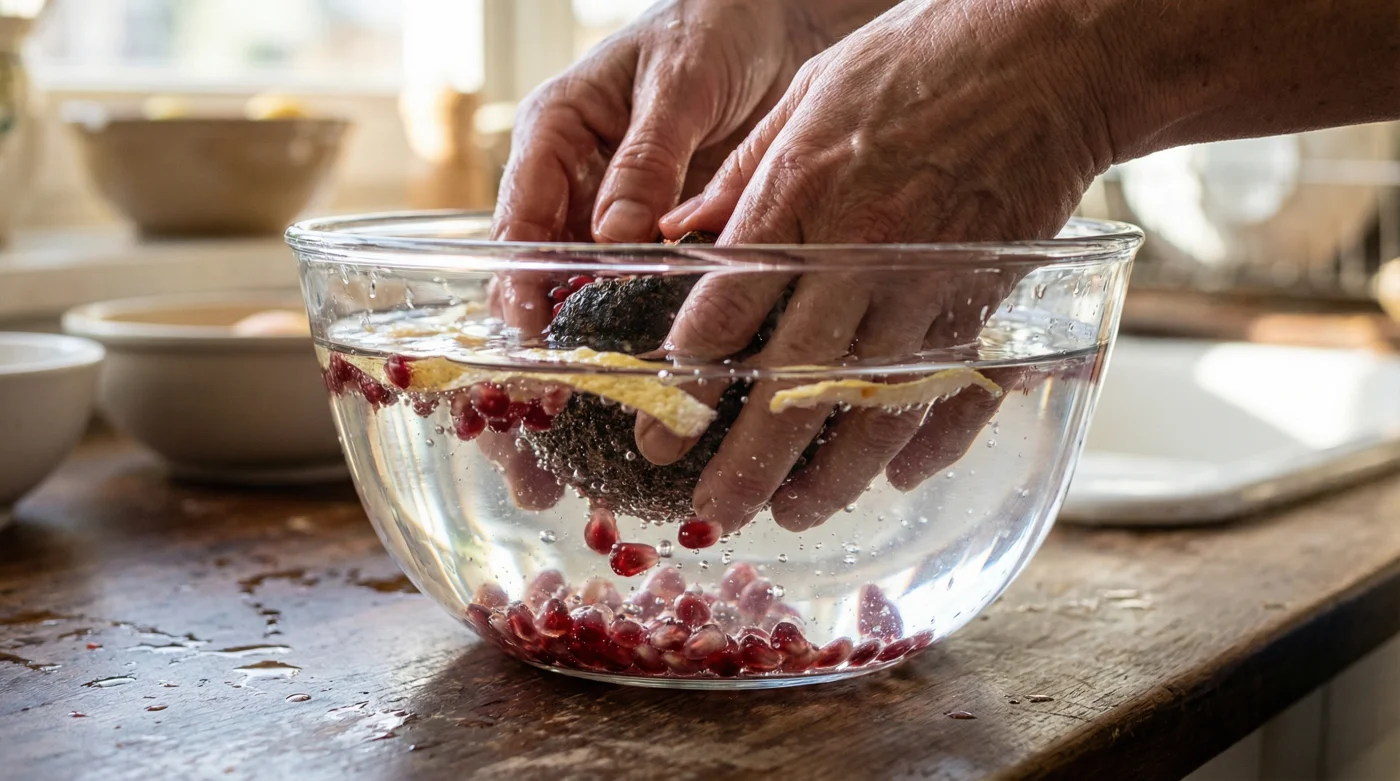
Water is the great equalizer in the kitchen. When you crack a raw pomegranate open entirely submerged in a bowl of cold water, you fundamentally change the physics of the task. Instead of fighting gravity, surface tension, and the tough internal walls of the fruit, you let buoyancy do the heavy lifting.
The brilliant, perspective-shifting advantage here lies in the specific gravity of the fruit’s components. The dense, juice-filled arils sink like heavy glass beads to the bottom of the bowl. Meanwhile, that frustrating, bitter white pith—the porous material that ruins the mouthfeel of your autumn dishes—is incredibly light. It naturally floats to the surface, allowing you to skim it away with zero effort and completely unstained hands.
Sarah, a 34-year-old catering chef from Portland, used to dread the holiday season. Her signature roasted squash dish demanded quarts of fresh pomegranate seeds, requiring hours of tedious, messy extraction that left her prep cooks looking like they had wrestled a berry monster. One morning, a veteran prep cook dropped scored halves into the produce-washing sink and started breaking them apart underwater. The water acted as a natural shock absorber, catching the spray of the popping seeds and keeping the kitchen pristine while protecting the delicate arils from bruising. It turned a high-stress chore into a quiet, meditative morning ritual.
Tailoring the Technique to Your Kitchen Pace
Understanding this aquatic approach allows you to adjust the method based on exactly how you plan to use the harvest. Not all extraction needs are the same, and the water bath adapts beautifully to your specific routine.
For the Sunday Batch-Prepper
When you are filling containers to eat throughout the week, you need volume and speed. You can score three or four fruits at once and use a massive mixing bowl. The cold bath acts as a natural preserving agent here. It immediately shocks the seeds, keeping them incredibly crisp and preventing the gradual weeping of juice that often happens when you pry them out dry and toss them directly into a plastic container.
For the Garnish Perfectionist
- Heavy whipping cream shaken inside glass jars creates instant homemade finishing butter.
- Standard cocoa powder dusted directly onto fresh tiramisu creates immediate soggy messes.
- Hard boiled eggs peel flawlessly using a shallow stovetop steamer basket.
- Severe Logistics Disruptions In San Antonio Trigger Regional Shortages Of Fresh Produce
- Darden Restaurants Announces Sudden Overhaul Of Olive Garden Kitchen Protocols Nationwide
The Cold Water Protocol
To execute this flawlessly, you need to set your station with intention. Gather a wide, deep mixing bowl, a sharp paring knife, and a slotted spoon. The setup takes mere seconds, but the payoff is immense.
Before you begin, fill your bowl with water cold enough to make the glass sweat. Lukewarm water will soften the fruit and encourage the membranes to stick together, defeating the entire purpose of the exercise. Ice water tightens the cellular structure of the arils, making them pop away from the pith with satisfying ease.
- Score the equator: Use your paring knife to cut a shallow line around the middle of the pomegranate, just piercing the skin but not slicing into the seeds.
- Twist and separate: Hold the fruit over the bowl and gently twist the halves apart. If it resists, make the score slightly deeper.
- Submerge completely: Plunge both halves into the icy water. Keep your hands entirely under the surface for the next step.
- Roll your thumbs: Push the center of the skin inward, inverting the half. Gently roll your thumbs over the clusters, letting the heavy seeds fall to the bottom.
- Skim and strain: Use a slotted spoon to scoop away the white membrane floating on top. Then, pour the water and seeds through a mesh strainer.
Your tactical culinary toolkit for this method is wonderfully minimalist. You need a bowl holding at least 3 quarts of water to give the pith room to rise, water sitting below 50 degrees Fahrenheit, and a standard mesh strainer to catch your perfectly clean prize.
Reclaiming the Ritual
There is a profound satisfaction in turning a historically chaotic kitchen task into something cleanly controlled. By bringing a simple bowl of water into the equation, you eliminate the hesitation that stops so many of us from buying raw pomegranates in the produce aisle.
You stop viewing the leathery red orb as a chore to be managed and start appreciating it as a simple seasonal luxury. The kitchen stays clean, your countertops remain unstained, and you are left with a perfect, jewel-toned bowl of crunch and acidity, ready to be scattered across your dinner.
Water does not just wash the fruit; it organizes it for you by weight, separating the sweet from the bitter without a single wasted drop.
| Key Point | Detail | Added Value for the Reader |
|---|---|---|
| Physics of Separation | Heavy seeds sink while the porous, bitter white membrane floats to the surface. | Saves you from picking out pith by hand, ensuring a perfect, clean mouthfeel. |
| Temperature Control | Using icy water shocks the arils and tightens their cellular structure. | Results in a louder, crisper crunch and extends the shelf life of your prepped fruit. |
| Stain Prevention | Cracking the fruit entirely submerged neutralizes the trajectory of the juice. | Eliminates red splatter on countertops, wooden cutting boards, and your clothing. |
Frequently Asked Questions
Does submerging the seeds wash away their flavor?
Not at all. The arils are completely sealed within their own natural casings. As long as you strain them promptly after extraction, they retain all of their tart, vibrant juice.How long do the extracted seeds last in the fridge?
When extracted in cold water and patted completely dry before storing, the seeds will stay crisp in an airtight container for up to five days.Can I use this method for fruits that are slightly past their prime?
Yes. In fact, the cold water helps rehydrate arils that may have started to soften slightly inside an older pomegranate, bringing back some of their necessary snap.What is the best way to dry them after straining?
Spread the strained seeds in a single layer on a kitchen towel and gently pat the tops. Getting them perfectly dry is critical to prevent mold during storage.Does the type of bowl matter?
You need depth. A shallow bowl will not provide enough vertical space for the membrane to float away from the sinking seeds. Opt for your deepest mixing bowl.