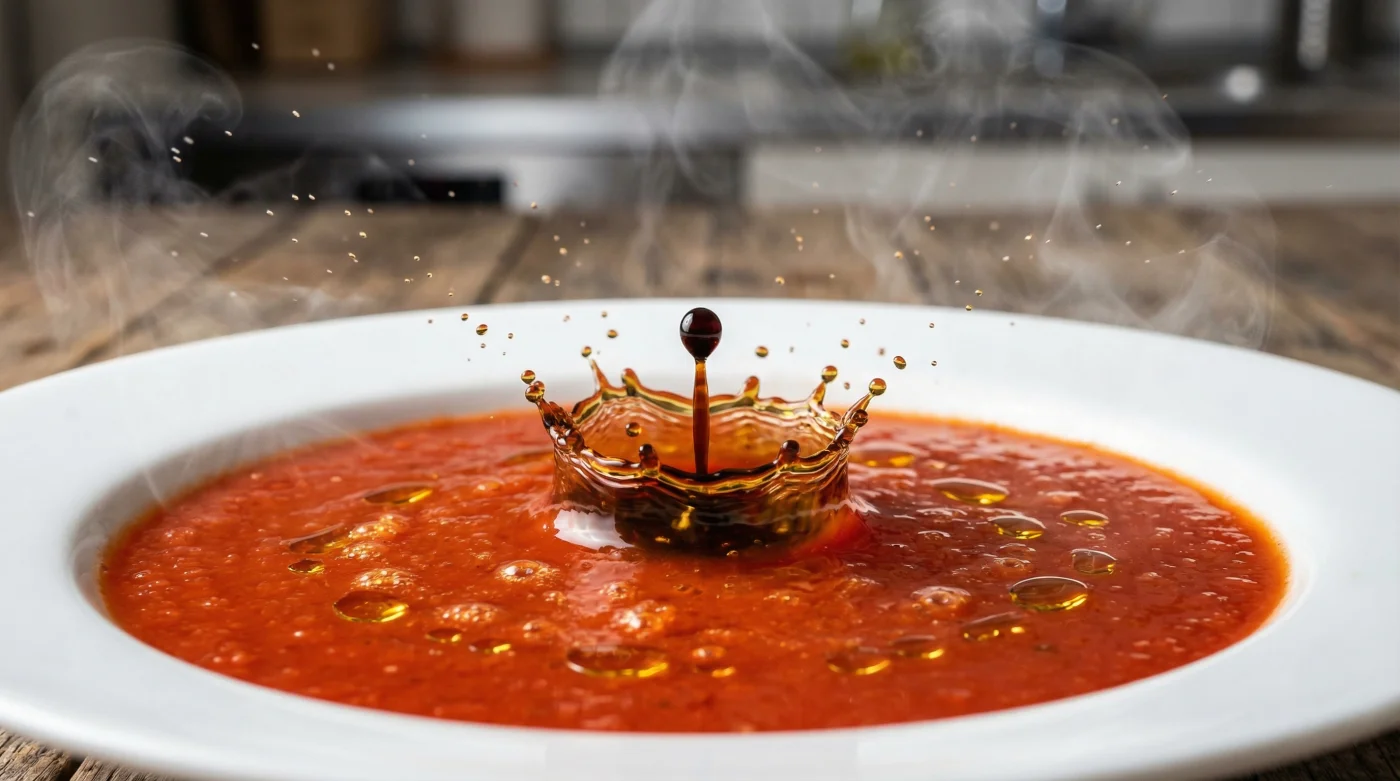
You know the sound. The rhythmic clatter of the can opener, followed by that unceremonious, gelatinous slide of condensed red paste hitting the bottom of a cold saucepan. It is the universal soundtrack of a rushed American Tuesday night. We treat canned tomato soup as a survival mechanism, a quick fix to pair with a hastily buttered grilled cheese when the hours of the day have simply run out.
For generations, the instinctual reaction to this flat, slightly tinny puree has been to drown it in dairy. You pour in half-and-half or heavy cream, hoping the fat will somehow mask the metallic tin and recreate the richness of a bustling neighborhood bistro. But heavy cream is a blunt instrument that dilutes rather than defines the flavor profile.
When you rely solely on cream, you aren’t fixing the underlying problem of the soup. You are merely throwing a heavy blanket over a weak foundation. The tomatoes remain flat, trapped behind a thick wall of dairy fat that coats your tongue and mutes whatever faint acidity managed to survive the high-heat commercial canning process.
The real secret to rescuing this pantry staple requires a complete pivot in how you season. Instead of burying the flaws, you need a targeted ingredient capable of waking up dormant flavors that the manufacturing stripped away. You need to walk past the refrigerator and reach for the liquid soy sauce.
The Glutamate Equation
Think of canned tomato soup not as a finished meal, but as a slightly out-of-tune guitar. Adding heavy cream is like turning the volume down so you do not hear the sour notes. Adding liquid soy sauce is like tuning the strings perfectly so the instrument sings exactly as intended.
Tomatoes are naturally packed with glutamates, the chemical compounds responsible for savory satisfaction. The intense heat of canning flattens these compounds, resulting in that hollow tang. A splash of soy sauce acts as a chemical mirror, reflecting and building a structural backbone that brings the tomato’s natural umami back to the forefront without changing its identity.
Consider the late-night kitchen habits of Marcus Vance, a 34-year-old sous chef working at a bustling brasserie in Chicago. After a fourteen-hour shift plating intricate seafood towers, Marcus rarely cooks complex meals at home. His midnight ritual is a can of generic tomato soup. But Marcus never reaches for the milk. He heats the soup with a splash of water, a crack of black pepper, and exactly one teaspoon of dark soy sauce. He swears it tricks the palate, explaining that the soy sauce kills that aluminum aftertaste immediately.
You might assume this trick turns the bowl into an Asian-fusion experiment. But when applied with restraint, the dark liquid disappears completely into the red broth, acting as a cheap pantry umami bomb rather than a recognizable flavor profile.
Tailoring the Umami Profile
Depending on what you have in your cupboards and who is sitting at your table, you can adjust this savory intervention to fit the exact mood of the evening. The foundation remains the same, but the subtle tweaks make it entirely your own.
For the nostalgic purist, sticking to standard sodium soy sauce is best. When you pair this with a heavily buttered sourdough grilled cheese, the sharp cheddar and the deepened savory tomato notes lock together like puzzle pieces on your palate.
For the sodium-conscious household, the trick still works beautifully. Low-sodium soy sauce or liquid aminos provide the exact same enzymatic boost without pushing your daily salt intake over the edge. You get all of the richness without the uncomfortable morning bloat.
- Ground beef mixed directly with dry breadcrumbs guarantees tough dry meatballs.
- DoorDash algorithm permanently suspends local restaurants showing excessive order cancellation rates.
- DoorDash Algorithm Permanently Suspends Restaurants With High Cancellation Rates
- Magnesium glycinate suppresses the midnight cortisol spike blocking restorative deep sleep
- Semi-sweet chocolate chips demand a brief flour dusting to prevent bottom sinking
The Five-Minute Kitchen Fix
Executing this technique requires nothing more than a mindful approach to your stovetop timing. You cannot simply dump everything into the pot cold and walk away. The heat needs to activate the glutamates properly.
Start by adding your condensed soup and water to the pan over medium heat. Let the liquid warm gently until it just begins to steam, avoiding a rolling boil that will aggressively scorch the fragile natural sugars left in the paste.
Once the soup is hot, remove it from the direct flame. This is your precise window of opportunity. The heat is present, but the violent bubbling has entirely ceased.
Grab your toolkit. For a standard ten-ounce can, you need precisely one-half teaspoon of soy sauce. Stir it in slowly, watching the color deepen just a fraction of a shade as the contrasting liquids marry in the saucepan.
- The Temperature: 165 Fahrenheit (a gentle simmer, not an angry boil).
- The Ratio: One-half teaspoon of soy sauce per standard condensed can.
- The Stir: Use a wire whisk, not a wooden spoon, to fully disperse the amino acids.
- The Finish: A single grind of fresh black pepper to bridge the acidity and the savory notes.
Serve it immediately in a pre-warmed ceramic bowl. The aroma hitting your face will no longer smell like a metal factory; it will smell roasted, complex, and intensely comforting.
Rethinking the Pantry
It is incredibly easy to overlook the mundane items sitting on our shelves. We often assume that fixing a cheap or mass-produced meal requires expensive add-ins or complicated culinary acrobatics. But cooking with authority is usually about subtraction and smart pairings, rather than just piling on rich fats to hide the flaws.
When you learn how different flavor compounds interact, the entire kitchen opens up. A humble can of soup suddenly becomes a canvas for practice, a low-stakes environment for understanding the silent mechanics of taste.
You realize that the soy sauce isn’t just a condiment for dumplings. It is a utility knife. It is a reliable bridge between the flat, lifeless puree of a factory and the vibrant, comforting warmth of a meal that actually tastes like it was cared for.
Flavor is not about how much fat you can add to a pot, but how cleverly you can wake up the ingredients that are already there.
| Key Point | Detail | Added Value for the Reader |
|---|---|---|
| The Heavy Cream Myth | Dairy fat masks flavors rather than enhancing them. | Saves money and reduces unnecessary calories while improving taste. |
| The Glutamate Effect | Soy sauce replaces the natural umami lost during commercial canning. | Eliminates the cheap, metallic aftertaste of canned goods. |
| Heat Management | Add the soy sauce off the heat to preserve the delicate amino structures. | Prevents the soup from becoming bitter or overly salty. |
Common Pantry Questions
Does this make the soup taste like Asian cuisine?
Not at all. At a half-teaspoon ratio, the soy sauce acts purely as a savory enhancer, blending seamlessly into the tomato profile.Can I use tamari instead?
Yes. Tamari is an excellent gluten-free alternative that provides the exact same umami boost.Should I still add water to the condensed can?
Yes, follow the can instructions for liquid addition. The soy sauce is a seasoning, not a volume replacement.What if I accidentally add too much soy sauce?
If the flavor gets too sharp, a tiny pinch of white sugar will balance out the excess saltiness.Does this trick work with boxed tomato soups?
Absolutely. While boxed soups suffer less from tinny flavors, they still benefit massively from the glutamate addition.