You stand at the stove on a quiet Tuesday morning. The kitchen smells faintly of dark roast coffee and toasted sourdough, but a familiar knot of dread tightens in your stomach. You crack an egg, hear the initial promising sizzle, and then immediately feel the drag of the spatula. The whites have cemented themselves to the gleaming metal. You spend the next ten minutes scraping a torn, ruined breakfast off the surface, wondering why anyone bothers with heavy cookware when it seemingly demands a cup of oil just to yield a broken yolk.
The Conversation of Heat
We often treat cooking like a sheer force of will. You turn the dial, add the fat, and hope for the best. The common myth insists that stainless steel is a sponge for delicate proteins, a surface destined to ruin anything lighter than a thick ribeye unless it is heavily bathed in grease. But your pan is not the enemy. It is simply misunderstood. Working with this metal is a conversation of heat. If you try to force the egg before the pan is ready, the metal fights back. The secret to a frictionless morning does not come from a chemical spray bottle. It comes from understanding the language of a single drop of water.
Years ago, I spent an afternoon watching a line cook named Elias work the breakfast rush at a packed diner in Chicago. He managed a dozen stainless steel skillets at once, flipping eggs with the grace of a card dealer. He never drowned his pans in butter. Instead, he simply flicked wet fingers over the hot metal. “You don’t guess,” he told me, wiping down his station with a clean towel. “You wait for the metal to tell you it is ready to float the food. If the water runs, the egg will stick. If the water dances, you are golden.”
| The Cook | The Common Frustration | The Leidenfrost Benefit |
|---|---|---|
| The Health-Conscious | Drowning eggs in butter just to prevent tearing. | Requires only a tiny coating of oil, saving unnecessary calories. |
| The Cast-Iron Skeptic | Heavy pans that require constant seasoning and care. | Offers a naturally slick surface with zero maintenance rituals. |
| The Budget Gourmet | Replacing scratched nonstick pans every single year. | Turns an immortal, affordable pan into a daily workhorse. |
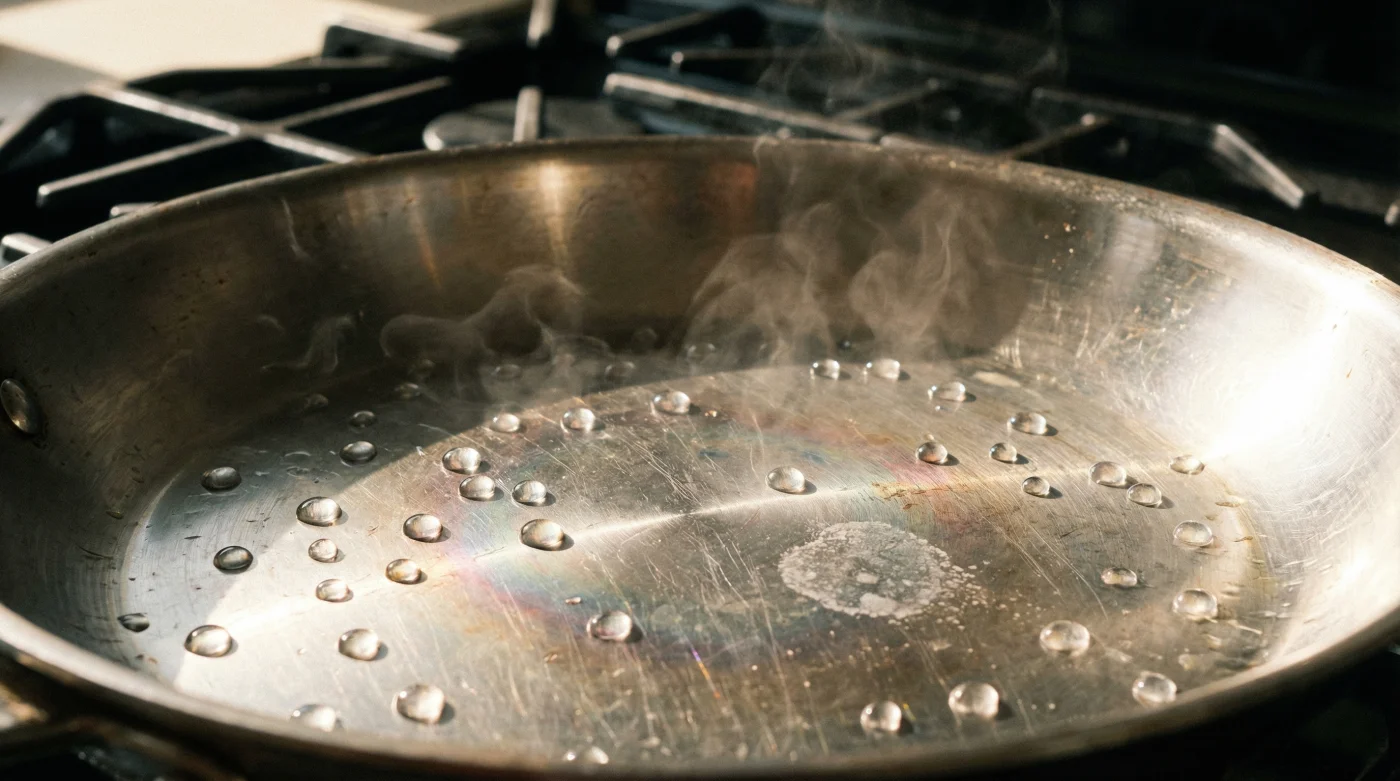
Elias was talking about the Leidenfrost effect. It sounds like a complex physics concept, but it is deeply practical. When your pan reaches the ideal temperature—around 380 to 400 degrees Fahrenheit—a drop of water does not simply evaporate on contact. Instead, the very bottom of the droplet vaporizes instantly, creating a microscopic cushion of steam. The water beads up like a silver marble and skitters effortlessly across the metal. That exact same invisible cushion of heat is what keeps the proteins in your egg from sinking into the microscopic pores of the steel.
| Pan Temperature | The Water Test Reaction | What Happens to the Egg |
|---|---|---|
| Under 300°F (Too Cold) | Water sits flat and slowly bubbles away into the air. | Proteins sink into the metal pores and fuse instantly. |
| 320°F – 350°F (Getting Warm) | Water aggressively sputters and hisses into steam. | Edges might lift slightly, but the center tears when flipped. |
| 380°F – 400°F (The Sweet Spot) | Water forms a single bead and glides across the pan. | The egg floats on a thermal cushion, sliding freely. |
| Over 420°F (Too Hot) | Water shatters into tiny, erratic specks that vanish. | The oil smokes immediately and the egg white burns fast. |
The Silver Marble Method
Mastering this technique takes only a few extra minutes of patience. Start with a completely dry pan on medium heat. Do not add oil yet. Adding oil to a cold pan prevents it from heating evenly and leads to sticky, burnt residues that take hours to soak off. The metal needs to expand first.
After about two minutes, wet your fingers under the faucet and flick a few drops of water into the center of the pan. If the water aggressively hisses and vanishes, wait another thirty seconds. You are looking for a distinct visual cue: the water should instantly pull together into a tight sphere.
When the bead dances around the pan without leaving a wet trail, wipe it out quickly with a paper towel. Now, lower the heat slightly and add your cooking fat. A small pat of butter or a teaspoon of olive oil is plenty.
Swirl the fat to coat the bottom, then gently slide in your egg. You will immediately notice the difference. The edges will crisp, the center will set, and with a gentle nudge of your spatula, the entire egg will glide across the steel as if it were moving on ice.
| Component | What to Look For | What to Avoid |
|---|---|---|
| The Pan | Heavy-bottomed, multi-ply stainless steel for even heating. | Thin, single-layer steel that creates severe hot spots. |
| The Egg | Taken out of the fridge ten minutes before cooking begins. | Ice-cold eggs straight from the carton, which shock the pan. |
| The Fat | Clarified butter or an oil with a moderate smoke point. | Aerosol nonstick sprays that leave a polymerized residue. |
Reclaiming Your Morning Rhythm
- White rice slashes carbohydrate absorption cooked with solid coconut oil
- Granulated garlic powder demands warm water hydration to mimic fresh raw cloves.
- Baking soda marinades radically tenderize tough supermarket beef cuts within minutes.
- Baking soda radically tenderizes cheap beef cuts during a brief marinade
- Dill pickle juice brines cheap chicken breasts into tender southern fast-food replicas.
“Stainless steel does not stick; impatience does.” — Chef Elias
Frequently Asked Questions
Does this work for scrambled eggs too?
Yes. The principle remains exactly the same. Wait for the water to dance, add your butter, and pour in the beaten eggs. Keep them moving gently so they cook on the steam cushion.
Why did my oil smoke as soon as I added it?
Your pan pushed past the Leidenfrost point and got too hot. If the water test shatters into tiny, explosive beads, take the pan off the burner for a minute before adding fat.
Do I need to wash the pan with soap afterward?
Since nothing stuck, a simple wipe with a soapy sponge and warm water is usually all it takes. Let the pan cool naturally before washing to prevent warping.
Can I use margarine instead of butter?
Margarine has a high water content, which can disrupt the temperature and cause splattering. Stick to real butter, ghee, or standard cooking oils for the best glide.
Does the type of stove matter for this trick?
Whether you have gas, electric coils, or induction, the metal responds the same way. Gas and induction simply reach the ideal temperature faster than electric coils.