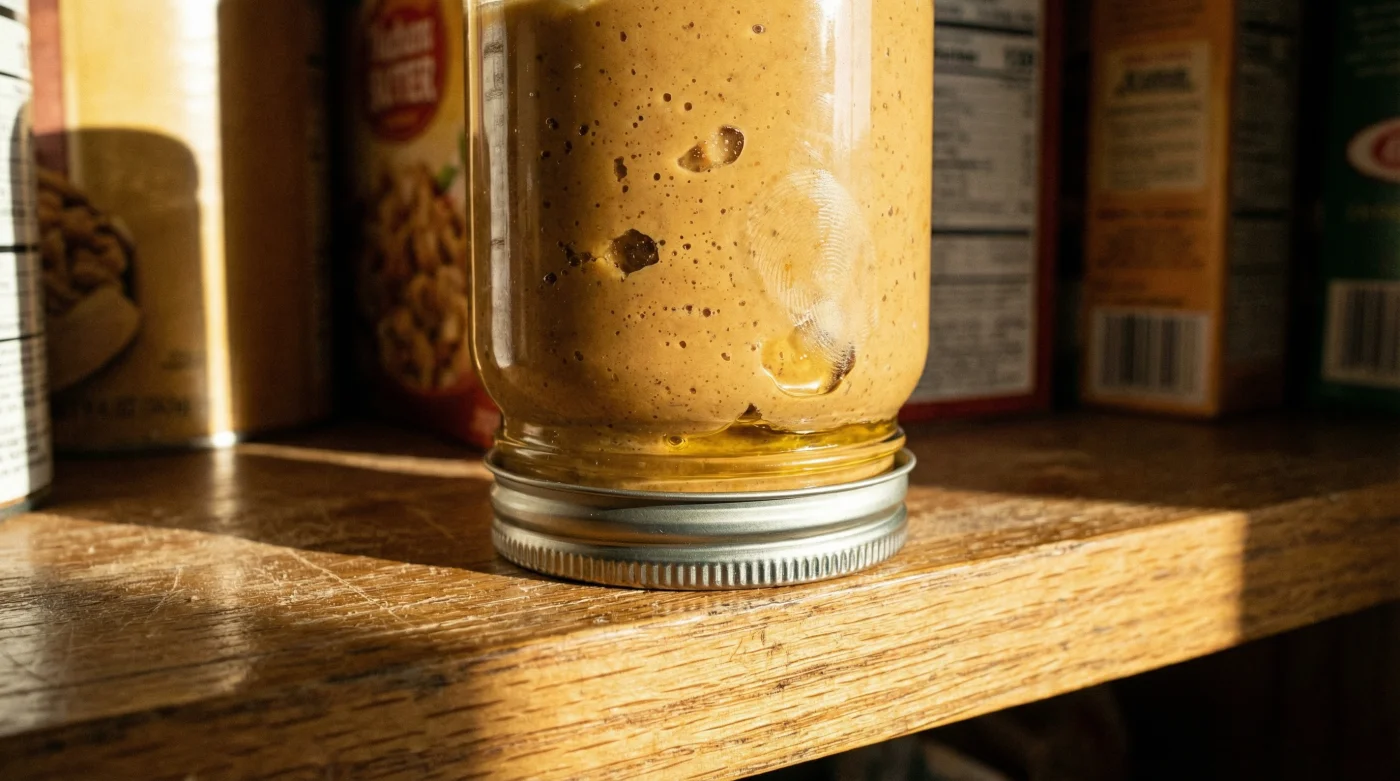
You know the sound. The futile scrape of a butter knife hitting a concrete-dense wall of crushed peanuts, followed by the inevitable slip. Golden, slick oil sloshes over the glass rim and pools onto your kitchen counter. You are left trying to fold a liquid into a solid in a space no wider than a teacup. It is an exercise in morning frustration.
We buy natural peanut butter for its purity, craving nothing more than roasted peanuts and perhaps a pinch of salt. Yet, the reward for this clean label is often a jar that feels physically impossible to maintain. You stir, you spill, and halfway through the month, you are left with dry, chalky remnants that tear your soft sandwich bread into shreds.
The Gravity of the Grind
The central myth of pantry organization is that all jars belong flat on their bottoms. We treat our active foods and our static preserves with the exact same spatial logic. But natural peanut butter is not a jam; it is a delicate emulsion constantly waiting to fall apart. When you store it right-side up, the dense peanut particles sink, while the lighter peanut oil rises to the top.
Peanut oil is significantly lighter than the fibrous, protein-rich solids left behind after the grinding process. Without artificial stabilizers or hydrogenated fats to bind them together, the two elements immediately begin a separation process. The heavy solids sink to the base of the glass, cementing themselves into an unyielding block. You are left fighting physics.
I learned the antidote to this daily struggle from Silas, a second-generation peanut roaster in Athens, Georgia. Standing in his storage room, breathing in air that smelled heavy and warm like roasted nuts, I noticed hundreds of glass jars resting on their lids. ‘You are forcing the river upstream,’ he told me, pointing to my own messy jar. ‘If you flip it, gravity pulls the oil upward through the solids. It acts as an invisible whisk.’
| Your Kitchen Routine | The Upside-Down Benefit |
|---|---|
| The Morning Toast Maker | Immediate spreadability without the frantic, messy two-minute stir. |
| The Weekend Baker | Accurate fat-to-solid ratio in every single scoop for consistent cookie dough. |
| The Smoothie Blender | Smooth, uniform paste that never leaves hard lumps clinging to blender blades. |
The Passive Churn
When you invert a fresh jar of natural peanut butter and slide it onto your pantry shelf, a slow, invisible churn begins. The oil, trapped at what is now the bottom of the jar, desperately wants to float to the highest point. To get there, it must seep slowly through the dense, heavy mass of crushed peanuts above it.
This natural upward migration of the oil keeps the solids deeply lubricated. By the time you reach for the jar a week later and flip it right-side up, the oil has traveled entirely through the paste. The result is a creamy, perfectly homogenized texture that requires little to no effort from your arm.
| Storage Position | Mechanical Logic | Textural Outcome |
|---|---|---|
| Right-Side Up | Oil rises instantly through the path of least resistance; solids compact at the base. | Excess oil spills upon opening; the bottom half becomes a dry, crumbly rock. |
| Upside-Down (Lid Down) | Oil slowly percolates upward, forcing its way through the compacted paste. | Continuously self-basting environment; a smooth, even consistency from top to bottom. |
Executing the Pantry Flip
- White rice slashes carbohydrate absorption cooked with solid coconut oil
- Granulated garlic powder demands warm water hydration to mimic fresh raw cloves.
- Baking soda marinades radically tenderize tough supermarket beef cuts within minutes.
- Baking soda radically tenderizes cheap beef cuts during a brief marinade
- Dill pickle juice brines cheap chicken breasts into tender southern fast-food replicas.
If you bring home a jar that has already separated severely on the grocery store shelf, you may need to give it one initial, thorough stir. Use a sturdy knife, reaching all the way to the glass bottom, pulling the dry pieces up into the oil. Once properly mixed, seal the lid tightly and store it inverted.
Ambient temperature plays a crucial role here, too. A dark, room-temperature pantry around 70 degrees Fahrenheit is ideal for this slow percolation. If you prefer cold peanut butter or take several months to finish a jar, you can store it upside-down in the refrigerator. The chill will firm up the fats, effectively freezing the homogenized state in place.
| Quality Marker | What to Look For | What to Avoid |
|---|---|---|
| The Lid Seal | Tight, factory-level closure with a flawlessly clean glass rim. | Sticky, oily residue trapped around the threads; a loose fit. |
| The Emulsion | A dull, matte shine across the entire surface when opened. | A clear, deep pool of liquid oil sitting over dry, cracked matter. |
| The Scent | Warm, earthy, freshly roasted nuts. | Sharp, sour, or metallic notes indicating rancid oil. |
A Smoother Morning Rhythm
Cooking and eating should not feel like an arm workout. It is easy to overlook the physical toll of poorly managed ingredients, but fixing this small kitchen annoyance has a profound ripple effect on your day. You stop avoiding the jar of natural peanut butter. You stop ruining beautiful slices of bread.
By letting gravity do the heavy lifting, you work alongside your ingredients rather than wrestling with them. The simple pantry flip transforms a notoriously high-maintenance staple into a reliable, ready-to-use comfort. When you reach into the pantry and grab a jar that is already primed, mixed, and ready to yield, you start your morning with a small victory.
Let the weight of the oil work for you, not against you; a flipped jar is a happy jar.
Frequently Asked Questions
Do I need to store the jar upside-down in the fridge or the pantry?
Keep it in a cool, dark pantry for everyday use. If you take longer than a month to eat it, the fridge extends the shelf life, but cold temperatures will make the butter much harder to spread.Will the oil leak out of the lid when stored upside-down?
Not if the lid is screwed on properly. Always wipe the glass rim clean with a damp cloth before twisting the cap tightly shut to ensure a flawless seal.Does this gravity method work for almond and cashew butter?
Yes. Any natural nut or seed butter that separates will benefit immensely from the inverted storage method.What if my peanut butter is already a solid brick at the bottom?
You will need to do the hard work just once. Stir it thoroughly using a heavy-duty knife until it is completely homogenized. Then, store it upside-down to prevent it from reverting to a solid brick.Why doesn’t conventional peanut butter separate like this?
Conventional brands add hydrogenated vegetable oils or palm oil to create a permanent, shelf-stable emulsion, artificially eliminating the need for stirring entirely.