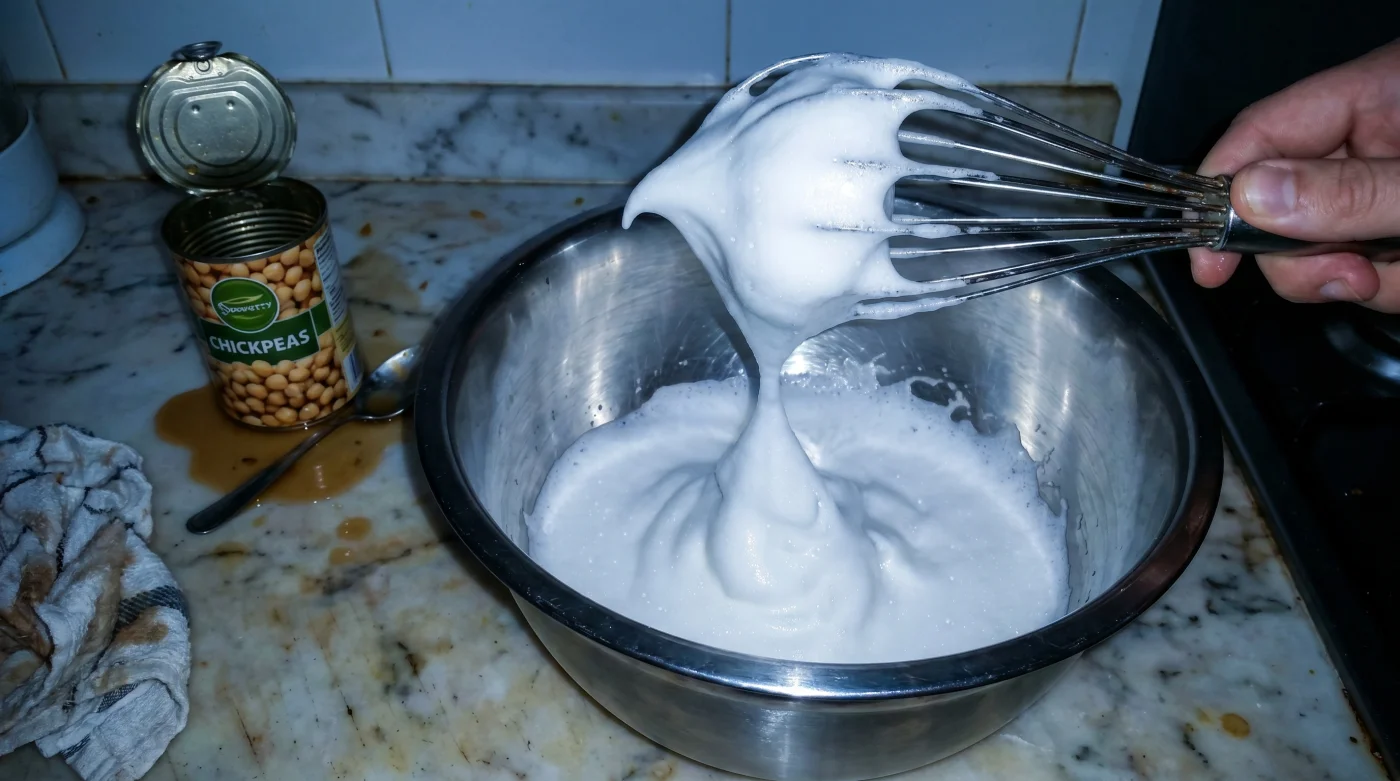
The metallic click of a can opener, the dull scraping of a tin lid peeling back, and the familiar rush of cloudy, thick liquid spiraling down the kitchen sink drain. For generations, this viscous runoff from a simple can of garbanzo beans has been treated as nothing more than an unpleasant byproduct of making hummus or a weeknight salad. You likely rinse the beans under cold water until the bubbles disappear, eager to wash away the murky evidence.
Yet, right inside that discarded stream lies a culinary anomaly that continues to outsmart some of the most expensive specialty ingredients on grocery store shelves. When you pour that beige water down the drain, you are actually throwing away a structural duplicate of egg whites. The texture is nearly identical to raw albumin, holding a precise balance of starches and proteins that mimic the exact properties required for delicate pastry work.
The professional reality starkly contrasts our domestic habits. While home cooks fret over the rising cost of organic eggs or the chemical aftertaste of commercial egg replacers, quiet revolutions are happening in high-end patisseries. Bakers are deliberately opening cans of chickpeas not for the legumes, but specifically to harvest the golden liquid inside, whipping it into crisp meringues and airy macarons that shatter perfectly between the teeth.
From Sink Waste To Structural Gold
Think of a traditional egg white as a tightly wound ball of yarn. When you whisk it, you pull the strands apart, trapping air between the threads until it forms a rigid, white cloud. For decades, the pastry world believed only an egg could perform this specific architectural feat. The perspective shift happens the moment you realize that the starchy liquid from a simple can of chickpeas, known in the trade as aquafaba, behaves exactly like that identical ball of yarn.
It contradicts the very foundation of classical baking rules. The cloudy bean water contains just enough soluble plant protein and gelatinizing starch migrating from the chickpeas during the canning process to form an invisible, elastic web. Instead of purchasing an eight-dollar carton of fragile eggs, you already have the exact chemical binder sitting dormant in your pantry, waiting to be agitated into stiff, glossy peaks.
This is not merely a frugal kitchen rumor. Take Joël Roessel, a 45-year-old French tenor and amateur cook, who was actively searching for a way to create a vegan meringue back in 2014. Frustrated with the heavy, dense results of flax eggs and starches, he began experimenting with the brine from various canned beans. He discovered that the specific viscous tension of chickpea water, when whipped vigorously, captured air bubbles with the exact same structural integrity as a fresh egg white. His quiet evening experiment with a hand mixer and a can of beans fundamentally rewrote the rulebook for plant-based pastry chefs across the globe.
Adjusting the Alchemy For Every Baker
Not all baking projects demand the same level of structural support, and the way you handle this pantry secret changes depending on what you pull from the oven.
For the Morning Muffin Baker
If your goal is a tender crumb for simple morning loafs, pancakes, or quick breads, the liquid requires zero preparation. You simply measure three tablespoons of the unwhipped chickpea water to replace one whole egg. It slips into the batter seamlessly, binding the flour and fat without leaving even a trace of savory bean flavor behind.
- Natural Peanut Butter Jars Require Immersion Blenders To Stop Separation
- Raw Whole Eggs Demand Fine Mesh Strainers For Flawless Poaching
- Hard Brown Sugar Softens Immediately Using One Damp Paper Towel
- Ground Turkey Patties Demand Unflavored Gelatin For Juicy Steakhouse Textures
- Canned Coconut Milk Requires White Vinegar For Flawless Bakery Frostings
- Little Debbie Donuts Shift Triggers Massive Supermarket Snack Aisle Chaos
- 801 Chophouse Bankruptcy Exposes Hidden Restaurant Meat Supply Crisis Immediately
- Fresh garlic cloves crushed with coarse salt release exponentially more aromatic oils
- Ground coffee beans demand a tiny salt pinch to neutralize bitter acidity
- Standard pie dough replaces ice water with cold vodka for maximum flakiness
For the Macaron Purist
When you attempt the notoriously finicky French macaron or a towering lemon meringue pie, the water needs a bit more discipline. Here, you must reduce the liquid on the stove by a third to concentrate the proteins, chilling it completely overnight. This concentrated version whips into a furiously stiff foam that holds precise piping ridges and survives the delicate folding of almond flour.
For the Savory Binding
Perhaps you are holding together a batch of vegetable fritters or a black bean burger. A light, ten-second frothing with a fork is all it takes to activate the starches just enough to coat the vegetables, acting as a flexible glue that crisps beautifully in a hot cast-iron skillet.
The Mechanics Of A Perfect Whip
Transforming murky bean water into a pristine, white cloud requires a mindful approach to your tools and timing. Any trace of oil or grease will instantly deflate your progress.
Before you begin, wipe your mixing bowl and whisk attachment with a paper towel dampened with a few drops of white vinegar. This strips away invisible fats that linger from previous meals, giving the starches the clean environment they need to climb.
Follow these exact technical parameters for foolproof results:
- Drain one 15-ounce can of chickpeas through a fine-mesh sieve, reserving the liquid (yields roughly half a cup).
- Add a quarter teaspoon of cream of tartar to stabilize the foam structure before turning on the mixer.
- Whip on medium speed for exactly four minutes until soft, trailing peaks begin to form.
- Increase speed to high and slowly shower in superfine sugar, continuing for another five minutes until the mixture turns intensely glossy and holds a rigid point when the whisk is inverted.
Your Tactical Toolkit here is brilliantly simple: a stand mixer or powerful hand mixer, a meticulously clean glass or metal bowl (never plastic, as it harbors oils), and cream of tartar to lower the pH and secure the walls of those newly formed air bubbles.
Redefining The Cost Of Creativity
Mastering this specific substitution does far more than save you a few dollars at the grocery store. It shifts your entire perspective on resourcefulness and food waste. When you see a byproduct normally destined for the drain stabilize into a towering, snow-white meringue, you begin to question what other mundane details in your kitchen are actually hidden advantages.
The pantry suddenly feels less rigid and infinitely more forgiving. Baking transforms from a strict, expensive science experiment dictating exact grocery runs into a fluid practice of utilizing what you already own. You gain the peace of mind that comes from knowing you can produce a bakery-quality dessert on a whim, relying entirely on a dusty can of beans sitting quietly in the back corner of your cupboard.
The true art of the pastry kitchen isn’t found in exotic imports, but in discovering the structural magic hiding right inside our most basic staples.
| Key Point | Detail | Added Value for the Reader |
|---|---|---|
| Whole Egg Replacement | 3 tablespoons of unwhipped liquid equals one whole egg. | Instantly mix up pancake and muffin batters without running to the store. |
| Egg White Replacement | 2 tablespoons of unwhipped liquid equals one egg white. | Easily scale down delicate recipes without splitting or wasting fresh yolks. |
| Stabilizer Addition | 1/4 teaspoon cream of tartar per half cup of liquid. | Guarantees a stiff, reliable foam that won’t collapse in the oven. |
Frequently Asked Questions
Does the baked dessert taste like chickpeas? No. The bean flavor completely vanishes during the baking process, especially when paired with standard extracts like vanilla or almond.
Can I use the liquid from low-sodium chickpeas? Yes, but the results may be slightly less stable. Standard salted chickpeas provide the best structural tension for whipping.
How long does the liquid last in the refrigerator? Store it in an airtight glass jar for up to five days. It should smell neutral; discard it if it develops a sour odor.
Can I freeze the chickpea water for later use? Absolutely. Pour the liquid into ice cube trays, measuring it out by the tablespoon, so you can thaw exactly what you need.
Why isn’t my liquid whipping into stiff peaks? The most common culprits are a plastic mixing bowl harboring invisible oils, skipping the cream of tartar, or simply not whipping long enough.