You dip a spoon into your freshly mixed cannoli filling. The scent of sweet cream, split vanilla bean, and a faint hint of orange zest floats above the bowl. It smells perfect. But the moment it hits your tongue, the illusion shatters. There it is—that stubborn, slightly sandy grit. Your filling tastes like a humble homemade effort, completely lacking that impossibly slick, velvety finish you find behind the curved glass of a professional bakery case. You followed the recipe exactly, gently folding the ingredients together to preserve the cheese. Yet, the texture still feels like it breathes through a pillow of damp sand. The frustration is real, but the flaw isn’t in your ingredients. It is in your mechanics.
The Friction of the Curd
For generations, home recipes have perpetuated a quiet myth: ricotta cheese is delicate. We are taught to treat it gently, stirring it into our Italian dessert fillings with a wooden spoon or a careful rubber spatula. We fear overworking it, assuming that aggressive mixing will turn our cheesecakes and layer cakes into a soupy mess. This gentle approach respects the moisture but entirely ignores the gravity of the curd. Whole milk ricotta is not a fragile emulsion; it is a landscape of tiny, stubborn protein bundles. When you simply stir these bundles, they retain their microscopic borders, rolling across your palate like fine gravel. To achieve a professional texture, you have to fundamentally change the structural dialogue with the engine of your kitchen.
| Target Audience | Specific Benefits of Whipping |
|---|---|
| Classic Cannoli Enthusiasts | Eliminates weeping moisture and creates a dense, pipeable cream that holds its shape for hours without soaking the shell. |
| Cheesecake Bakers | Prevents the dreaded ‘grainy bite’ in baked or no-bake cheesecakes, yielding a dense, New York-style mouthfeel. |
| Morning Toast Devotees | Transforms a lumpy spread into a luxurious, cloud-like base for local honey, figs, and flaky sea salt. |
I learned this truth on a damp Tuesday morning, standing in the prep kitchen of an old-school pastry shop just a few miles from my house. Chef Leo, a veteran baker whose apron always smelled faintly of toasted pistachios, watched me gently fold a massive bowl of whole milk ricotta. He sighed, wiping his flour-dusted hands on a towel. ‘You are treating the cheese like blown glass,’ he pointed out, pulling a heavy-duty food processor onto the stainless steel counter. ‘It is raw material. You have to break the stones to weave the silk.’ He dumped my carefully folded bowl into the machine and let the blade scream for a full two minutes. What emerged was a glossy, transcendent cream. The machine wasn’t destroying the cheese; it was fulfilling its potential.
| Mechanical Phase | Scientific Action | Micro-Texture Result |
|---|---|---|
| Initial Chop (0-30 seconds) | High-speed metal blades shear the largest whey-protein curds into smaller, uniform fragments. | Chalky and broken; moisture begins to separate from the fat. |
| Friction Heating (30-90 seconds) | Blade friction slightly warms the milk fat (approaching 70 degrees Fahrenheit), softening the lipids. | The mixture turns slightly loose as fats melt and coat the shattered proteins. |
| Full Emulsion (90-180 seconds) | Fat molecules completely bind with the ambient moisture, creating a suspended, stable matrix. | A brilliant, glossy sheen develops. The texture becomes thick, velvety, and completely homogeneous. |
The Aggressive Spin
To replicate this bakery-level magic at home, you need to abandon the whisk and plug in your food processor. First, ensure you are starting with high-quality, whole milk ricotta. Skim milk versions lack the fat necessary to create a smooth emulsion and will simply turn watery. Drain your cheese through a cheesecloth-lined sieve for at least an hour to remove excess whey.
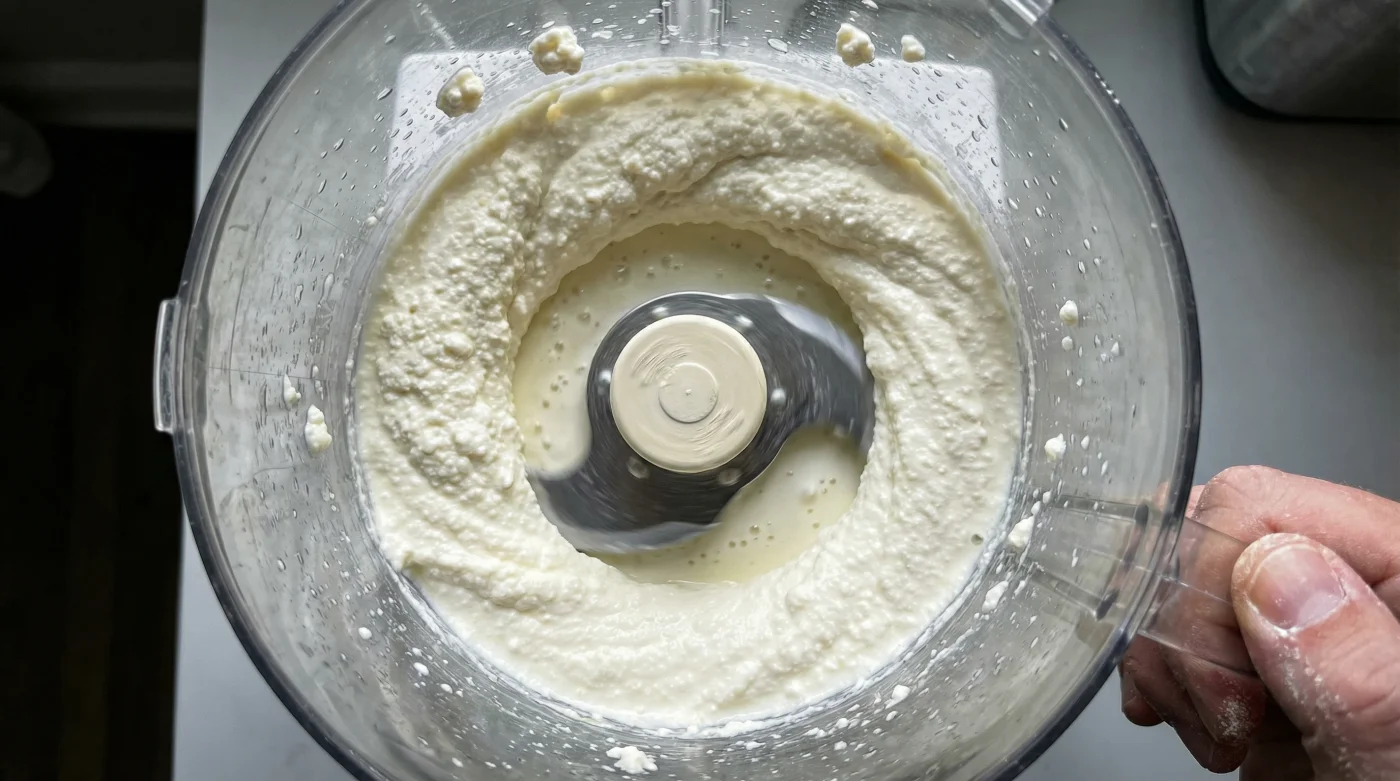
Transfer the drained cheese directly into the bowl of your food processor fitted with the standard steel blade. Do not add your sugar or flavorings yet; the sharp sugar crystals can interfere with the initial smoothing process. Lock the lid in place and turn the machine on high.
Let the processor run continuously for at least two to three minutes. This feels unnervingly long when you are standing there watching it. You will see the cheese go through a loose, liquid phase before the magic happens. The continuous shearing force eventually forces the fat and protein to emulsify, thickening the mixture back up into a gorgeous, spackle-like consistency.
Once the ricotta is entirely smooth and holds a stiff peak when you pull the blade away, you can gently pulse in your powdered sugar, vanilla, or melted chocolate. The hard mechanical work is done. Your filling is now a stable, silky canvas ready to be piped into pastry shells or layered into a rich dessert.
| Quality Checklist | What to Look For | What to Avoid |
|---|---|---|
| Ingredients List | Only Milk, Cream, Salt, and an acid (like vinegar or lemon juice). | Gums, stabilizers (carrageenan), or artificial thickeners. |
| Moisture Content | A dense block that leaves minimal pooling water in the plastic tub. | A soupy consistency where the cheese floats in cloudy whey. |
| Fat Percentage | Whole milk designation, usually hovering around 10-11% milk fat. | Part-skim or fat-free varieties, which will break under the blade. |
The Bigger Picture
Mastering this simple physical modification does more than just fix a dessert. It fundamentally shifts how you interact with your ingredients. When you stop fearing the machinery in your kitchen and start understanding the mechanical limits of the food itself, a new level of confidence takes root. You realize that professional results are rarely born from hidden, impossible-to-find ingredients. Instead, they are born from technique, patience, and the willingness to apply a little controlled force.
- Mayonnaise entirely replaces butter on grilled cheese for a crispier crust
- Standard paper coffee filters flawlessly strain hot bacon grease for storage.
- Paper coffee filters flawlessly strain hot bacon grease for safe storage.
- Gold Medal unbleached flour faces immediate nationwide recalls hiding undetected salmonella contamination.
- Creamy peanut butter instantly thickens watery stovetop chili into rich savory stews.
The secret to professional pastry is not always a lighter touch; sometimes, it is knowing exactly when to let the machine do the heavy lifting.
Frequently Asked Questions
Can I use a blender instead of a food processor?
While a high-speed blender can work, its narrow base often requires adding liquid to keep the blades spinning, which ruins the thick texture you need for fillings. A food processor’s wide bowl is much better suited for dry shearing.
Will whipping the ricotta make it too runny for cannoli?
It will briefly look runny in the first 60 seconds, but as the emulsion forms around the three-minute mark, it actually thickens into a stable, pipeable cream that holds its shape beautifully.
Do I still need to drain the ricotta if I am going to whip it?
Yes, absolutely. Whipping incorporates the existing moisture. If there is excess whey in the cheese, the emulsion will fail and you will end up with ricotta soup. Always drain it first.
Can I whip the cheese a day ahead of time?
You can! Whipped ricotta stores perfectly in an airtight container in the refrigerator for up to 48 hours. It may firm up slightly when chilled, which makes it even easier to pipe.
Does this technique work with part-skim ricotta?
It is not recommended. The mechanical friction relies on the milk fat to create that velvety mouthfeel. Part-skim lacks the fat necessary to emulsify smoothly and often results in a chalky paste.