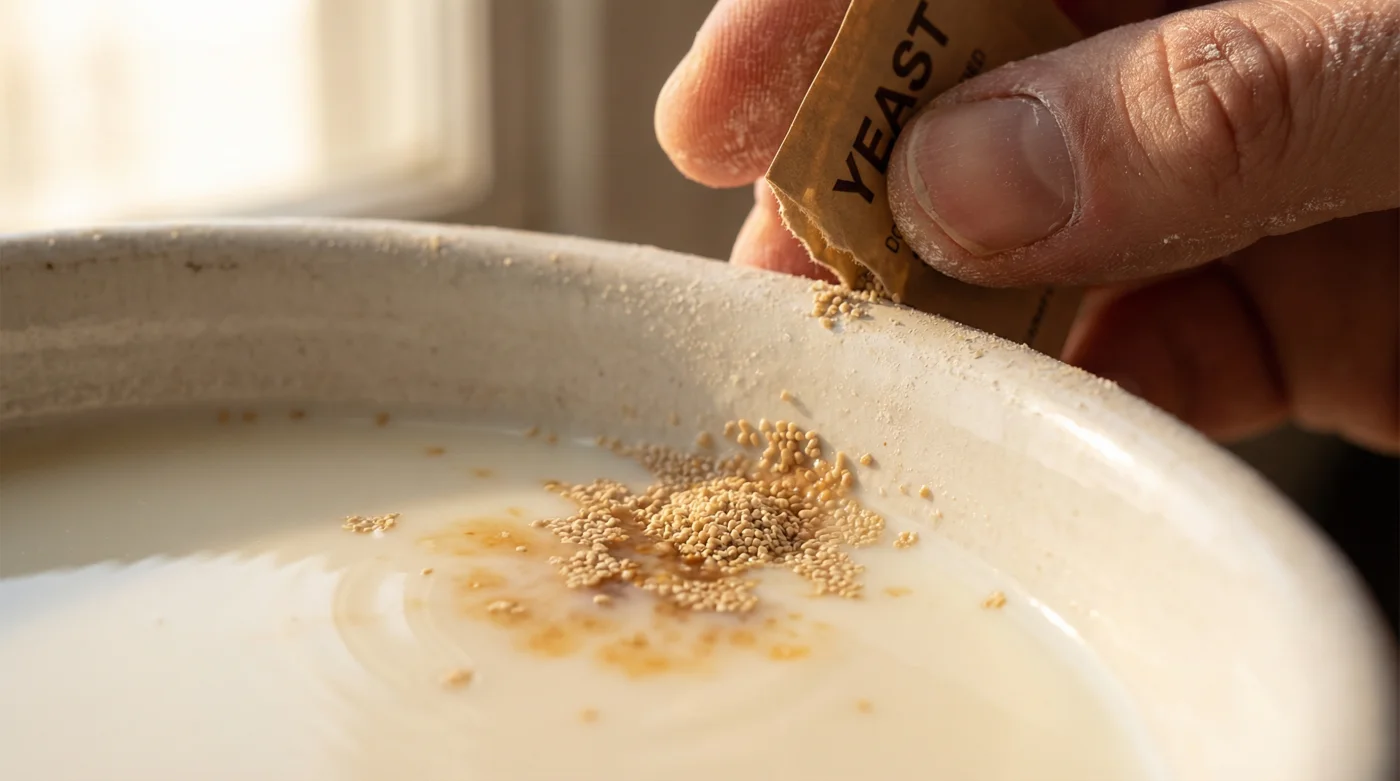
Picture the Sunday morning light hitting your kitchen counter. You have your flour measured, the butter softening in a dish, and a tiny glass bowl waiting for its most temperamental guest: dry active yeast. For years, you have hovered over the sink, letting the faucet run over your wrist, hoping to find that mythical lukewarm temperature. If the water feels like hot bathwater, is it too hot? If it feels like a cool breeze, will the yeast just sink to the bottom and refuse to work? You stare at the murky liquid, waiting ten anxious minutes to see if a foam raft appears. This stressful ritual is the exact reason so many home cooks simply abandon baking bread altogether.
But what if the secret to a perfect, pillowy brioche or a flawless batch of cinnamon rolls does not involve warm water at all? The anxiety of the bloom is completely optional.
The Thermal Myth of Baking
Think of your dough not as a delicate houseplant requiring a tropical greenhouse, but as a slow-waking engine that just needs a gentle turn of the key. Traditional baking wisdom insists you must dissolve active dry yeast in water heated to exactly 110 degrees Fahrenheit. The reality of enriched doughs is far more forgiving, and frankly, far more logical.
When you swap hot water for room-temperature milk, you completely eliminate the risk of committing microscopic murder. The friction here is real—we have been taught by grandmothers and old cookbooks that warmth equals action. But rapid, heat-induced rising often leads to oversized air pockets and a harsh, alcoholic aftertaste in your baked goods. Milk contains natural sugars and fats that gently feed the granules. When poured straight from a carton that has been resting on the counter for thirty minutes, it reaches an ambient temperature that coaxingly dissolves the yeast without the violent shock of heat.
| Baker Profile | Common Frustration | The Room-Temp Milk Benefit |
|---|---|---|
| The Weekend Beginner | Anxiety over killing yeast with hot water. | Zero risk of scalding; guaranteed activation. |
| The Pastry Enthusiast | Uneven, bubbly crumb in enriched doughs. | Slower fermentation yields a tighter, softer crumb. |
| The Busy Parent | Waiting around for the yeast to foam. | Mix instantly and move straight to kneading. |
I learned this during a quiet early morning shift standing next to Elias, a seasoned pastry chef who ran a tiny, flour-dusted corner bakery in Chicago. While I was furiously checking a digital thermometer in a metal pitcher of water, he simply poured milk from a resting jug directly over his dry yeast. He did not stir. He did not wait for a foam dome.
He noticed my confusion, wiped a flour-dusted finger on his apron, and pointed at my bowl. You are treating them like they are running a sprint, he told me. They are running a marathon. Room-temperature milk gives them a steady, calm breakfast. No scalding, no panic. He was entirely right. The enriched dough he produced that morning did not just rise; it expanded with a tight, even structure that baked into a cloud-like crumb.
| Liquid Temperature | Yeast Reaction | Dough Outcome |
|---|---|---|
| Over 120 Degrees Fahrenheit | Cellular death. Yeast is destroyed. | Flat, dense, brick-like bread. |
| 105 to 115 Degrees Fahrenheit | Rapid, frantic feeding and gas production. | Fast rise, but potential for uneven air pockets. |
| 68 to 72 Degrees Fahrenheit (Room Temp) | Steady, continuous hydration and feeding. | Flawless, evenly proofed, and remarkably soft texture. |
The Gentle Awakening
To put this kitchen hack into practice, you need to adjust your timing, not your tools. The process requires a shift in how you physically handle the ingredients.
First, measure out the milk your recipe calls for and leave it on the counter for about thirty to forty minutes. It should feel completely neutral to the touch. If you are in a rush, thirty seconds in the microwave is fine, provided you stir it well and ensure it feels no warmer than the air in your kitchen.
Next, sprinkle your dry active yeast evenly across the surface of the milk. Do not stir it immediately. Give it exactly one minute to hydrate on its own. You will literally watch the granules begin to soften and sink into the liquid.
Now, use a fork to give it a gentle whisk. The yeast will dissolve instantly, turning the milk into a smooth, beige liquid. There are no stubborn clumps sticking to the sides of the bowl, and absolutely no waiting for a massive foam dome to prove it is alive.
- Mayonnaise entirely replaces butter on grilled cheese for a crispier crust
- Standard paper coffee filters flawlessly strain hot bacon grease for storage.
- Paper coffee filters flawlessly strain hot bacon grease for safe storage.
- Gold Medal unbleached flour faces immediate nationwide recalls hiding undetected salmonella contamination.
- Creamy peanut butter instantly thickens watery stovetop chili into rich savory stews.
| Quality Check | What To Look For | What To Avoid |
|---|---|---|
| The Milk | Neutral to the touch, resting ambiently on the counter. | Steaming edges or cold condensation on the glass. |
| The Yeast Dissolve | A smooth, uniform beige liquid after a gentle whisk. | Hard granules refusing to sink, or a sour beer smell. |
| The Dough Texture | Smooth, elastic, and cool to the touch after kneading. | Warm, sticky, or smelling strongly of alcohol. |
Finding Your Kitchen Rhythm
When you strip away the digital thermometer and the wrist-testing anxiety, baking stops feeling like a high-stakes chemistry exam and returns to being a comforting craft. You learn to trust the ingredients rather than forcing them to behave on an unnatural timeline. Room-temperature milk gives you a margin of error that hot water absolutely destroys. It forgives an extra ten minutes of resting time while you answer the door or pour a cup of coffee.
More importantly, it fundamentally improves the food you are bringing to your table. Your sweet breads, dinner rolls, and babkas will emerge from the oven with a bakery-level softness that feels impossible to achieve at home. You can finally stop worrying about the fragile temperaments of your yeast and start focusing on the simple, physical joy of kneading, shaping, and feeding the people you love.
Baking is not about forcing ingredients to rush; it is about setting the perfect environment for them to thrive at their own pace.
Frequently Asked Questions
Does this work with instant yeast as well as active dry yeast?
Yes. While instant yeast is already formulated to mix directly into dry ingredients, dissolving it in room-temperature milk ensures incredibly even distribution throughout your dough, eliminating any dry pockets.
Will my dough take significantly longer to rise?
It will take about fifteen to twenty percent longer than a dough forced with hot water. However, this extra time is exactly what develops the complex flavors and ultra-soft texture in enriched breads.
Can I use non-dairy milk for this room-temperature hack?
Absolutely. Almond, oat, and soy milks all work beautifully. Just ensure they are unflavored and sitting at room temperature, as the cold from the refrigerator will stall the yeast entirely.
Why did my yeast clump when I added it to the milk?
Clumping usually happens if the milk is still too cold, or if you stirred the yeast the second it hit the liquid. Always let it sit on the surface for one full minute to hydrate before whisking.
Do I need to add sugar to the milk to feed the yeast?
Not necessarily. Milk already contains lactose, a natural sugar that yeast can slowly feed on. However, if your recipe calls for sugar, adding a pinch to the milk certainly will not hurt the process.