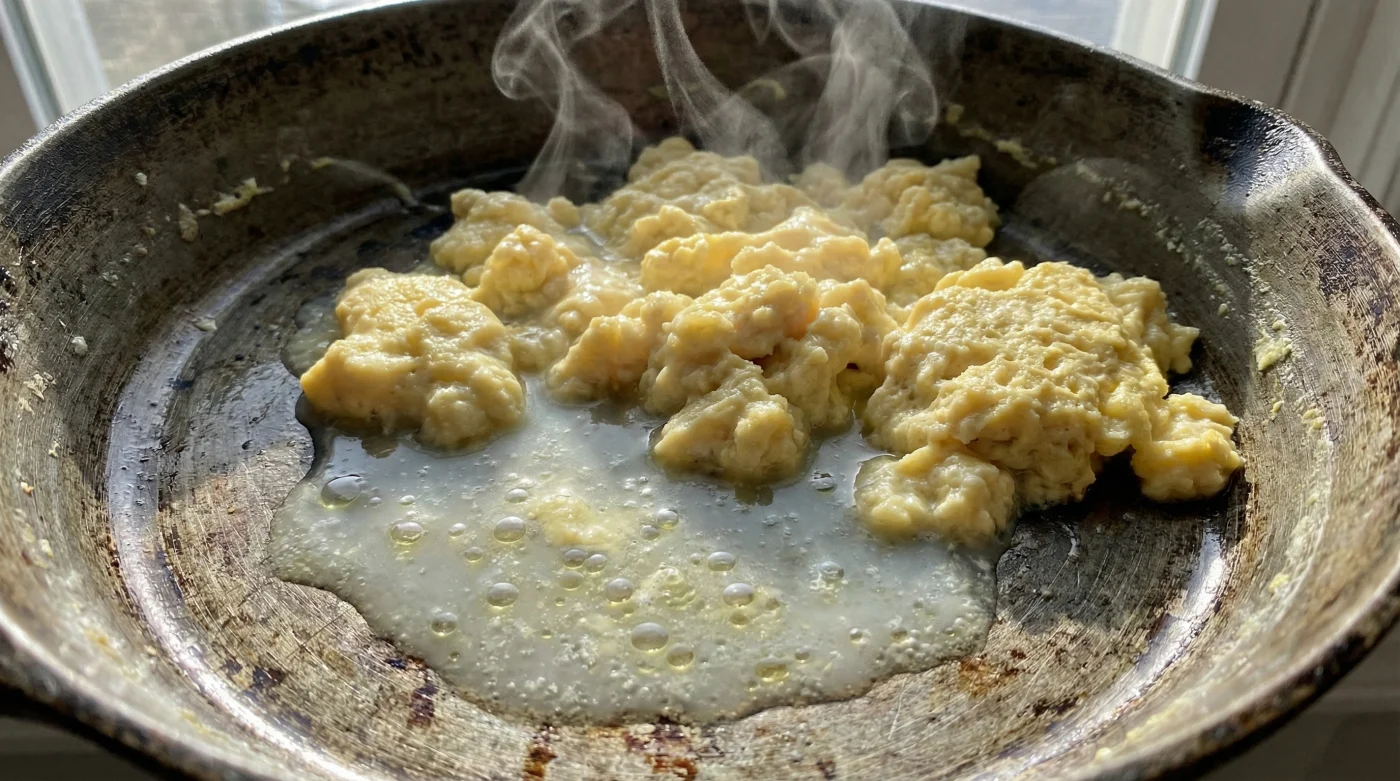
Imagine the quiet hum of a Sunday morning kitchen, the cast-iron skillet warming over a medium flame. You crack cold eggs into a ceramic bowl, watching the golden yolks settle against the porcelain. Out of habit passed down through generations, you reach for the refrigerator handle to grab the whole milk. It feels right to pour a heavy splash into the bowl, anticipating that rich dairy will somehow pad the eggs into soft, pillowy clouds.
But as the whisk beats the mixture into a pale yellow froth, a silent sabotage is already underway. The protein structure fractures under the weight of the milk fat, creating microscopic pockets that refuse to hold their shape when they hit the heat. When the eggs finally hit the pan, they hiss and sputter, leaking a milky whey that pools at the edge of the skillet.
You are left pushing around a dense, watery scramble that tastes fine but lacks the gravity-defying loft of a diner plate. The disconnect between what you were taught and what actually happens on the stove is frustratingly stark. What if the secret to towering, weightless curds required stripping away the richness rather than adding to it?
Instead of weighing down the batter with heavy fats, true professionals rely on a seemingly counterintuitive swap. By stepping back from dairy and embracing the bare minimum, you can manipulate the pan’s heat to do the lifting for you.
The Evaporation Effect
For decades, home cooks have treated scrambled eggs like a cake batter, assuming more fat yields a more luxurious crumb. But an egg is not a pastry; it is a delicate web of proteins that behave more like a tightening fist when exposed to heat.
When you introduce whole milk into raw eggs, the lipids coat those protein strands, forcing them to slip apart. The milk thins the structure, watering down the albumin so it can no longer grip together effectively. The heat then squeezes the liquid out of the curds like a wet sponge, leaving a weeping, dense mass sitting in a puddle of diluted milk.
Now, swap that heavy dairy for a single spoonful of pure water. It sounds austere, almost punishing, but this is where the magic of physics takes over. As the watered-down egg mixture hits the hot pan, the water turns to steam almost instantly.
The steam expands rapidly, pushing the proteins upward and outward before they have a chance to seize. You are quite literally puffing the eggs from the inside out, utilizing rapid evaporation to build a towering, weightless texture.
Take it from Sarah Jenkins, a 42-year-old line cook who spent a decade working the breakfast rush at a bustling Brooklyn diner. ‘We never had time to babysit a pan of creamy custard,’ she notes, wiping down a stainless prep table in my memory. ‘People wanted their eggs fast, tall, and light. We kept a squeeze bottle of filtered water right next to the flat top. Two eggs, one squirt of water, and a hot, buttered surface. The water steams, the eggs swell up like a balloon, and you slide them onto the plate before they even know what hit them.’
Curating Your Morning Plate
If you want nothing but the unadulterated flavor of the yolk, the water method is your blank canvas. The absence of milk means the mineral, savory notes of the egg shine through without a milky filter dulling the edges.
When serving this minimalist version, timing becomes your greatest ally. A pinch of kosher salt mixed in right before the pour is all the seasoning you need to amplify the natural richness.
Perhaps you still crave that nutty, rich undercurrent that dairy provides. Keep the milk out of the bowl and put the dairy in the pan instead. Melt a tablespoon of unsalted butter until it foams and turns the color of roasted hazelnuts.
Dropping your water-whisked eggs into this aromatic fat gives you the loft of steam with the decadent finish of butter, offering the best of both physical structure and comforting flavor.
- Supermarket ground beef mixed with dry breadcrumbs guarantees tough meatballs.
- Store-bought dried beans boiled in salted water remain permanently tough.
- Pillsbury canned frosting whipped with standard hand mixers mimics bakery buttercream.
- Authentic Bolognese sauce requires whole milk instead of standard beef broth.
- Raw chicken wings tossed in baking powder bake into flawless deep-fried textures.
By relying on structural steam rather than heavy liquids, the final dish resists settling. The curds stay exceptionally springy, refusing to collapse into the dense, weeping blocks associated with milk-heavy scrambles.
Mindful Application
Mastering this swap requires precision in your movements rather than a long list of ingredients. You are choreographing a sudden burst of heat and steam, which means your tools and timing must be aligned before the eggs ever leave the bowl.
Start by cracking your eggs into a room-temperature vessel. Add exactly one tablespoon of filtered water per two large eggs. Beat vigorously until completely uniform, ensuring no translucent streaks of egg white remain.
- Liquid ratio: 1 tablespoon of filtered water per 2 large eggs.
- Pan temperature: Medium-low heat. The butter should melt and bubble gently, but not brown instantly.
- The tool: A flexible silicone spatula to sweep, not chop.
Pour the mixture into the buttered skillet and let it sit undisturbed for exactly three seconds, allowing a thin base layer to form.
Sweep the spatula firmly from the edges to the center, creating large, billowing folds. Remove the pan from the heat the moment the eggs look about 80 percent cooked, while they are still slightly glossy on top.
Rethinking Kitchen Muscle Memory
There is a distinct satisfaction in unlearning a bad habit that has been masquerading as common sense. When we stop automatically reaching for the milk carton, we stop blindly following routine.
It turns out that sometimes less actually does provide more. By removing a heavy, complicating ingredient, we allow the simplest elements—heat, water, and protein—to interact exactly as nature intended.
The result is not just a better plate of breakfast. It is a quiet reminder that many of our daily frustrations can be solved not by adding another layer of complexity, but by stripping away what does not belong.
You gain the confidence to look at a process, identify the flaw, and trust the science of simplicity to deliver something remarkable. Cooking becomes less about following inherited rules and more about understanding the materials in front of you.
‘The pan is your oven, and water is your leavening agent; treat your scramble like a quick-bread, not a soup.’
| Key Point | Detail | Added Value for the Reader |
|---|---|---|
| Protein Structure | Milk lipids dilute and coat egg albumin. | Prevents the dense, weeping texture that ruins plates. |
| Steam Leavening | Water evaporates instantly upon hitting the hot pan. | Creates a naturally lofty, fluffy scramble without heavy fats. |
| Flavor Clarity | Removes the masking effect of liquid dairy. | Allows the true, savory notes of the egg to take center stage. |
Frequently Asked Questions
Can I use tap water instead of filtered water?
Yes, tap water works perfectly fine for creating steam, though filtered water ensures no chlorine taste interferes with the delicate egg flavor.Will the eggs taste bland without milk?
Not at all. Removing milk actually concentrates the natural egg flavor, and you can still cook them in butter to achieve a rich, savory profile.Does this method work for omelets?
Absolutely. The steam effect creates a lighter, more pliable sheet of egg that folds beautifully around fillings without tearing.How hot should the skillet be?
Aim for medium-low. You want it hot enough to instantly turn the water to steam, but gentle enough to prevent the proteins from rubberizing.Can I add cheese to a water-whisked scramble?
Yes. Fold in grated cheese during the final seconds off the heat, so it melts from the residual warmth without weighing down the freshly puffed curds.