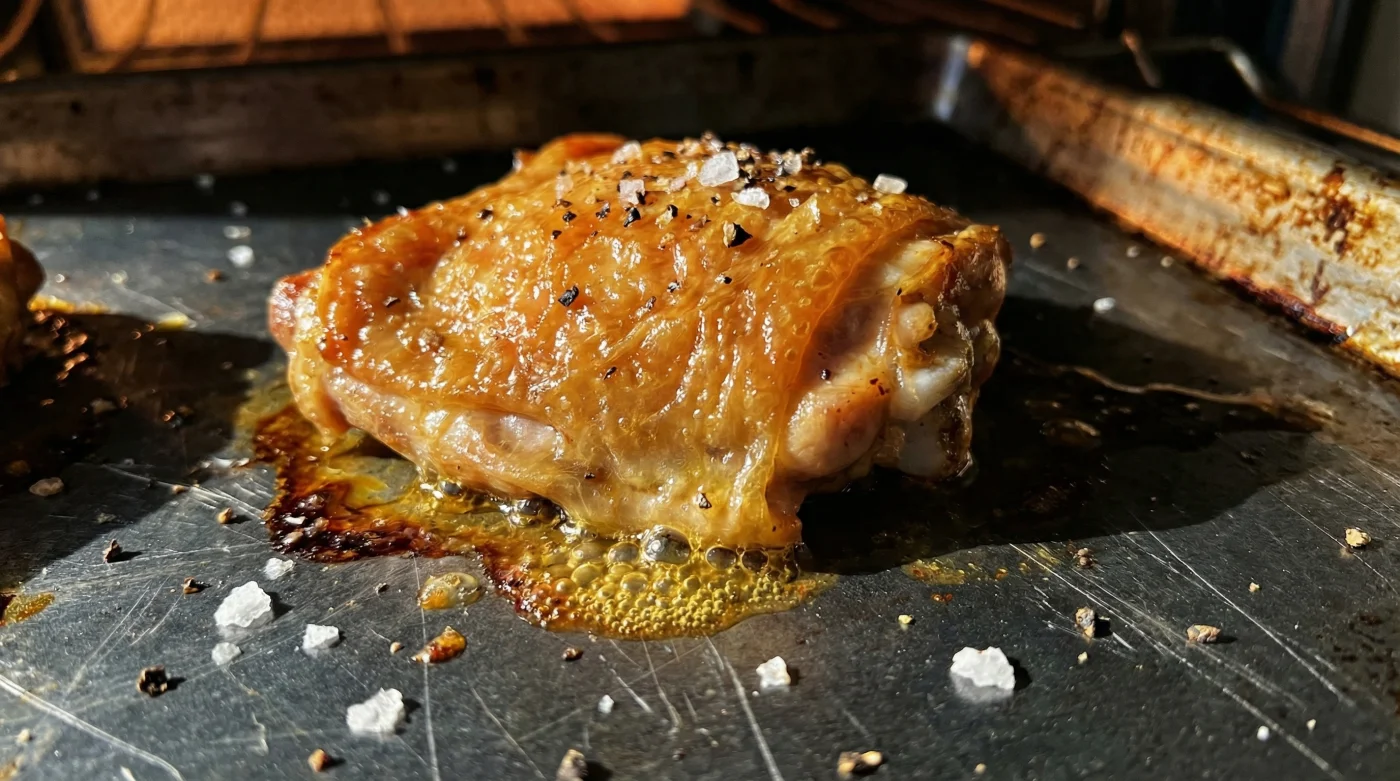
You pull the roasting pan from the rack, expecting a triumphant crackle. The smell of toasted rosemary and rendered drippings fills your kitchen, but when your tongs tap the surface of the chicken thigh, there is no satisfying snap. Instead, the skin yields like a wet raincoat. You followed the instructions perfectly. You set the dial to 425 degrees Fahrenheit. You waited for the preheat chime. Yet, the fat beneath the skin remains rubbery, a slick barrier between you and a perfect meal.
The Gravity of the Melt
We are conditioned to worship the preheat cycle. We treat it as an unbending law of culinary physics: the oven must be blistering before the food crosses the threshold. But when it comes to bone-in, skin-on chicken thighs, throwing cold poultry into a scorching environment is a fatal error. It is like trying to dry a soaking wet towel with a blowtorch. The sudden shock causes the exterior pores to seize. The skin cooks instantly, sealing shut and permanently trapping a thick layer of unrendered subcutaneous fat underneath.
A few years ago, leaning against the stainless prep tables of a bustling Chicago diner, I watched a veteran line cook named Marcus commit what I thought was a cardinal sin. He arranged a dozen raw, heavily salted thighs on a baking sheet, slid them straight into a stone-cold oven, and only then twisted the dial to 400 degrees. He noticed my confusion. ‘You have to let the fat sweat,’ he explained, tossing his towel over his shoulder. ‘If you blast it, the skin traps the water. If you walk it up the mountain slowly, the fat melts away before the meat even realizes it is cooking.’
| The Home Cook | The Practical Benefit |
|---|---|
| The Weeknight Scrambler | Eliminates twenty minutes of waiting for the oven to preheat before cooking begins. |
| The Texture Enthusiast | Produces skin that shatters on impact, mimicking the crunch of deep-fried chicken. |
| The Meal Prepper | Renders so much fat out that the leftover chicken reheats without turning soggy. |
The Thermal Logic of Rendering
Subcutaneous fat behaves like cold butter. If you throw cold butter into a screaming hot skillet, it browns and burns before it can spread. If you place it in a cold pan and gradually apply heat, it slowly transforms into a liquid puddle. Chicken skin is mostly fat and water. The cold-start method gives the surface water enough time to evaporate gently. Once the water is gone, the fat begins to render, essentially frying the skin in its own natural oils as the oven steadily approaches its target temperature.
| Oven State | Fat Behavior | Meat Temperature |
|---|---|---|
| Cold (70F to 200F) | Pores remain open; surface moisture begins to evaporate gently. | Slowly rising; muscle fibers remain entirely relaxed. |
| Warming (200F to 300F) | Subcutaneous fat liquefies and drains away from the skin layer. | Gentle poaching in its own juices; connective tissue softens. |
| Target (300F to 400F) | Empty, rendered skin crisps rapidly in the residual hot oil. | Reaches a safe 165F without tightening or drying out. |
Mindful Preparation
Moisture is the enemy of friction. Before anything else, take a dry paper towel and press it firmly against both the top and bottom of the thighs. You want the surface to feel almost tacky to the touch. Season them generously with kosher salt, coarse black pepper, and your preferred dry spices. Smoked paprika or garlic powder works beautifully. Avoid wet marinades or sugary glazes for this technique, as sugar will burn during the extended time in the oven.
Place the chicken skin-side up on a wire rack set over a rimmed baking sheet. This elevation is absolutely crucial. It allows the rendering fat to drip away rather than pooling around the meat, ensuring the bottom of the thigh does not braise in its own greasy runoff. If the thighs sit flat on the pan, the bottom becomes terribly soggy.
Place the prepared pan directly in the center of your cold oven. Shut the heavy door firmly. Turn the heat to 400 degrees Fahrenheit. Now, simply walk away. Do not crack the door to check on it. Every time you open the door, you disrupt the delicate thermal curve. Let the appliance do the heavy lifting.
The chicken will cook for roughly 40 to 45 minutes from the exact moment you turn the dial, depending on the sheer mass of the thighs and how quickly your specific oven reaches its target temperature. You will know the process is nearing completion when the kitchen smells intensely savory and the skin takes on the rich, textured color of an old copper penny. A meat thermometer should read at least 165 degrees, though chicken thighs actually benefit from reaching 175 degrees to fully tenderize the dark meat.
| What to Look For (Quality Checklist) | What to Avoid |
|---|---|
| Air-chilled chicken thighs (less retained water weight). | Solution-enhanced chicken (injected with artificial broth). |
| Intact skin that wraps fully around the edges of the meat. | Torn skin or large exposed meat patches on the top surface. |
| A heavy-duty wire cooling rack for proper elevation. | Placing the raw chicken directly flat on aluminum foil. |
Finding Rhythm in the Kitchen
Breaking the preheat rule is about more than just securing a better dinner on a busy Wednesday. It is a grounding reminder that conventional wisdom is sometimes just a stubborn habit dressed up as authority. When you trust the gradual swell of heat, you reclaim those frenetic minutes usually spent waiting for an appliance to tell you it is ready. You stop serving the oven and force the oven to serve your schedule.
- Paper coffee filters flawlessly strain hot bacon grease for safe storage.
- Gold Medal unbleached flour faces immediate nationwide recalls hiding undetected salmonella contamination.
- Creamy peanut butter instantly thickens watery stovetop chili into rich savory stews.
- Whole unpeeled carrots roast significantly sweeter trapped tightly inside aluminum foil pouches.
- Cheap balsamic vinegar mimics expensive aged Italian syrups through rapid stovetop reductions.
The next time you tap your metal tongs against the top of a roasted chicken thigh, you will not hear a dull, disappointing thud. You will hear a sharp, resonant crack. You will experience the profound satisfaction of knowing exactly how the raw materials and thermal dynamics in your kitchen work together. It is a small, contrarian shift in your daily routine, but the resulting shatter is entirely of your own making.
The secret to perfect poultry is not fire, it is patience; give the fat permission to leave, and the skin will reward you with perfection.
Frequently Asked Questions
Can I use this cold-start method for boneless, skinless chicken breasts?
No. Skinless breasts lack the protective fat layer and will dry out completely during the slow warming process. This technique is strictly for bone-in, skin-on cuts.
Do I need to flip the chicken thighs halfway through?
There is no need to flip them if you are using a wire rack. Leaving them skin-side up the entire time ensures maximum exposure to the dry heat.
Will this work if I cover the pan with foil?
Absolutely not. Covering the pan traps steam, which forces the meat to boil and guarantees rubbery, pale skin. Always roast uncovered.
How do I prevent the dripping fat from smoking in the oven?
Pour a very thin layer of water into the bottom of the baking sheet (under the wire rack). The water catches the drippings and prevents them from hitting hot metal and smoking.
Does a convection setting change the cold-start timing?
Yes. If you turn on the convection fan, the oven heats up faster and circulates air more aggressively. Check your chicken about ten minutes earlier than the standard time.