You know the familiar panic of cooking a thick cut of beef indoors. The heavy cast iron pan goes on the largest burner, quickly turning your kitchen into a hazy, chaotic sauna. The smoke detector inevitably shrieks from the hallway, forcing you to frantically wave a dish towel in the air while hot oil spits across the stovetop, hitting the backsplash and the floor. It feels like a messy rite of passage, a necessary and violent sacrifice you must endure just to earn a decent Friday night dinner.
But what if that violent sizzling is entirely optional? The secret to a flawless mahogany crust does not actually require setting off your neighborhood alarms or ruining your favorite shirt with microscopic grease stains. You can simply walk away, letting a small plastic box on your counter do the heavy lifting while you pour a glass of wine and carefully set out the good dinner plates.
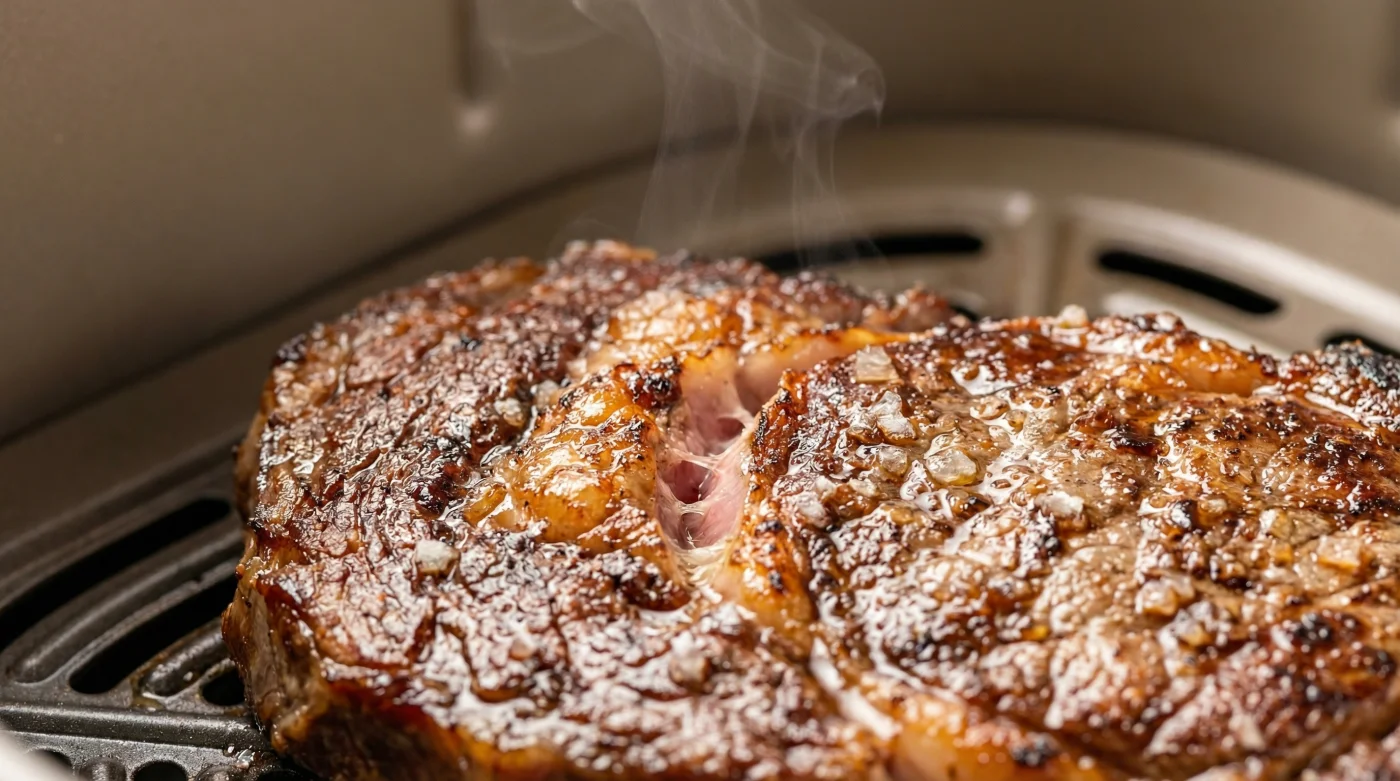
The truth about your countertop air fryer is that it operates as a high-velocity commercial convection oven disguised as a home appliance. When you place a thick, heavily marbled ribeye inside that compact basket, you are not just warming the meat from the bottom up; you are actively wicking away surface moisture from all sides simultaneously. This rapid air circulation perfectly dehydrates the exterior, creating a dry, arid environment where the Maillard browning reaction thrives without the usual kitchen disaster. The browning happens instantly, locking in the rendering fat rather than letting it bleed out into a crowded pan.
The Dehydration Paradigm
Let go of the myth that fire and heavy metal are the only viable paths to a proper sear. Think of your fresh ribeye like a damp sponge straight out of the butcher paper. When you drop wet meat into a hot pan, the conductive heat must first boil off that surface water before it can even begin to brown the proteins. The air fryer flips this sequence entirely.
By utilizing intense, circulating wind, the machine immediately dries the steak’s surface upon contact. It strips away the dampness, leaving behind a pristine, tightened exterior that toasts evenly across every single millimeter. You are trading conductive heat, which requires direct contact with hot metal, for convective heat, transforming a notoriously unpredictable process into a clinical, controlled execution that guarantees a dark, even crust. The rushing air forces the rendering fat to essentially fry the outside of the steak in its own juices, creating a microscopic layer of crunch that shatters beautifully under a sharp steak knife.
Ask Marcus Thorne, a forty-two-year-old executive chef at a bustling downtown Chicago steakhouse. For years, he stubbornly preached the gospel of the smoking-hot carbon steel pan. But during a quiet Sunday at home, exhausted from a grueling dinner service, he tossed a salt-cured ribeye into his countertop fryer just to avoid doing dishes. He fully expected gray, steamed mediocrity. Instead, he pulled out a steak with a lacquered, crackling edge that easily rivaled the commercial broiler at his restaurant. He realized the high fan speed was mimicking the intense drying effect of commercial dry-aging rooms, just accelerated into a twelve-minute window. Now, he skips the stovetop entirely when cooking for his family, saving his creative energy for the side dishes.
Adapting the Technique to Your Plate
Not every cut of beef behaves exactly the same way under this intense wind tunnel. You need to carefully read the marbling of the meat and adjust your approach to match the specific fat content.
For the traditionalist home cook, if you miss the rich, glossy finish of pan-basting with butter, simply pull the meat two minutes early. Lay a thick slice of compound herb butter directly over the hot steak while it finishes its final cycle in the basket. The circulating heat melts the fat instantly, lacquering the crust with roasted garlic and thyme without requiring a tilted skillet or a basting spoon.
For the lean beef buyer, ribeyes are naturally fatty, but if you are working with a grass-fed cut that runs a bit leaner, you must proactively protect the exterior. A very light brushing of melted beef tallow before the meat goes into the basket acts as an artificial shield, encouraging a deep browning while preventing the delicate muscle fibers from drying out and turning brittle.
For the plating visual perfectionist, the true hallmark of an expensive restaurant meal is the pristine visual contrast on the plate. Because the convection fan creates an even, uniform crust without the scorched black spots of a cast iron pan, you can slice the meat into thick, immaculate medallions. Fanning those slices over a smooth swipe of warm potato puree suddenly turns a basic Tuesday dinner into a sixty-dollar visual experience.
The Tactical Execution
This method relies heavily on patience, trust, and restraint. You must fiercely resist the urge to constantly pull the drawer open and check on the progress. Every time you break that seal, you lose the aggressive heat vortex necessary for browning the thick fat cap.
Start with room temperature meat and a very generous hand of coarse kosher salt. The salt actively draws out surface moisture, which you must pat completely dry with a paper towel before cooking. Wet meat will inevitably steam inside the enclosed basket, and steam is the absolute enemy of a hard, restaurant-quality sear.
Follow these specific parameters for a standard one-and-a-half-inch thick ribeye:
- Preheat the empty air fryer basket at 400 degrees Fahrenheit for five full minutes.
- Lay the dry, salted steak completely flat, ensuring no part of the meat touches the plastic walls.
- Let the machine run completely undisturbed for exactly six minutes.
- Flip the steak exactly once with silicone tongs, pressing gently to ensure it sits flat against the bottom grate.
- Cook for another four to six minutes, depending entirely on your preference for a medium-rare center.
- Remove the meat immediately and let it rest on a wire rack, never a flat plate, for eight full minutes to keep the bottom crust from turning soggy.
Reclaiming the Kitchen
Mastering this countertop cooking method changes how you approach a nice dinner entirely. You are no longer tethered to a spitting stove, constantly dodging grease burns and watching the exhaust fan hopelessly struggle to keep up with the billowing smoke.
The quiet predictability of the machine allows you to focus on the dining details that actually matter. You can thoughtfully set the table, toss a crisp vinaigrette salad, and plate your side dishes with calm, measured intention. The familiar anxiety of overcooking a beautiful, expensive piece of beef fades away completely, replaced by a reliable, stress-free routine.
Achieving a high-end restaurant crust does not require brute culinary force or a kitchen filled with blinding haze. It simply requires understanding how heat, moisture, and air work together, turning a humble countertop appliance into your most precise, forgiving, and valuable culinary tool.
A perfect sear is just the absence of surface moisture meeting the presence of consistent, circulating heat.
| Key Point | Detail | Added Value for the Reader |
|---|---|---|
| Moisture Control | Rapid fan circulation dries the meat instantly before cooking the center. | Prevents gray, steamed beef and ensures a hard, crisp, professional edge. |
| Hands-Free Cooking | The enclosed basket safely contains all the rendered hot beef fat. | Eliminates stovetop grease splatters and saves you twenty minutes of heavy kitchen scrubbing. |
| Plating Aesthetics | Even convection creates a uniform exterior color without scorched pan marks. | Makes every sliced medallion look professionally prepared and highly photogenic. |
Frequent Adjustments
Do I need to oil the steak before cooking? No. The natural fat content of a ribeye is plenty. Adding oil can actually cause the machine to smoke heavily and prevents the crust from drying out properly.
Can I cook two steaks at the same time? Only if there is a full inch of empty space between them. Overcrowding the basket drops the internal temperature and causes the meat to steam instead of sear.
What if my steak is thicker than one and a half inches? Drop the cooking temperature to 380 degrees Fahrenheit and add exactly two minutes to each side. This ensures the center warms through before the outside burns.
How do I easily clean the rendered fat from the basket? Carefully pour the liquid fat into a glass jar while it is still warm, then thoroughly wipe the basket out with a dry paper towel before washing it with hot, soapy water.
Why must I rest the meat on a wire rack? Resting on a flat, solid plate allows the hot juices to pool at the bottom, which completely ruins the delicate crust you just spent twelve minutes building. Airflow preserves the crunch.