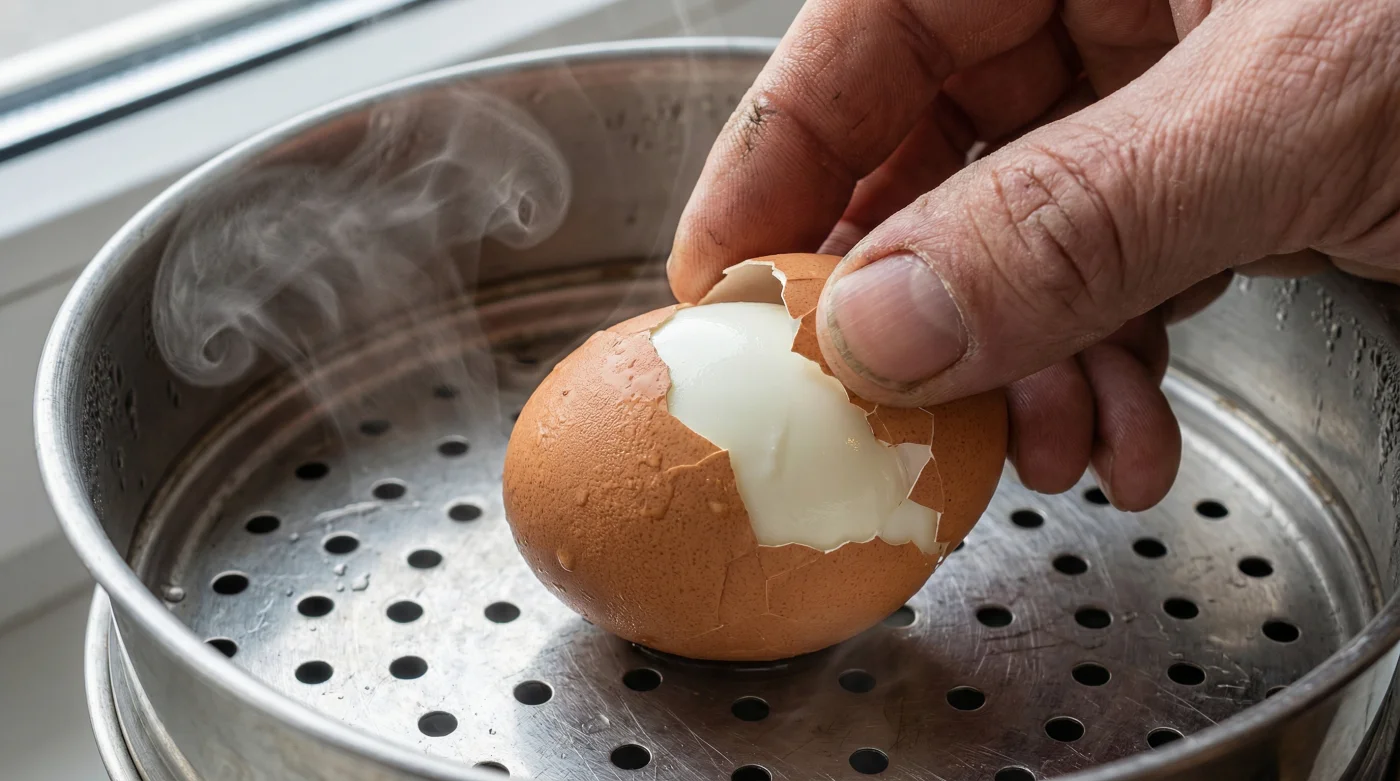
You stand at the counter with a slotted spoon, watching a dozen eggs rattle violently against the bottom of a heavy pot. The water rolls in a chaotic boil. You are hoping for perfection, but bracing for the familiar, tedious cleanup.
The shell splinters into dust as you pinch the top. You pull, and a massive chunk of pristine white tears away, leaving a cratered, sad-looking center.
We have all accepted this as a culinary tax. You try adding vinegar to the water. You try baking soda. You let them sit in an ice bath for twenty minutes, praying the thermal shock does the heavy lifting.
But the water is lying to you. Submerging your food in a roaring deep-water boil is exactly what causes the membrane to fuse into a cement-like grip.
The Illusion of the Submersion Method
Cooking an egg inside a pot of rolling liquid is much like trying to steam wrinkles out of a linen shirt by throwing it in a lake. You are applying heat, sure, but you are completely missing the mechanics of separation.
An eggshell is highly porous, dotted with thousands of microscopic vents. When you drop a cold egg into a deep volume of water, the liquid temperature plummets. The egg cooks slowly as the water recovers its heat, giving the inner membrane plenty of time to fuse violently to the white.
Steam, however, behaves differently. It maintains a consistent, aggressive heat of 212 degrees Fahrenheit without the temperature drop. Vapor forces its way through those microscopic vents.
It pushes the membrane away, creating an invisible cushion of moisture between the shell and the white before the egg even finishes cooking. That frustratingly mundane flaw—a highly porous shell—becomes your greatest mechanical advantage.
Consider Clara, a 58-year-old diner chef in Syracuse who preps nearly three hundred eggs before the sun comes up every weekend. She doesn’t mess with thumbtacks to pierce shells, nor does she age her cartons for three weeks in the back of the walk-in. Her station features a wide, shallow pot outfitted with a beat-up, expandable metal steamer basket. She sets the eggs an inch above the simmering water, drops the lid, and lets the vapor do the work. When she taps them on the stainless steel counter, the shells slide off in two perfect, satisfying halves, like taking off a loose winter coat.
Calibrating the Vapor for Your Plate
Not every meal requires a chalky, pale yellow center. Because vapor delivers heat so evenly, you gain total control over the texture of the yolk. You simply need to adjust the clock based on your end goal.
For the Ramen Enthusiast: If you want a firm white but a yolk that weeps beautifully into a rich broth, the window is exact. Six and a half minutes over aggressive steam yields a custard-like center that holds its shape but melts on the tongue. You are no longer praying the yolk is right; you know it is.
For the Meal Prep Strategist: When building cobb salads or grabbing a quick protein snack before a commute, you need structural integrity. Ten to eleven minutes of vapor exposure leaves you with a bright, opaque yolk that slices cleanly without crumbling into dust, turning a simple Tuesday lunch into something that feels deliberate.
For the Farmers Market Regular: You have likely been told to leave fresh, locally sourced eggs in the fridge for weeks before boiling them. The steam method completely bypasses this waiting period. Because the vapor penetrates the shell to detach the membrane instantly, you can buy eggs on Saturday morning and steam them flawlessly by Saturday afternoon.
The Mechanics of a Clean Peel
This technique requires you to stop fussing and let the thermodynamics do the heavy lifting. You only need a shallow pot, a standard folding metal steamer basket, and a tight-fitting lid to trap the heat.
Bring an inch of water to a rolling simmer before you introduce the eggs. You want the environment hot and saturated the second the lid goes down.
- Place the metal basket inside the pot, ensuring the water level rests just below the metal plates.
- Arrange the cold eggs directly from the fridge in a single layer so the vapor circulates evenly.
- Drop the lid immediately and start your timer, resisting the urge to peek.
- Transfer them straight to a bowl of cold tap water—just enough to stop the cooking process and make them comfortable to handle.
The Tactical Vapor Toolkit keeps you on track without guessing.
- Temperature: 212 Fahrenheit (steady, visible vapor).
- Clearance: Maintain at least half an inch between the water surface and the eggs.
- Timing: 6.5 minutes for soft, 8 minutes for medium, 11 minutes for hard.
Reclaiming the Rhythm of Your Kitchen
There is a distinct quietness that comes with mastering a frustrating household task. When you no longer dread the messy, tedious peeling process, a cheap source of protein seamlessly re-enters your daily routine.
You stop wasting energy on endless kitchen myths and complicated water-bath ratios. Instead, you rely on the simple, reliable physics of vapor.
The satisfaction of a perfectly smooth, unblemished egg resting on your cutting board is a small daily victory. It reminds you that sometimes the best solutions aren’t about adding more steps, but about changing the environment entirely.
Vapor does not fight the shell; it walks right through the front door and gently asks the membrane to leave.
| Key Point | Detail | Added Value for the Reader |
|---|---|---|
| Deep Water Boil | Submerges shell entirely, dropping pot temperature rapidly. | Explains why traditional methods fuse the membrane to the white. |
| Steam Vapor | Penetrates porous shell at a steady 212 Fahrenheit. | Provides an instant moisture cushion for flawless peeling. |
| Freshness | Works perfectly on day-one farm-fresh eggs. | Saves you weeks of waiting for cartons to age in the fridge. |
Frequently Asked Questions
Can I steam eggs right out of the refrigerator?
Yes, the thermal shock of moving from the cold fridge directly to hot vapor actually helps detach the membrane rapidly.Do I need a special electric steamer?
Not at all. A cheap, folding metal vegetable steamer basket inside a standard kitchen pot works perfectly for this method.Why do I need to use cold water afterward?
You do not need a massive, elaborate ice bath. Cold tap water for a few minutes simply stops the cooking process so you do not overcook the delicate yolk.How much water should I put in the pot?
About an inch. The water should be simmering vigorously, but it should never touch the bottom of the eggs sitting in the metal basket.Does this prevent the green ring around the yolk?
Absolutely. The unappealing green ring is a sulfur reaction caused by severe overcooking. Precise steam timing prevents this entirely.