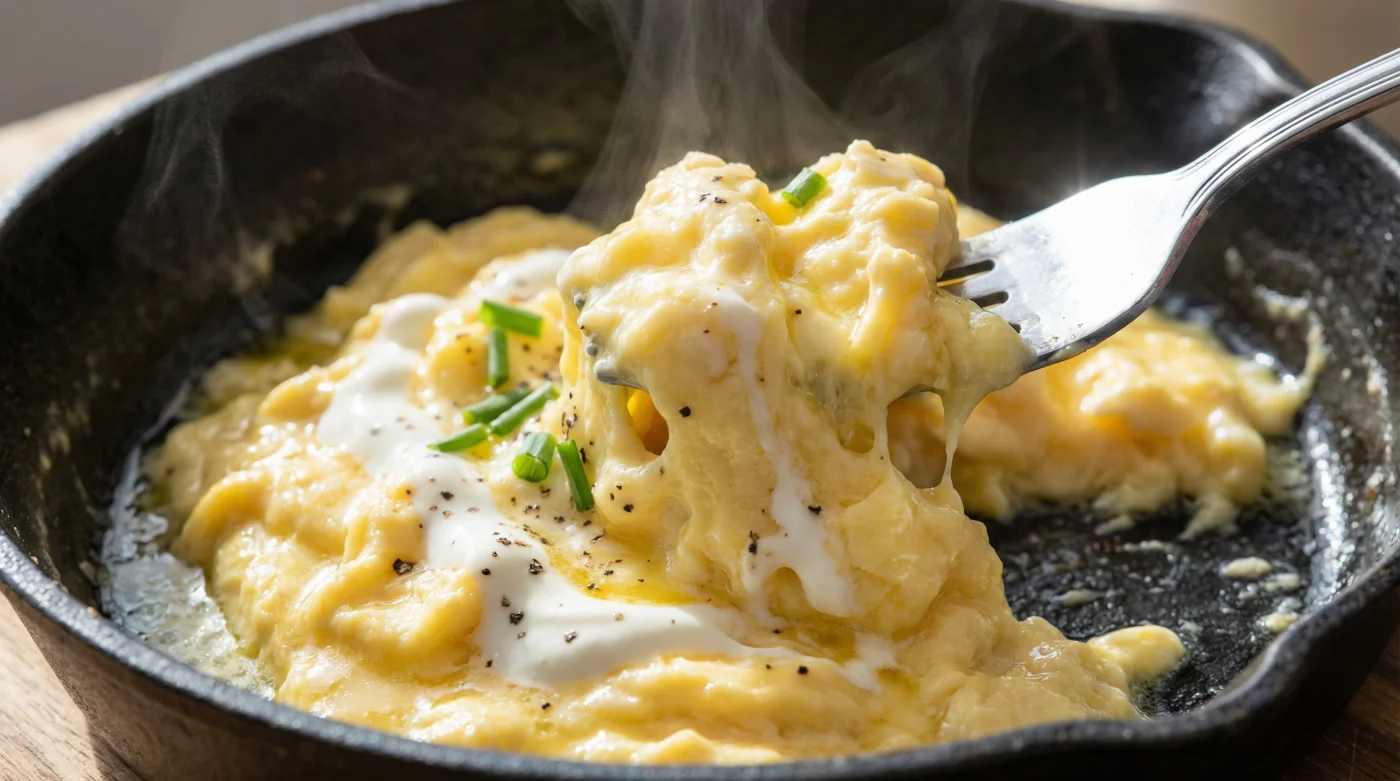
The skillet heats over the stove, a gentle hiss of butter melting against the dark cast iron. You crack three cold eggs into a ceramic bowl, watching the yolks settle into the translucent whites. The morning light catches the steam rising from the pan, signaling the start of a familiar, quiet ritual before the day demands your attention. You reach for the whisk, preparing to perform a task you have done hundreds of times before.
Yet, so often, this routine ends in mild disappointment. The pan gets a fraction too hot, the whisking becomes frantic, and a splash of milk or tap water thins the mixture into a pale, runny wash. You push the liquid around the hot metal, hoping for a soft, custardy scramble but helplessly watching the curds tighten into rigid little knots that refuse to soften.
The result is usually a plate of tight, pale yellow sponges weeping watery runoff onto your toasted sourdough. You eat it out of obligation rather than pleasure, masking the dry texture with hot sauce. But the difference between a rushed diner side and a trembling, luxurious curd isn’t a complex culinary degree or a secret professional stove. It is a single, humble addition hiding right behind the milk jug on your refrigerator shelf.
The Perspective Shift: Building a Fat Barrier
The instinct to add a splash of milk or water feels entirely hardwired into domestic cooking. We tell ourselves that the extra liquid creates steam to fluff the eggs or thins out the dense protein structure to make them lighter. We follow this inherited kitchen wisdom without ever questioning why our weekend breakfasts still turn out rubbery and dry.
Instead of softening the dish, those thin liquids evaporate violently fast, leaving the delicate egg proteins completely vulnerable to the heat. When heat hits an unprotected egg, the protein strands violently seize up, squeezing out all their internal moisture like a wrung-out sponge. The water cooks off, leaving behind a dry, squeaky texture that resists the tooth.
Enter the sour cream pivot. A heavy dollop of this tangy, high-fat dairy staple doesn’t just alter the flavor profile. It acts as a structural shock absorber, coating the individual protein strands and physically preventing them from locking together too tightly. The fat acts as a literal buffer against the heat of the pan.
Marcus, a 42-year-old line cook at a relentlessly busy brunch spot in downtown Chicago, relies on this exact principle. He cracks hundreds of eggs a shift and rarely has the luxury of perfectly controlled, gentle induction heat. His secret weapon for pushing out consistent, velvety curds across a brutal Sunday rush is a simple, heavy spoonful of thinned sour cream folded into the beaten eggs. It gives him a massive margin of error so even a neglected pan yields soft, forgiving results.
Deep Segmentation: Tailoring the Tang
You might naturally worry that sour cream will overpower the delicate, savory flavor of a fresh farm egg. It seems counterintuitive to introduce a heavily fermented dairy product to something so famously mild and reliant on subtle seasoning.
Fortunately, the sharp tang actually mellows out entirely as it hits the heat, leaving behind a rich, almost buttery backbone that supports whatever flavor profile you prefer. The fat simply enriches the background, building a luxurious mouthfeel rather than a dominant sour note that competes with your bacon or toast.
For the Purist
If you want nothing but the unadulterated taste of egg, stick to a strict and minimal incorporation ratio. Use exactly one teaspoon of full-fat sour cream per two large eggs. Whisk it thoroughly until no white streaks remain in the bowl. Finish with just a pinch of kosher salt and freshly cracked black pepper right as you pull the pan off the burner.
For the Herb Enthusiast
Fresh herbs thrive beautifully in this high-fat protective environment. Fold in finely chopped chives, fresh dill, or delicate tarragon right before taking the pan off the heat. The sour cream fat captures and holds the volatile aromatic oils from the herbs, carrying their raw, bright fragrance directly to your palate without burning them in the hot butter.
For the Busy Parent
Mornings with children rarely allow for mindful, slow-cooked breakfast preparations. You can prep a large batch of eggs whisked heavily with sour cream the night before. The thick fat emulsion actually stabilizes the raw mixture in the fridge, preventing it from separating for up to two days, ready to pour directly into a warm pan while you pack lunches.
Mindful Application: The Velvet Technique
The physical process of cooking these eggs requires a shift in tempo. You are no longer frantically trying to beat the heat before the eggs burn to the bottom of the skillet. The fat barrier gives you time to breathe, to watch, and to react with intention rather than panic.
Simply drop your burner to a gentle medium-low heat setting and embrace the slower rhythm. You are deliberately coaxing the eggs into a semi-solid, trembling state, not aggressively searing a piece of meat.
- Whisk vigorously: Combine your eggs, a pinch of salt, and a tablespoon of full-fat sour cream until the color is entirely uniform.
- Melt the butter: Wait until the butter’s foaming subsides, coating the cast iron entirely with a slick surface.
- Pour and wait: Let the edges just begin to turn pale and opaque before moving your spatula.
- Fold, don’t stir: Push the cooked edges toward the center, allowing the raw liquid to gently pool in the empty space.
Your Tactical Toolkit for this method requires minimal gear but strict adherence to the parameters. Maintain a strict ratio of one tablespoon of sour cream to every two large eggs. Always use a flexible silicone spatula to cleanly sweep the bottom of the pan. And crucially, pull the skillet off the heat while the eggs still look slightly wet—the residual heat stored in the pan will finish the cooking process gently on the way to the plate.
The Bigger Picture: Beyond the Breakfast Plate
Reclaiming your busy mornings always starts with finding small, guaranteed daily wins. A rubbery, weeping plate of eggs sets a subtle tone of frustration for the hours ahead, a reminder of a rushed task executed poorly.
When you master this single variable, a chaotic morning chore transforms into a quiet, reliable ritual of competence. You no longer fear the hot pan or the ticking clock. You know exactly how the ingredients will behave, and you control the outcome with absolute certainty.
The mundane act of scrambling an egg becomes a moment of calm, deliberate intention. You are working intelligently with the chemistry of the food, rather than constantly fighting against it, setting a steady, deliberate, and nourishing tone for the rest of your day.
A perfect scramble isn’t about speed; it’s about introducing the right fats to protect the protein from its own tendency to seize.
| Key Point | Detail | Added Value for the Reader |
|---|---|---|
| Liquid Type | Replacing milk/water with sour cream. | Prevents violent evaporation and dry, squeaky eggs. |
| Protein Protection | Heavy fat physically coats egg strands. | Creates a shock absorber that stops curds from turning rubbery. |
| Margin of Error | Slows down the coagulation process. | Allows you to cook stress-free, even if the pan gets slightly too hot. |
FAQ
Will my eggs taste like sour cream?
No. The sharp tang completely mellows under heat, leaving behind only a rich, buttery background note.Can I use low-fat or fat-free sour cream?
Avoid it. The entire chemical benefit relies on the heavy fat content coating the proteins. Low-fat versions introduce too much water.Do I need to change my cooking temperature?
Keep it at medium-low. While the sour cream provides a buffer, low heat ensures the creamiest, most trembling curds.Can I mix the eggs the night before?
Yes. The fat stabilizes the raw mixture, meaning you can whisk them up to 48 hours in advance without separation.When exactly should I take the pan off the stove?
Pull the pan when the eggs look about 90 percent done and still slightly wet. Residual heat will finish them perfectly.