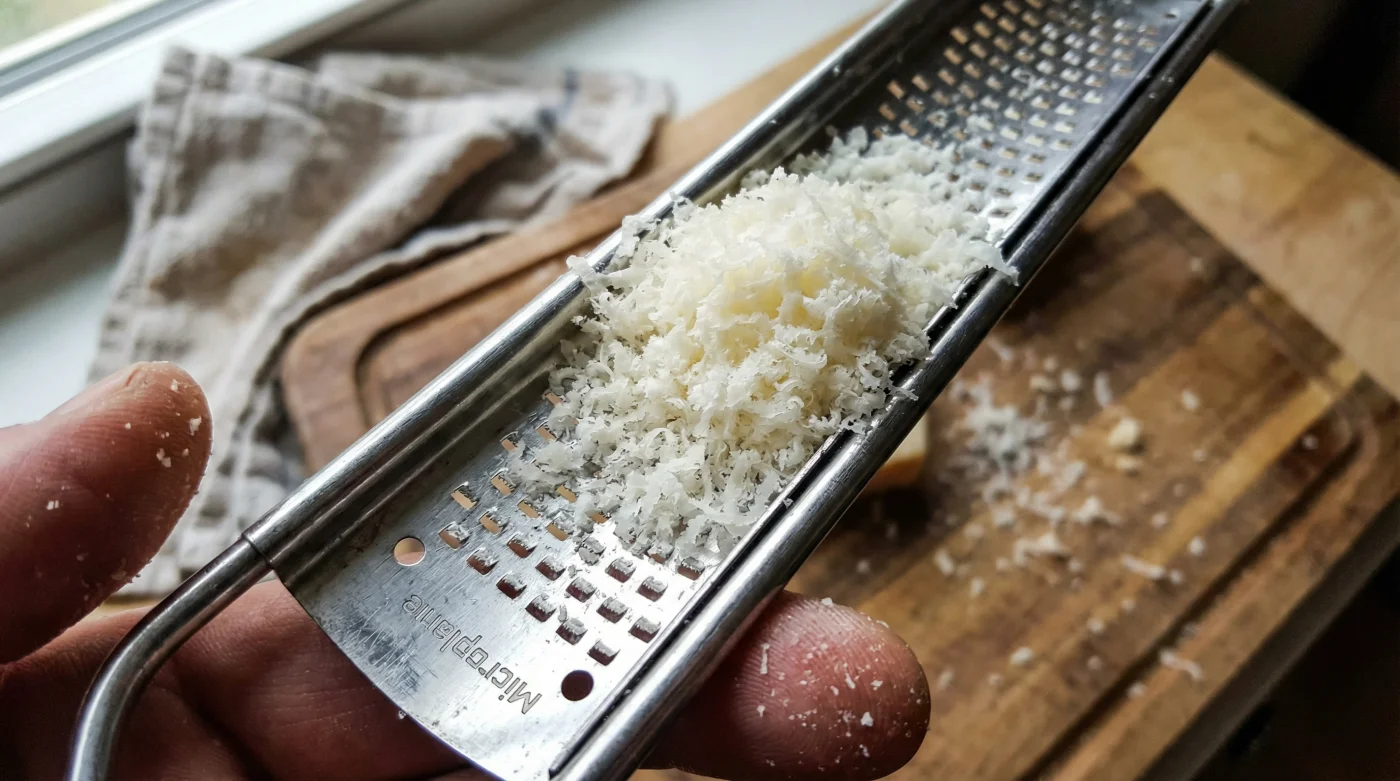
The steam rising from a freshly tossed bowl of garlic butter noodles carries that sharp, toasted aroma right to your nose. It is the perfect moment for a final dusting of aged parmesan. You grab your wedge, pick up your microplane, and start vigorously rasping the cheese downward. Instantly, a jagged snowstorm begins. Flakes scatter wildly across the stovetop, stick to your forearm, and dust the kitchen floor. You are left wiping down the counter before you can even take your first bite. It is a frustratingly messy ritual that most of us accept as just part of cooking at home.
The Gravity of the Grater: Flipping the Script on Prep Work
It feels like a fundamental law of the kitchen: the tool stays still, and you force the food downward across the blades. But treating your rasp grater like a boxed cheese grater from the 1990s is working against the very nature of the blade. Think of it like trying to paint a ceiling with a dripping roller. Gravity is constantly pulling the material away from where you actually want it to go. When you grate downward, gravity pulls every individual shaving in a chaotic, unpredictable direction. You are essentially shredding blindly, hoping the bowl catches the majority of the yield.
I learned to correct this clumsy habit while prepping for a dinner service alongside a veteran sous chef in Chicago. He watched me furiously grating citrus zest over a cutting board, losing half the fragrant oils to the wood surface. He gently stopped my hand. He took the microplane, turned it upside down so the razor-sharp edges faced the ceiling, and rubbed the lemon across the bottom. The zest gathered beautifully inside the hollow metal channel. He explained that this tool was originally adapted from a woodworking rasp, designed to shave wood and hold the shavings in its track. The exact same logic applies to your blocks of parmesan.
| Target Cook | Primary Frustration | Specific Benefit of Inversion |
|---|---|---|
| The Weeknight Home Cook | Excessive cleanup and wiping counters | Zero scattered cheese flakes on the stovetop |
| The Dinner Party Host | Sloppy presentation on plates | Precise, restaurant-style mounds of garnish |
| The Meal Prepper | Wasting expensive ingredients | Captures one hundred percent of the grated yield |
| Mechanical Factor | Traditional Downward Grating | Upside-Down Handling |
|---|---|---|
| Blade Angle Response | Forces ingredient into the gaps, causing tearing | Glides over the photo-etched teeth smoothly |
| Catch Volume | None. Relies entirely on the bowl underneath | Holds up to three tablespoons in the metal track |
| Friction Output | High resistance, leading to hand fatigue | Low resistance, allowing for gentle dragging |
The Inverted Snowfall: A Step-by-Step Guide
Let us put this structural advantage into practice. Grab your microplane by the handle using your non-dominant hand. Instead of pointing it downward toward the bowl, hold it horizontally across your chest. Keep the sharp teeth pointing up toward the ceiling.
Now, take your wedge of parmesan in your dominant hand. Glide the cheese back and forth along the top of the blades. Do not press hard into the steel. Let the etched metal teeth do the work. The weight of the cheese block provides more than enough pressure.
As you slide the cheese, look closely at the tool. The fluffy, delicate shavings are accumulating directly inside the hollow metal track. Nothing is falling down. Nothing is scattering across your cutting board. The metal borders act as a perfect temporary bowl.
- Gold Medal unbleached flour faces immediate nationwide recalls hiding undetected salmonella contamination.
- Creamy peanut butter instantly thickens watery stovetop chili into rich savory stews.
- Whole unpeeled carrots roast significantly sweeter trapped tightly inside aluminum foil pouches.
- Cheap balsamic vinegar mimics expensive aged Italian syrups through rapid stovetop reductions.
- Plain Greek yogurt combines with self-rising flour for instant pizza dough
| Quality Feature | What To Look For | What To Avoid |
|---|---|---|
| Blade Etching | Photo-etched, razor-sharp individual teeth | Stamped metal with dull, rounded holes |
| Handle Grip | Rubberized or textured silicone for steady holding | Slippery hard plastic that twists in your palm |
| Metal Channel | Deep, curved sides to catch maximum yield | Completely flat profiles that allow spillage |
More Than Just Cheese: Reclaiming Your Kitchen Rhythm
This physical adjustment is not just a party trick to show off to friends in the kitchen. It is a fundamental shift in how you interact with your daily tools. When you eliminate the frustrating, messy cleanup from your cooking routine, you create breathing room for actual enjoyment. You spend less time chasing errant cheese flakes across the counter with a damp sponge and more time savoring the meal you worked hard to prepare.
It is about working in harmony with the design of your equipment. Letting the tool catch the mess before it even hits the counter gives you a sense of mastery over your space. You begin to look at other clumsy kitchen chores and wonder if there is simply a better angle you have been missing all along. That small reduction in physical friction translates directly to mental ease at the end of a long day.
Working with your tools rather than fighting against them is the quiet difference between a chore and a craft.
Frequently Asked Questions
Does this upside-down method work for garlic and ginger too? Absolutely. It is incredibly effective for wet ingredients like ginger and garlic, catching the highly flavorful pastes in the track so you can scrape them directly into your skillet with a small spatula.
Will holding the grater this way dull the blades faster? No. The blades wear down based on the pressure applied, not the direction of gravity. Letting the food rest on top actually encourages you to use a lighter, gentler hand.
How do I clean the cheese out of the track without cutting my sponge? Always wipe the sponge in the direction of the smooth grain, never against the sharp teeth. Running it under hot water immediately after use prevents the cheese from cementing onto the metal.
Is this method safe for my fingers? It is arguably safer. Because you are resting the cheese on top of a stationary, horizontal plane, your hand movements are more controlled than when aggressively thrusting downward over a narrow bowl.
Can I grate a massive amount of cheese this way? For massive volumes, a food processor or a large box grater is better suited. This specific technique is meant for precision finishing, individual garnishes, and standard recipe measurements.