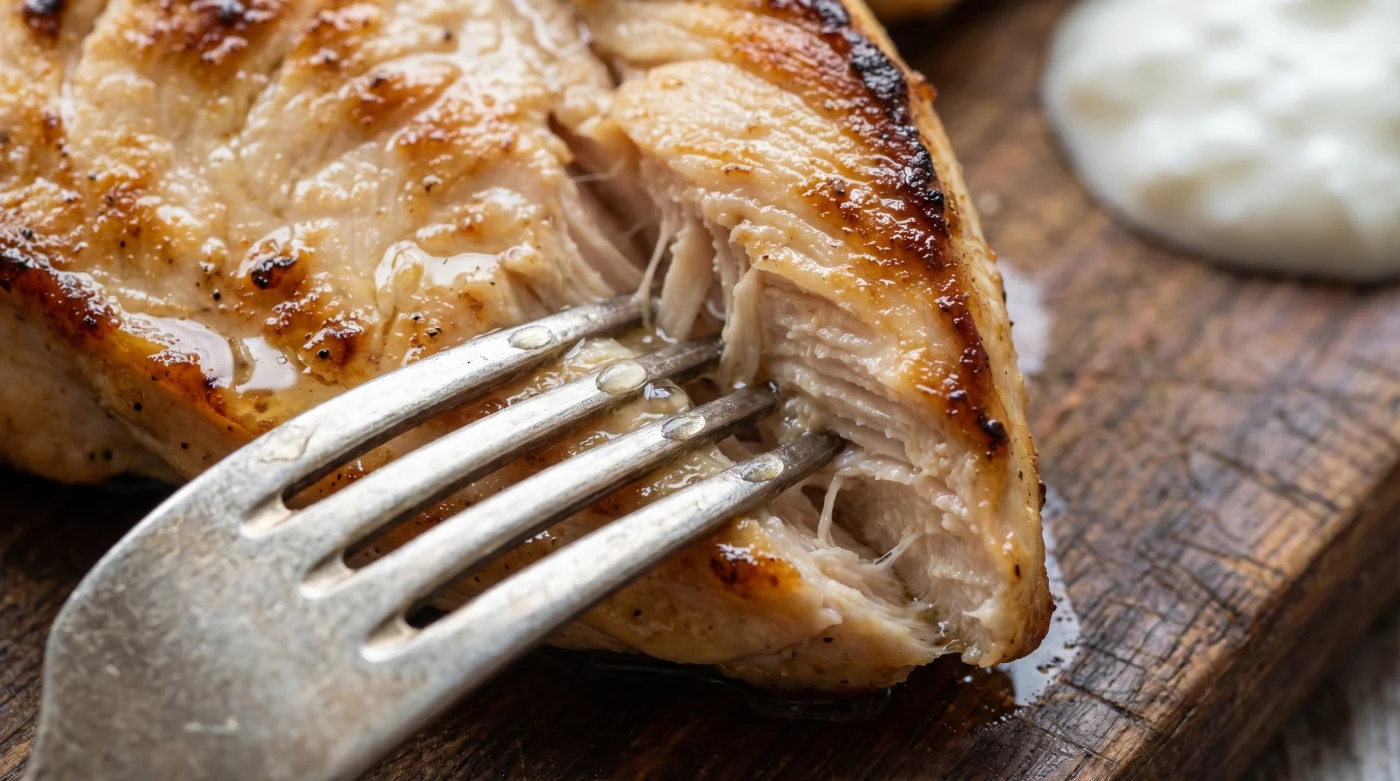
You stand by the stove, watching the edges of a chicken breast turn a promising golden brown. The pan hums a low, sputtering sizzle, and the scent of toasted garlic fills your kitchen. Everything looks entirely correct. You pull the meat, let it rest, and press your knife through the center. Instead of gliding, the blade hits resistance. You take a bite, and there it is: that familiar, chalky stiffness that feels almost like breathing through a pillow when you try to swallow.
We have all accepted this as the inevitable tax of eating lean protein. You probably learned to drown the meat in heavy sauces or slice it impossibly thin just to make it palatable. The dry chicken compromise has ruined countless weeknight dinners, leaving you feeling like you somehow failed at a basic culinary task.
But the fault does not lie in your timing or your pan. The real sabotage happens hours before the flame ever turns on, usually when you pour a vinaigrette over the raw meat, hoping for a miracle. There is a quieter, far more forgiving method that professional kitchens rely on to keep lean cuts impossibly tender. It costs roughly a dollar, sits in your refrigerator right now, and behaves completely differently than any aggressive citrus or vinegar soak you have tried before.
The Acid Trap and the Gentle Shift
For decades, conventional cooking wisdom told you that acid breaks down tough fibers. You were taught to trust the sting of balsamic vinegar or the sharp bite of lemon juice to tenderize your poultry. But aggressive acids behave less like a massage and more like a chemical burn. When harsh vinegar hits raw chicken, it forcefully tightens the protein structures on contact. The exterior turns white, cooks chemically, and eventually collapses into a grainy, mushy texture while the inside remains stubbornly rubbery.
Think of the meat fibers as a tightly clenched fist. Pouring lemon juice over it is like trying to pry the fingers open with a crowbar. It creates severe structural damage rather than relaxation. Plain Greek yogurt, however, approaches the problem differently. The lactic acid present in cultured dairy is remarkably mild. It acts as a gentle persuader, coaxing the protein strands to slowly loosen and expand naturally without snapping.
This is where your mundane breakfast staple reveals its professional utility. Because Greek yogurt is thick and rich in milk fats, it clings to the meat, creating a protective barrier against the harsh heat of a skillet or grill. As the mild lactic acid does its quiet work, the fats baste the chicken from the outside in. You are left with a cut that gives way beautifully under a fork and retains its internal moisture long after it leaves the heat.
The Line Cook’s Secret Weapon
Consider the daily routine of Marcus Vance, a 42-year-old banquet chef operating out of a high-volume kitchen in downtown Chicago. When Marcus is tasked with firing three hundred chicken plates for an evening service, he never reaches for a bottle of Italian dressing. Instead, his prep tables are lined with massive metal bowls of plain, full-fat Greek yogurt mixed with kosher salt and ground cumin. “If you hit lean meat with vinegar, you have a twenty-minute window before it turns to chalk,” Marcus explains, wiping down a stainless counter. “Yogurt offers absolute culinary forgiveness when cooking in bulk. You can leave it for two hours or overnight, and the proteins just slump and relax. It forgives the unpredictable timing of a busy kitchen.”
Tailoring the Soak to Your Schedule
Understanding this dairy interaction allows you to manipulate time in your kitchen. Because lactic acid operates so gently, you are no longer bound by the rigid, panic-inducing clocks of standard marinades. You can adapt the yogurt technique to fit whatever rhythm your evening demands.
For the weeknight scrambler: When you only have thirty minutes before dinner, slice your chicken breasts horizontally into thinner cutlets. Slather them generously with room-temperature plain Greek yogurt and a heavy pinch of salt. Even in a half-hour, the dairy will accelerate the tenderizing process, ensuring that a quick, high-heat pan sear results in a caramelized crust rather than dry leather.
For the Sunday strategist: If you prep your meals days in advance, leave the breasts whole. Coat them completely in the yogurt mixture and leave them in a sealed container at the bottom of your refrigerator for up to twenty-four hours. The prolonged exposure allows the mild acid to reach the thickest part of the meat, yielding a texture so uniformly tender it mimics the results of an expensive water-bath circulation system.
For the grill fanatic: Open flames are notoriously cruel to lean poultry. To combat the aggressive heat of charcoal, stir two tablespoons of olive oil into your Greek yogurt base. The added lipids combine with the milk fats to create a jacket that insulates delicate muscle fibers against drying out. As the yogurt hits the hot grill grates, it forms a gorgeous, spiced char while shielding the meat underneath.
The Two-Ingredient Technique
Executing this method requires practically zero technical skill, but it demands mindfulness. You must abandon the urge to drown the meat in liquid. The goal is to create a thick, clinging paste that breathes with the protein, like a heavy winter blanket, not a watery soup that drowns it.
Start by drying your chicken breasts thoroughly with a paper towel. Moisture remains the absolute enemy of a proper dairy coating. Place the meat in a glass bowl and apply your yogurt strategy. Follow these specific parameters to guarantee the restaurant-level texture you are chasing:
- Use whole-milk plain Greek yogurt. Non-fat versions lack the protective lipids required to survive high-heat cooking.
- Measure roughly half a cup of yogurt for every two large chicken breasts.
- Add one heavy teaspoon of kosher salt directly into the yogurt. The salt draws the lactic acid deeper into the tissue.
- Scrape off the excess before cooking. You want a thin, translucent film remaining on the meat, not thick globs that will steam and curdle in the pan.
For your tactical toolkit, ensure your cooking surface reaches a medium-high 400 degrees Fahrenheit before the meat makes contact. Sear the breasts for roughly six minutes undisturbed on the first side to establish a crust, then flip. Always rely on a digital probe thermometer; pull the meat exactly when the thickest center reads 160 degrees Fahrenheit, allowing the carryover cooking to naturally reach the safe 165-degree mark as it rests on your cutting board.
Reclaiming the Evening Plate
Mastering this simple dairy application changes your relationship with the most common, uninspired ingredient in your grocery cart. You stop viewing lean chicken breasts as a chore or a dietary obligation. Instead, you begin to see them as a blank, yielding canvas, ready to absorb whatever rich, vibrant flavors you choose to introduce to the kitchen.
When you no longer worry about chewing through tough, dry fibers, the act of cooking becomes a calming meditation rather than an exercise in anxiety. You can finally trust the physical process. You can pour yourself a drink, listen to the rhythmic sizzle of the pan, and know with absolute certainty that the meal you are about to serve will be remarkably tender, profoundly comforting, and entirely under your control.
“Lactic acid doesn’t force the meat to change; it provides the quiet environment for the protein to relax on its own terms.”
| Key Point | Detail | Added Value for You |
|---|---|---|
| The Tenderizer | Plain, whole-milk Greek yogurt | Provides gentle lactic acid that softens meat without making it chemically mushy or chalky. |
| The Barrier | Natural milk fats | Coats the exterior of the chicken to completely prevent moisture loss during a high-heat sear. |
| The Timeline | 30 minutes to 24 hours | Offers incredible scheduling flexibility without the risk of structurally burning the meat. |
Frequently Asked Questions
Can I use flavored or sweetened yogurt?
Absolutely not. The added sugars will immediately burn and blacken in a hot pan, ruining the flavor. Always use plain, unsweetened yogurt.Does regular, non-Greek yogurt work?
It functions similarly, but regular yogurt has a much higher water content. It tends to steam the chicken rather than allowing it to sear. Greek yogurt is thicker and yields vastly superior crusts.Will my chicken taste strongly of dairy?
No. The tangy flavor of the yogurt mellows completely under heat. It acts primarily as a tenderizing mechanism and fat barrier, leaving behind only a subtle richness.Should I rinse the yogurt off before cooking?
Never rinse raw chicken. Simply use a butter knife or the edge of a spoon to scrape off the thickest excess blobs. Leave a thin, clinging layer.Can I add other spices to the yogurt mix?
Yes. Smoked paprika, garlic powder, cumin, or dried oregano mix beautifully into the yogurt base to create a complex, deeply embedded flavor profile.