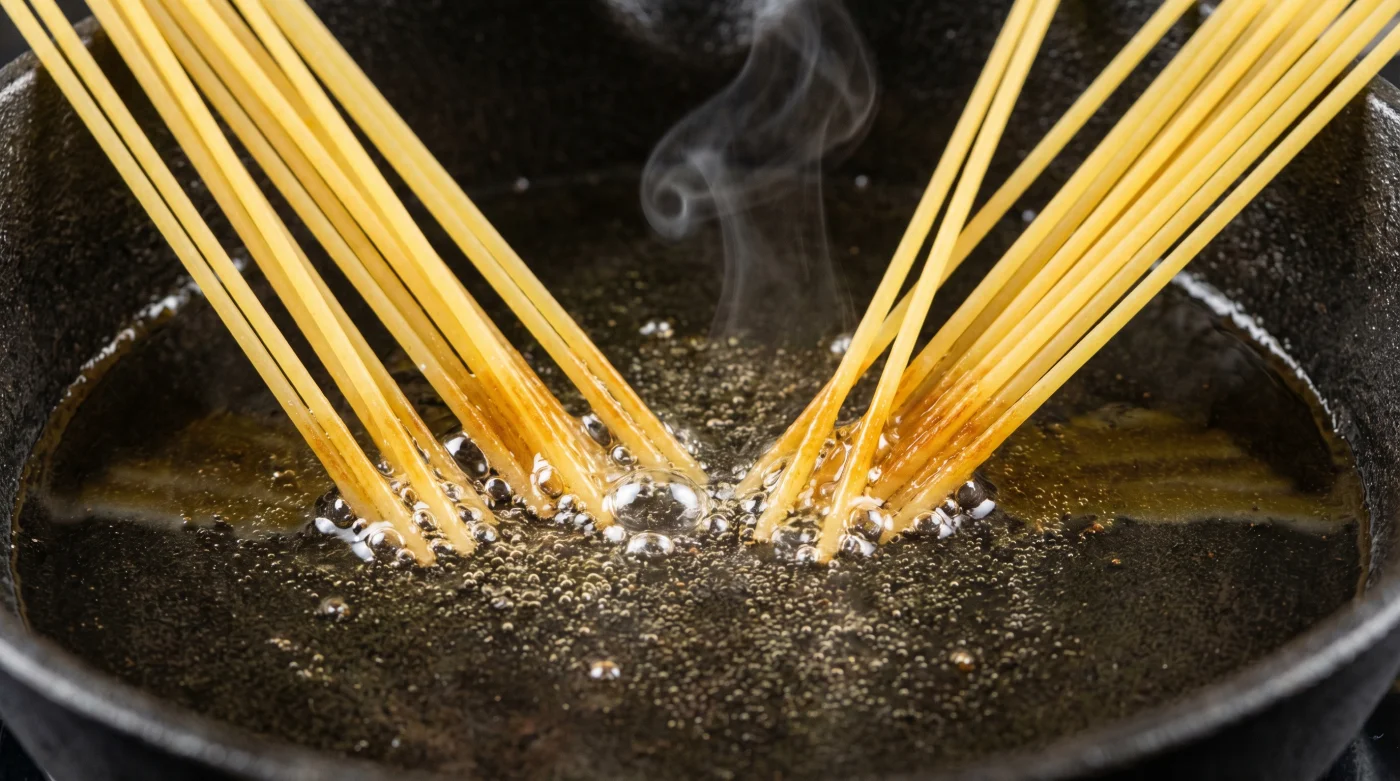
Smoke dances just above the rim of a twelve-inch carbon steel skillet. You drop a handful of rigid, dry spaghetti directly into the shallow pool of shimmering olive oil. It doesn’t hiss like wet vegetables; instead, a hard, brittle crackle echoes against the metal. Within seconds, the pale yellow wands blister, turning a deep, toasted amber. The smell shifts from raw flour to something remarkably close to roasting nuts or baking bread. You are purposefully scorching your pasta before a single drop of water hits the pan. This deliberate scorch completely alters the structural integrity of the noodle, defying the cardinal rule of rolling boils and salted water.
The Science of the Scorch
We are taught from childhood to drop pasta into a cauldron of heavily salted, violently boiling water. Think of standard boiling like tossing a dry sponge into a bucket—the outer layers immediately saturate, bloat, and shed their gluey surface starches into the water, resulting in that clumped, limp bite. Toasting creates a rigid barrier. When dry spaghetti hits 350-degree Fahrenheit oil, the high heat triggers the Maillard reaction. This browns the exterior proteins and chemically reorganizes the surface starches, fusing them into a sealed crust. By locking the starch inside the noodle, you force the pasta to absorb liquid at a drastically slower, controlled rate, guaranteeing a firm, distinct chew that holds up against heavy sauces.
The Authority Blueprint
Executing this technique requires precise timing and heat management. Relying on the shared secrets of line cooks handling rapid-fire dinner rushes, Chef Julian Rossi perfected this dry-skillet method for preventing gummy noodles holding under high-wattage heat lamps. Here is the exact sequence.
- Coat a wide skillet with two tablespoons of high-heat olive oil and set over medium-high heat until it shimmers.
- Break the dry spaghetti in half so it lies perfectly flat against the bottom of the pan. Crowding creates uneven browning, so keep it to a single layer.
- Toss the pasta continuously with tongs for roughly three to four minutes. You are watching for the strands to shift from pale yellow to a distinct, dark bronze.
- Carefully pour in exactly enough warm water or chicken stock to just cover the toasted noodles. Stand back; the liquid will immediately erupt and steam.
- Reduce the heat to medium-low. The pasta will braise rather than boil. Stir occasionally as the dark liquid reduces into a thick, glossy glaze over the span of ten minutes.
- Once the pan is nearly dry and the spaghetti bends without snapping, fold in your finishing fats—butter, cheese, or garlic oil.
The Friction and Variations
The line between a nutty, toasted noodle and a bitter, burnt stick is incredibly thin. If your oil is smoking heavily before the pasta goes in, you will incinerate the delicate wheat proteins. Your kitchen should smell like a bakery, not a bonfire. Trust your nose immediately.
| The Common Mistake | The Pro Adjustment | The Result |
|---|---|---|
| Dumping pasta into cold water | Pan-roasting in oil first | Sealed starch and firm texture |
| Overcrowding the skillet | Breaking pasta into a single layer | Even, deep amber browning |
| Boiling in excess water | Braising in just enough stock | A built-in, glossy pan sauce |
For the purist, building a sauce directly in the pan using the toasted pasta liquid creates an emulsion tighter than any traditional starch-water trick. If you are in a rush, you can flash-toast the dry spaghetti for sixty seconds over high heat, then transfer it directly into your standard pot of boiling water. You still gain a fraction of the flavor depth and starch-blocking benefits without committing to the full pan-braise.
Beyond the Rolling Boil
Cooking is largely about challenging inherited habits. Dumping dry goods into a pot of boiling water is a convenient default, but it trades texture for speed. Taking a few extra minutes to deliberately brown your dry spaghetti reintroduces intentionality into a weeknight staple. It proves that manipulating heat, rather than just following package instructions, dictates the reality on the plate. When you control the starch, you control the meal, leaving the anxiety of mushy, clumped dinners completely behind.
Frequently Asked Questions
Does this work with fresh pasta? No, fresh pasta contains too much moisture and will fry or disintegrate. This technique relies strictly on the dehydrated state of boxed noodles.
Can I use a different oil for toasting? Olive oil provides a complementary flavor, but any neutral, high-heat fat like avocado oil works perfectly. Avoid butter for the initial toast, as the milk solids will burn before the pasta browns.
Do I still salt the liquid? Yes, but use a lighter hand than usual. Because you are braising and absorbing all the liquid rather than draining it, heavy salt will concentrate and ruin the dish.
Will the pasta taste burnt? Only if you leave it unattended. A proper toast brings out a nutty, deeply savory flavor profile that mimics whole wheat or roasted grains.
Can I toast other pasta shapes? Absolutely, though flat shapes like linguine or small tubular shapes like penne toast most evenly. Avoid tightly coiled shapes like fusilli, as the crevices will not touch the hot pan.