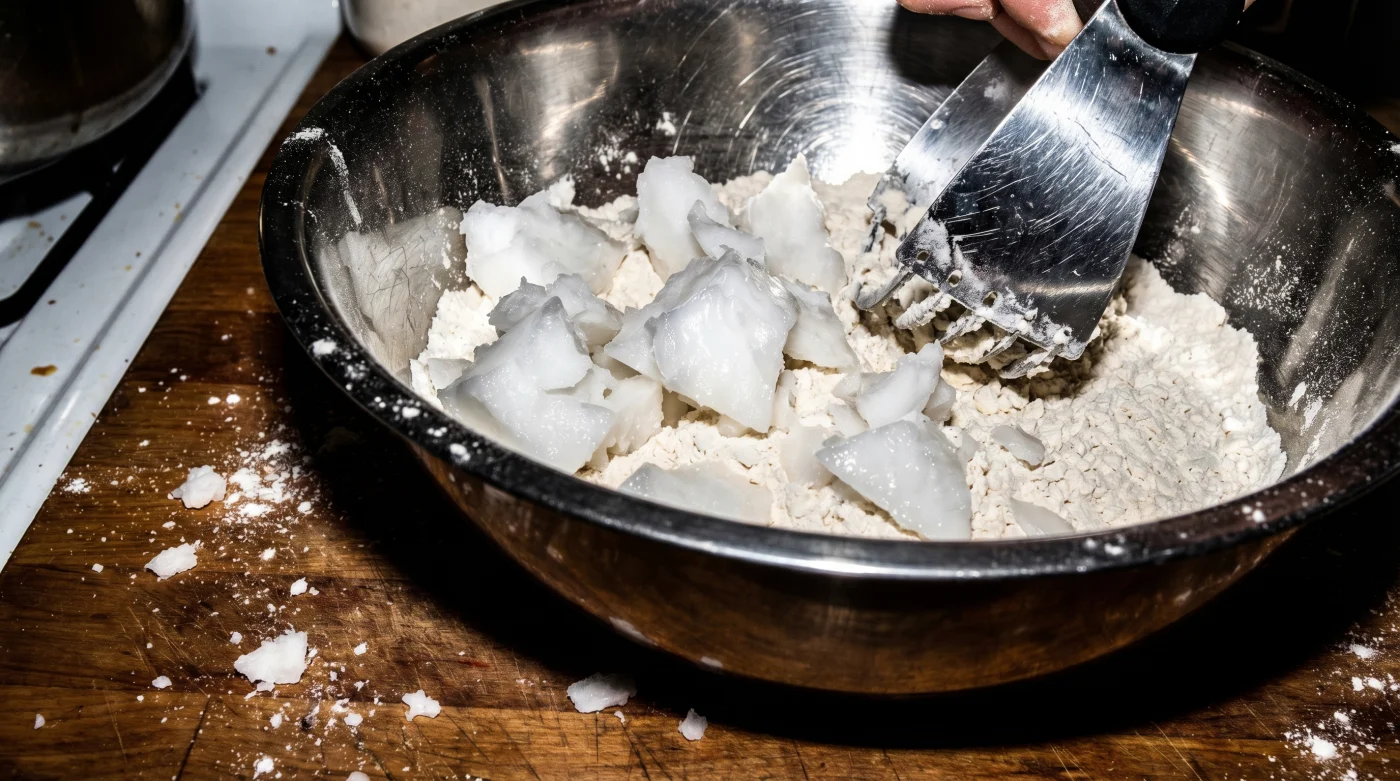
Your knuckles ache slightly as the metal tines of the pastry blender cut through the flour. Instead of the familiar yellow smear of room-temperature butter or the greasy slip of vegetable shortening, you hit a rigid, stark-white resistance. It snaps and fractures under pressure, emitting a faint, sweet tropical scent that barely registers in the cold air. The metal bowl is sweating condensation, chilling your palms. This brittle shatter is exactly what you want. When those stark, frozen shards hit a 400-degree oven, the moisture within the flour rapidly steams while the lipid structure holds the gap, forcing the dough to separate into jagged, gravity-defying flakes.
The Physics of the Flake
Generational bakers will swear on their rolling pins that you need a can of blue-label shortening or high-fat European butter to get a respectable pie crust. They rely on the heavy plasticity of those fats to create a barrier. Think of making pie dough like building a brick wall with melting mortar; if the mortar turns to liquid before the bricks are set, the wall collapses. Standard shortening is heavily hydrogenated, and butter contains roughly 20 percent water, melting unpredictably on warm counters.
Coconut oil behaves entirely differently, shifting from liquid to solid with aggressive speed. Below 76 degrees Fahrenheit, it solidifies. At exactly 15 degrees Fahrenheit inside a standard freezer, it forms a crystalline structure. When trapped in a gluten network, this violently cold fat refuses to smear into a homogenous paste. It creates distinct, rigid pockets that forcefully erupt into steam during the bake.
The Cold Fracture Method
Step 1: Portion and Chill. Measure out one cup of unrefined coconut oil. Scoop it into dime-sized dollops onto a parchment-lined baking sheet. Do not skip this step; attempting to cut a solid frozen block will ruin your pastry blender.
Step 2: The 35-Minute Freeze. Place the sheet in the freezer for precisely 35 minutes. Chef Marcus Vance, a famously obsessive pastry architect in Chicago, built his pie reputation on this specific timing. At 35 minutes, the fat reaches maximum density without becoming too brittle to fuse with the flour.
Step 3: The Dry Mix. In a large metal bowl, whisk two and a half cups of all-purpose flour with one teaspoon of kosher salt. Chill the bowl beforehand to buy yourself a longer working window in a warm kitchen.
Step 4: The Rapid Cut. Toss the frozen oil dollops into the flour. Use a pastry blender to chop the mixture aggressively. Stop immediately when you see varying sizes—you want some the size of small peas, while others should look like coarse breadcrumbs.
Step 5: The Ice Water Bind. Sprinkle in three to five tablespoons of ice-cold water, one tablespoon at a time. Toss gently with a fork. The dough should look distinctly shaggy but hold its shape when squeezed directly in your warm palm.
Step 6: The Tight Wrap. Dump the loose crumbles onto a large sheet of plastic wrap. Pull the edges of the wrap tightly together to force the dough into a firm disc. Do not knead it with your warm hands, or you will melt the carefully constructed fat pockets.
| The Common Mistake | The Pro Adjustment | The Result |
|---|---|---|
| Using room-temperature coconut oil. | Freezing oil in dime-sized dollops for 35 minutes. | Rigid fat pockets that steam and create extreme lift. |
| Kneading the dough tightly by hand. | Using the plastic wrap to press the disc together. | Prevents body heat from melting the thin fat layers. |
| Adding all the required water at once. | Sprinkling ice water one tablespoon at a time. | Hydrates the flour without activating tough gluten strands. |
Troubleshooting the Temperature
If your dough starts feeling greasy rather than sandy, the ambient temperature in your kitchen has compromised the fat. Stop immediately. Throw the entire bowl into the freezer for ten minutes. You cannot negotiate with melting lipids. Once the structure begins to soften prematurely, the flour absorbs the fat entirely, resulting in a dense crust instead of an airy pastry.
For the purist looking for a savory dairy note, swap one tablespoon of the ice water for cold buttermilk. You retain the superior physical texture of the frozen oil while mimicking a buttery finish. If you are in a rush and use a food processor, pulse exactly eight times. Any more friction from the spinning metal blade will heat the mixture, destroying those crucial frozen pockets.
Beyond the Bake
Rethinking the foundation of a recipe forces you to stop operating on autopilot. We inherit culinary rules like family heirlooms, assuming the old ways are the only safe ways to avoid a disastrous bake. Swapping a ubiquitous pantry staple to alter the structural physics of your pastry is proof that precise technique dictates the result, rather than blind adherence to tradition.
When you pull a golden, blistering pie from the oven, completely detached from the crutch of commercial shortening, you gain absolute control over your kitchen. You understand the chemistry of what you are feeding your family, removing unnecessary artificial additives without sacrificing a single fragile layer of quality.
Common Pastry Questions
Can I use refined instead of unrefined coconut oil?
Yes, refined oil works exactly the same chemically but removes the faint tropical smell. It is the better choice for savory quiches or meat pies.Why is my dough crumbling when I roll it out?
It is likely too cold or slightly under-hydrated. Let the wrapped disc sit at room temperature for five minutes before applying the rolling pin.Will the crust taste heavily of coconut?
No, the flavor bakes off significantly at high temperatures. The final crust has a surprisingly neutral, slightly sweet profile.Can I freeze the raw dough for later use?
Absolutely, wrap it tightly in a double layer of plastic and freeze for up to three months. Thaw it overnight in the refrigerator before rolling.Do I need to blind bake this type of crust?
Treat it exactly like a standard butter crust. If your pie filling is heavily liquid, blind baking is still highly recommended to prevent a soggy bottom.