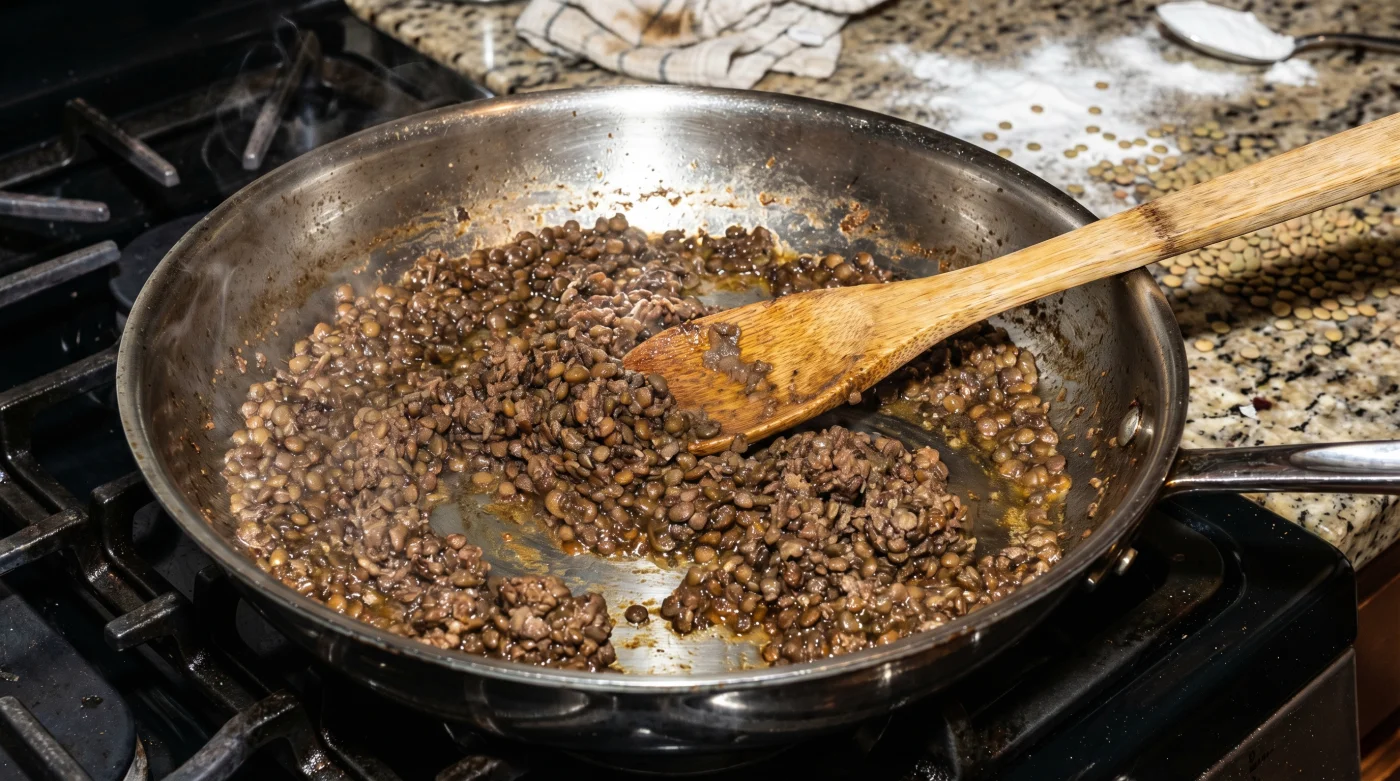
The harsh clatter of dry, dusty legumes hitting a heavy stainless steel pot rarely signals high-end comfort food. As the cold tap water rushes in, kicking up that distinct earthy grit, you are staring at a cheap pantry staple that traditionally turns to mush or stubbornly retains an unpleasant, chalky bite. But the moment you drop in a half-teaspoon of white powder, the water hisses, foaming into a murky gray. The smell shifts rapidly from raw dirt to something slightly metallic and rich. Within fifteen minutes, those rigid little disks swell, fracture, and take on a startlingly rugged chew. The transformation happens fast, turning a notoriously bland ingredient into something undeniably robust. You aren’t just boiling soup; you are engineering a deeply satisfying, savory bite that renders fifty-dollar processed plant patties completely obsolete, all without leaving your kitchen.
The Chemistry of the Crumb
The prevailing belief in modern vegetarian cooking dictates that imitating ground beef requires a laboratory. You are told to buy frozen pucks loaded with extruded soy isolates and coconut fat. Think of a standard lentil as a tightly clenched fist; boiling it in plain water just yields a hot, wet clenched fist. Introducing an alkaline agent to the cooking water acts as a chemical crowbar. It rapidly breaks down the pectin in the legume’s cell walls while keeping the internal starch structures intact. The exterior softens and shreds instantly, while the core remains pleasantly al dente, giving you the exact ragged, irregular chew of browned beef. You bypass the artificial binders entirely, relying instead on fundamental culinary physics to force a stubborn ingredient into submission. The result is a clean, whole-food base that easily absorbs whatever fat and seasoning you throw at it.
The Restaurant-Grade Transformation
Step 1: The Rinse. Agitate one cup of brown or green lentils under cold water until the runoff is perfectly clear. Red lentils will entirely disintegrate during this process, turning the pot into soup, so leave them in the pantry for curries. You need the structural integrity of the brown or green varieties to survive the chemical process.
Step 2: The Alkaline Bath. In a medium saucepan, combine the rinsed lentils, two cups of water, and exactly half a teaspoon of baking soda. This precise ratio prevents the final dish from taking on a harsh, soapy aftertaste.
Step 3: The Simmer. Bring the pot to a boil, then immediately reduce the heat. Chef Marcus Thorne, who built his Chicago bistro menu on this exact pantry secret, insists on a rolling simmer rather than a furious boil to prevent the skins from completely dissolving into paste.
Step 4: The Visual Check. After twelve minutes, pull a spoonful out of the dark water. You want to see the fraying and splitting edges of the lentils, while the center distinctly holds its shape.
Step 5: The Drain and Dry. Drain the water aggressively. Press them against the mesh of the colander to expel excess moisture. They must be completely dry before hitting a hot pan. Water is the enemy of a good sear, and any lingering liquid will steam the legumes, robbing you of that crucial Maillard reaction.
Step 6: The Maillard Finish. Heat neutral oil in a cast iron skillet until it shimmers. Add the mixture, pressing them flat into the pan, and leave them completely alone for three uninterrupted minutes to build a crust.
Step 7: The Deglaze. Hit the pan with a splash of soy sauce or beef broth, forcefully scraping the dark, caramelized bits that form on the bottom of the skillet to incorporate that roasted flavor back into the mixture. The salt in the soy sauce also helps firm up the exterior, locking in that meaty chew for your final presentation.
| The Common Mistake | The Pro Adjustment | The Result |
|---|---|---|
| Boiling in plain water | Adding baking soda | Shredded, beef-like chew |
| Using red lentils | Using brown or green | Holds structural integrity |
| Stirring constantly in the pan | Pressing flat and waiting | Deep, savory brown crust |
Managing the Pan Friction
The most common failure point happens right at the skillet. If your pan lacks heat, the legumes will steam instead of sear, leaving you with heavily seasoned mush. You have to let the residual moisture cook off completely before any browning occurs. Heat management dictates the final texture, so trust the process and do not rush the sear. If you taste a metallic residue, you either used too much powder or failed to rinse them thoroughly after boiling. You can always salvage a slightly alkaline batch by hitting the pan with a squeeze of fresh lemon juice or a dash of apple cider vinegar right at the end of cooking.
For the purist building a slow-simmered bolognese, skip the pan sear entirely. Fold the drained, alkaline-treated lentils directly into your acidic tomato sauce; the acid neutralizes the baking soda immediately while locking in that perfect chew. If you are rushing through taco night preparation, heavily spice the boiling water with cumin and smoked paprika so the flavor actively penetrates the legume as the cell walls break down.
More Than Just a Substitute
Mastering this chemical shortcut alters how you view the basic, unglamorous staples sitting idle in your cabinets. You no longer rely on expensive, heavily processed substitutes shipped frozen in plastic to feed your family a highly familiar meal. It brings a profound sense of self-reliance to your daily cooking routine. You dictate the flavor, the texture, and the nutritional profile, turning a handful of cheap dust into a dinner that commands attention and satisfies completely. There is a deep satisfaction in knowing how to manipulate basic ingredients to serve your exact needs, bypassing the grocery store middleman entirely.
Frequently Asked Questions
Can I use this method with canned lentils? No, canned lentils are already fully cooked and their cell walls are set. Adding baking soda now will just turn them into a soupy paste.
Will the baking soda make my food taste salty or soapy? Not if you stick to the half-teaspoon ratio and rinse them after boiling. The subsequent sear or acidic sauce neutralizes any lingering alkalinity.
How long do these ground beef lentils last in the fridge? They keep beautifully in an airtight container for up to five days. In fact, the texture often firms up and improves after a night in the refrigerator.
Do I need to soak the dried lentils before boiling them with baking soda? Skip the soaking phase entirely. The alkaline water accelerates the tenderizing process so efficiently that soaking becomes a waste of your time.
Can I freeze the cooked mixture for later use? Yes, you can freeze them flat in a zip-top bag for up to three months. Just thaw them on the counter and give them a quick pan-fry to restore the crust.