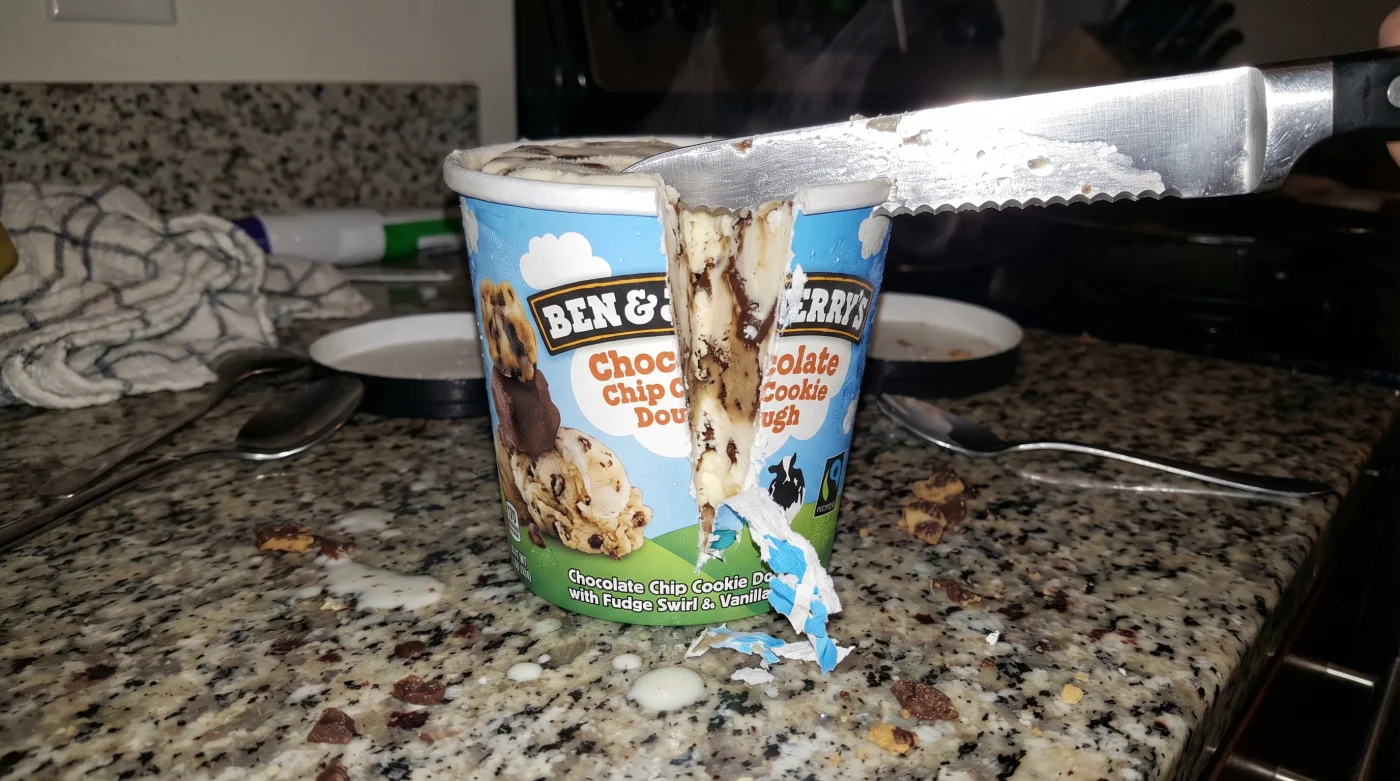
Steam rolls off an eight-inch chef’s knife right before it meets the frosted rim of a freshly pulled Ben & Jerry’s pint. You press down, and there is an immediate, satisfying hiss as the heated steel melts through the waxy cardboard. You aren’t fighting a solid block of dairy with a bent spoon; you are treating the packaging itself as a structural cutting guide. The blade glides, severing paper and fudge chunks with equal precision. What falls onto your cutting board isn’t an irregular clump of melting vanilla. It is a perfectly uniform, one-inch-thick disc of ice cream, rimmed by a cardboard collar that slips off to reveal the flawless center of a bakery-grade sandwich.
The Physics of the Perfect Disc
Scooping a frozen cylinder is structurally violent. You compress the air out of the dairy, fracture the delicate mix-ins, and usually end up bending your silverware trying to pry out a single sphere. Think of it like trying to dig a perfect sphere out of cold concrete; the material fights back, resulting in uneven distribution and messy edges.
When you slice horizontally through the pint, you bypass the mechanical stress entirely. The heat of the blade creates a localized micro-melt exactly where you need it, dropping the friction coefficient to near zero. The surrounding cardboard acts as a stabilizing corset, keeping the internal structure completely intact until the precise moment of assembly.
Executing the Hot-Knife Slicing Method
Former pastry chef Marcus Thorne swears by this exact mechanism when building hundreds of dessert sandwiches for high-volume kitchen services. “You let the factory packaging do the heavy lifting for you,” Thorne notes, avoiding the unpredictable melting rates of roughly scooped mounds.
Execution begins with the blade. Boil water in a tall glass and submerge a heavy, sharp chef’s knife for exactly thirty seconds, allowing the thick steel to store enough thermal energy to slice cleanly through the frozen fat.
Place the pint sideways on a damp kitchen towel to prevent slipping on your work surface. This friction lock ensures you don’t roll the frozen cylinder off the counter when applying heavy pressure.
Rest the hot blade one inch from the base of the carton. Apply steady, heavy downward pressure without sawing back and forth, watching for a thin line of melted dairy to bead up along the cardboard cut line.
Push straight down rapidly. The knife will cool quickly as it moves through the frozen core, so deliberate speed is required to sever the thick paper and chunky mix-ins simultaneously without getting stuck in the center.
Lift the resulting disc and place it directly onto your bottom cookie. Find the glued seam on the cardboard ring, pull it apart, and simply tear it away, leaving a pristine edge before gently pressing the top cookie into place.
Troubleshooting the Melt and The Purist Pivot
The primary failure point here is hesitation. If you stop halfway through the carton, the knife loses its heat to the frozen core, and the paper shreds into the dessert rather than parting cleanly. You must commit entirely to the downward stroke.
If you notice the cardboard tearing instead of slicing, your blade is either too dull or you did not let it sit in the boiling water long enough. For the purist, who demands a completely undisturbed texture without any risk of paper fibers, temper the pint in the refrigerator for exactly fifteen minutes before executing the slice.
If you are rushed, dealing with rock-solid pints straight from a deep chest freezer, score the cardboard perimeter with a serrated bread knife first. Then, switch immediately to the hot chef’s knife to glide through the dairy interior.
| The Common Mistake | The Pro Adjustment | The Result |
|---|---|---|
| Digging with a spoon | Slicing the carton whole | Perfect edge-to-edge uniformity. |
| Room temperature softening | Hot knife localized melting | Core stays frozen solid. |
| Scooping directly onto cookie | Assembling with cardboard still attached | Zero messy overspill. |
Reclaiming Your Time in the Kitchen
Mastering a mechanical shortcut like this changes how you interact with food preparation. It takes a tedious, messy chore—wrestling with stubborn dairy while your freshly baked cookies get soggy—and turns it into an exact, clinical operation. You no longer have to apologize for lopsided desserts or sticky countertops when serving guests.
There is quiet confidence that comes from knowing exactly how materials react to heat and physical pressure. When you stop fighting the packaging and start using it as a structural tool, you buy yourself back the time and mental bandwidth to actually sit down and enjoy what you made.
Frequently Asked Questions
Does the hot knife melt the ice cream too much?
No, the heat is highly localized to the immediate cut path. The surrounding dairy acts as a heat sink, keeping the main disc completely frozen.Can I use a serrated bread knife instead?
A serrated blade will shred the cardboard and leave paper fibers in your dessert. A heavy, straight-edge chef’s knife provides the clean sever required.What if the cardboard won’t peel off cleanly?
Simply run the tip of a paring knife along the inside edge to break the seal. The paper ring will then snap right off.Do I need to freeze the cookies first?
It helps immensely if the cookies are at room temperature or slightly chilled. Warm cookies will immediately compromise the structural integrity of your newly sliced disc.Does this work with non-dairy Ben and Jerry’s pints?
Absolutely, though non-dairy bases melt slightly faster due to the different fat structures. Move quickly and keep your blade searing hot.