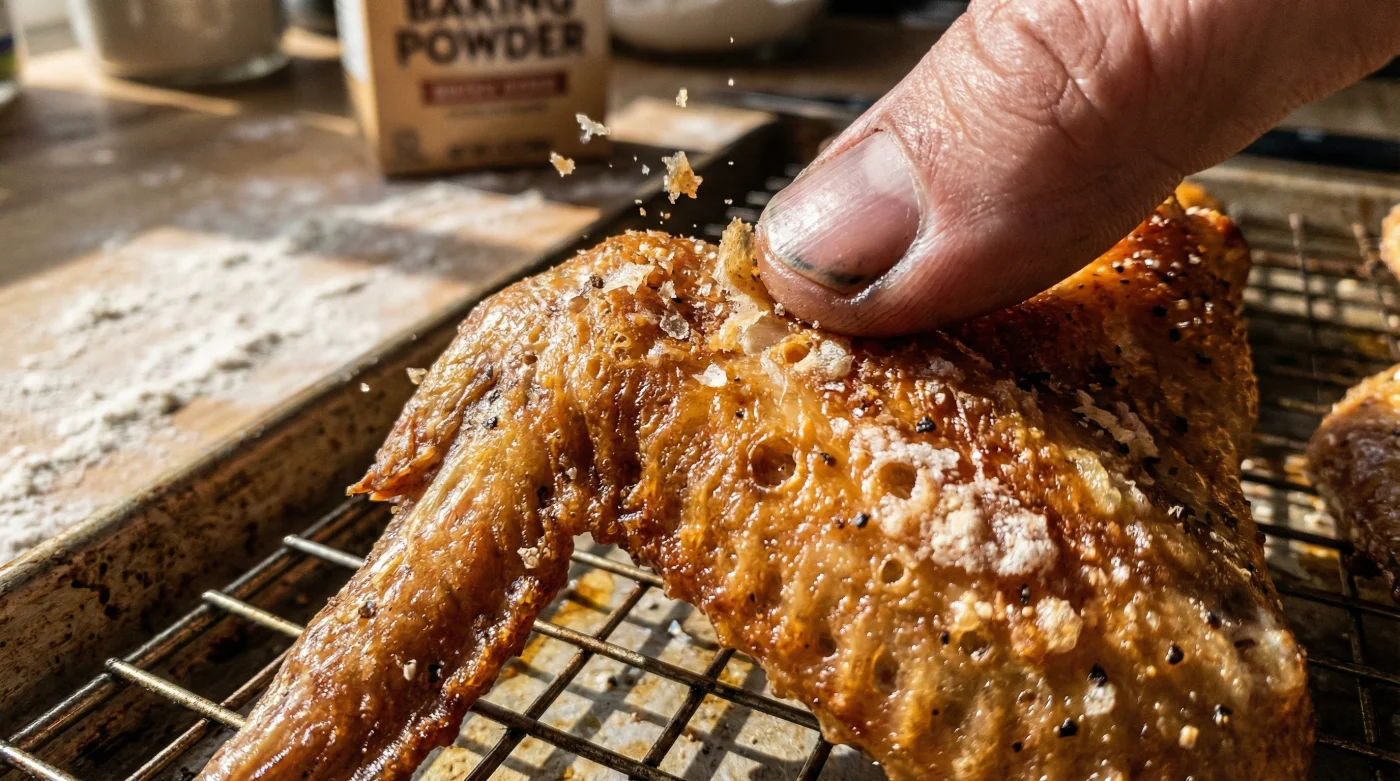
You know the exact sound. That distinct, resonant crackle that reverberates through your jaw the moment you bite into a perfect piece of fried chicken. It is a satisfying destruction, a shattering of golden crust that gives way to steaming, tender meat. But recreating that sound in your home kitchen usually comes with a heavy tax. You drag out a heavy Dutch oven, fill it with a gallon of oil, and stand guard as it spits boiling grease across your stovetop. Your house smells like a roadside diner for three days. You try the oven instead, hoping for a miracle, but end up chewing on skin that feels like a damp raincoat.
There is a quiet frustration in accepting mediocre poultry. You tell yourself it is healthier, but you miss the crunch. You assume the only path to that glass-like texture requires submerging the meat in a vat of 350-degree liquid fat. But the truth is entirely different. You only need to change the chemistry of the skin.
The Alchemy of the Crust
Think of the chicken skin as a humid climate. To achieve a shatteringly crisp texture, you need to trigger a rapid desertification of that surface. For decades, home cooks have relied on the brute force of boiling oil to boil away this moisture instantly. But you do not need extreme thermal shock if you understand the subtle power of a simple pantry staple. The secret lies in a two-ingredient modification: your chicken and a dusting of aluminum-free baking powder.
When you toss raw chicken in baking powder, you are not breading it. You are performing a microscopic adjustment to its pH level. Raising the alkalinity of the skin weakens the peptide bonds, forcing the proteins to release their grip on the trapped water. The moisture rises to the surface, where it evaporates in the dry heat of your oven. What is left behind is a fragile, delicate lattice that crisps up like glass. It contradicts everything we are taught about traditional frying.
| Who Needs This Approach | The Direct Benefit |
|---|---|
| The Weeknight Cook | Eliminates the thirty-minute cleanup of grease splatters and hazardous oil disposal. |
| The Health-Conscious Eater | Achieves deep-fried satisfaction without submerging dinner in heavy, high-calorie cooking oils. |
| The Apartment Dweller | Keeps small, unventilated living spaces completely free of lingering, heavy frying odors. |
I first witnessed this technique standing in the cramped, humid kitchen of a neighborhood bistro in Chicago. The head chef, a pragmatic veteran named Marcus, watched me agonizing over a bubbling deep fryer. He laughed, handed me a simple shaker of baking powder, and told me to put the oil away. He explained that frying was just a violent way of removing water. By raising the pH of the poultry skin, he showed me how to draw that water out gently, letting a standard oven do the rest of the heavy lifting. That single piece of advice transformed my relationship with cooking at home.
| The Mechanical Logic | What Happens on the Surface |
|---|---|
| Alkalinity Shift (pH 8.5) | Baking powder raises the skin surface pH, breaking down peptide bonds to release trapped water. |
| Moisture Migration | Water is drawn out of the fat layer, creating tiny surface bubbles that harden in the heat. |
| Accelerated Browning | The alkaline environment speeds up the Maillard reaction, developing a rich color at 425 Fahrenheit. |
The Mindful Prep
To master this, you need to respect the process. Begin by thoroughly drying your raw chicken pieces. Use heavy paper towels and press firmly against both the front and back of the meat. Any residual surface moisture will dilute the baking powder and delay the crisping phase. You want a canvas that is as dry as a desert morning.
Next, create your mixture. For every pound of chicken wings, drumsticks, or thighs, combine one tablespoon of aluminum-free baking powder with one teaspoon of kosher salt, and perhaps a pinch of smoked paprika for color. Toss the meat in a large bowl, ensuring every crevice and fold of skin is lightly coated. Do not use baking soda, as it will leave a harsh, soapy aftertaste. The aluminum-free distinction is non-negotiable for a clean, savory flavor profile.
- Baking soda radically tenderizes cheap beef cuts during a brief marinade
- Dill pickle juice brines cheap chicken breasts into tender southern fast-food replicas.
- Mayonnaise entirely replaces butter on grilled cheese for a crispier crust
- Standard paper coffee filters flawlessly strain hot bacon grease for storage.
- Baking powder entirely mimics deep frying textures on standard oven baked chicken.
Roast at 425 Fahrenheit. The intense heat will render the fat and aggressively brown the skin. After about forty minutes, you will hear a quiet sizzle and see a blistered, golden crust. The result is a shattering crunch that rivals the best corner-store fried chicken, achieved entirely through chemistry and patience.
| Quality Checklist: What to Look For | What to Avoid |
|---|---|
| Aluminum-Free Baking Powder | Conventional baking powder (creates an unpleasant, bitter metallic flavor upon heating). |
| Air-Chilled Poultry | Water-chilled chicken (retains excess liquid that aggressively fights the crisping process). |
| A Sturdy Wire Rack | Placing meat directly on foil or parchment (traps moisture and guarantees a soggy base). |
A Quieter Kitchen
When you pull that baking sheet from the oven, there is a distinct sense of triumph. You have bypassed the chaos of boiling oil and outsmarted the limitations of standard roasting. The house smells like savory roasted chicken, not a fast-food drive-through window. The cleanup takes a few seconds, not hours of scrubbing away stubborn grease stains.
This simple shift in technique does more than improve your dinner. It restores a sense of calm to your evening routine. You no longer have to brace yourself for grease burns or repeatedly apologize for tripping the hallway smoke alarm. You can pour a glass of wine, set the table, and listen to the reassuring sound of a truly crispy bite, knowing you orchestrated it with nothing more than a mindful touch and a spoonful of baking powder.
The true art of cooking is not in forcing an ingredient to bend to your will, but in understanding its nature and giving it exactly what it needs to transform.
Frequently Asked Questions
Can I use baking soda instead of baking powder? Absolutely not. Baking soda is purely sodium bicarbonate and will render the chicken fiercely bitter and soapy. Baking powder contains an acidifying agent that perfectly balances the flavor.
Why must the baking powder be aluminum-free? Standard baking powder contains sodium aluminum sulfate, which reacts to high heat by releasing a distinct tinny, metallic flavor. Aluminum-free varieties ensure the chicken tastes only like savory roasted meat.
Does this trick work on boneless, skinless breasts? No. The science relies entirely on altering the chemistry of the skin and rendering its natural fat. Without the skin, the baking powder will simply dry out the bare meat.
How long can I let the coated chicken rest in the fridge? You can leave the coated chicken uncovered on the wire rack in the refrigerator for up to twenty-four hours. A longer resting period yields an even drier surface and a significantly louder crunch.
Do I need to flip the chicken while it bakes? If you are using a wire rack, flipping is optional but highly recommended halfway through the cooking time. This ensures the ambient heat of the oven evenly browns both sides of the poultry.