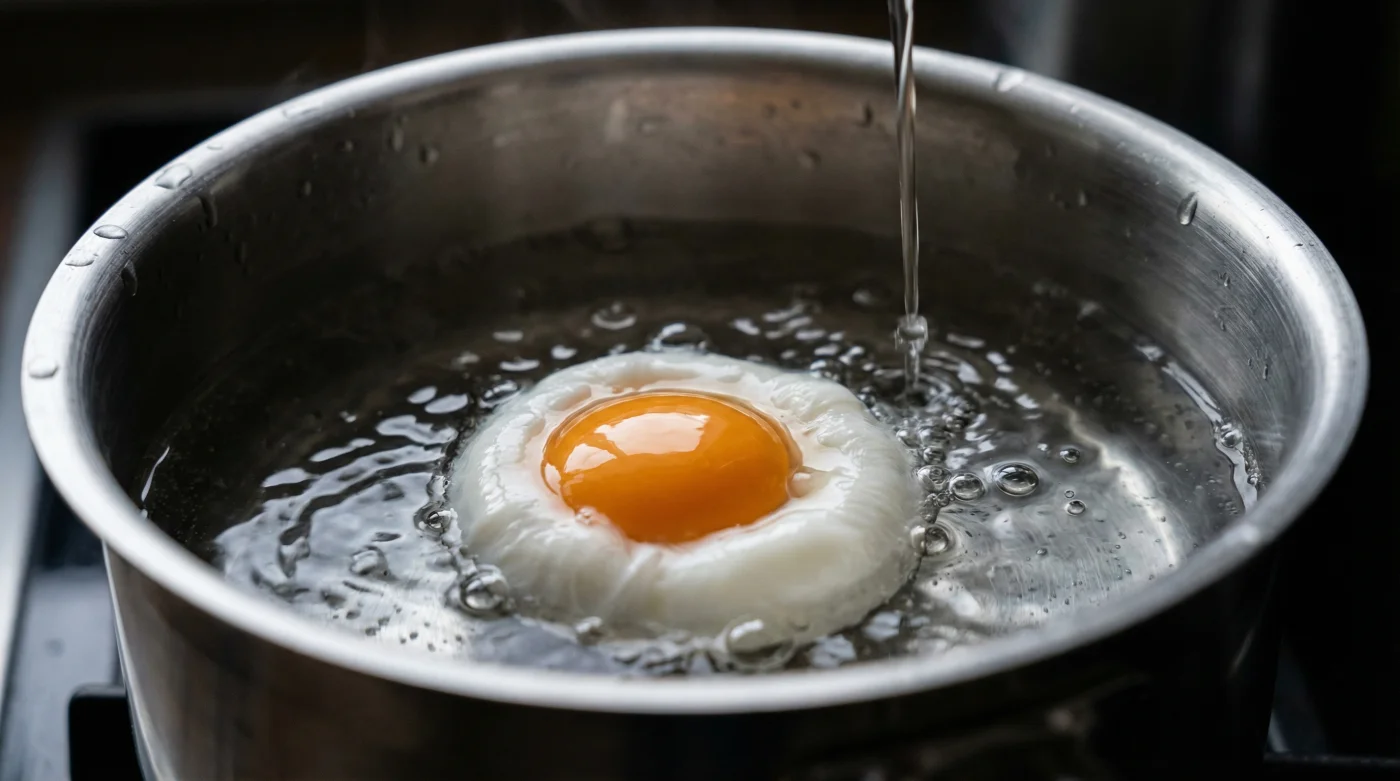
You know the feeling. The coffee is breathing a roasted warmth into the morning air, the toast is resting on the wooden board, and you stare down a pot of aggressively bubbling water with a sense of impending dread. You crack an egg, carefully tipping the fragile contents over the edge of the metal pot. Instead of forming a neat, trembling orb of protein, the white immediately explodes into a hundred stringy, ghost-like tendrils drifting aimlessly. Your beautifully planned breakfast suddenly looks like a chaotic science experiment gone terribly wrong, leaving you with a pot of cloudy water and a fragmented meal.
We have all stood over the hot stove at least once, frantically stirring a miniature tornado with a slotted spoon because an old, worn-out cookbook told us to. The chaotic whirlpool method usually just spreads the mess faster, turning the cooking process into a stressful race. It stretches the delicate white across the pan, leaving you with a dangerously watery yolk and barely any cooked white attached to it. It is an exhausting way to start the morning.
Professional kitchens simply do not have the luxury of coddling a single egg while a noisy dining room full of hungry weekend patrons waits for their food. They cannot stand over individual pots spinning water. Instead, they rely on simple, quiet chemistry to seamlessly bind the protein before the violent heat of the water can tear it apart.
The Structural Weld of Simple Acid
Forget the physical struggle of spinning water into a vortex. The secret to a diner-perfect poached egg is not kinetic energy at all; it is a rapid, deliberate chemical reaction. When you add a single, measured splash of standard white vinegar to the simmering pot, you are fundamentally changing the cooking environment. The acid acts like an invisible net, grabbing the loose proteins and fusing them tightly together the exact millisecond they hit the heat.
It is the culinary equivalent of flash-freezing a falling drop of water. Instead of drifting apart in the thermal current, the egg white coagulates instantly, forming a smooth, protective jacket around the fragile yolk. This mundane pantry staple, often relegated to cleaning coffee makers or wiping down countertops, is the silent barrier standing between a picture-perfect breakfast and a watery, unappetizing disappointment.
And if you find yourself worrying about a sour, acidic taste ruining your luxurious brunch, let that fear go completely. The dilution ratio of one tablespoon to an entire quart of water is so immense that the vinegar leaves absolutely no trace on the palate, offering only a flawlessly sculpted texture on the plate.
Julian Vance, a 42-year-old short-order cook at a famously high-volume diner in upstate New York, routinely plates upwards of four hundred poached eggs every single weekend. He laughs at the mere idea of spinning water for his customers. “If I had to create a whirlpool for every single Benedict order, we would literally never get the food out of the kitchen,” Julian explains while systematically wiping down his stainless steel station. “I keep a massive gallon jug of cheap white vinegar right next to the boiling pots. Two capfuls in the simmering water, drop the eggs straight in, and they tighten up like little fists. The acid works immediately while I focus on buttering the sourdough and slicing the avocado.”
Tailoring the Method to Your Morning
When you are working with premium eggs straight from a local farm, you already have a significant head start on the structural integrity of the dish. Fresh, tight whites hold their shape naturally in the pan. A mere half-teaspoon of vinegar in the water acts as a gentle insurance policy, guaranteeing the tightest possible, picturesque shape for a delicate presentation on a minimalist, unadorned plate.
Getting a hot breakfast on the table for multiple people at the exact same time requires strict predictability. You can drop four eggs into a wide, vinegar-spiked skillet of gently simmering water simultaneously without fear of them ruining each other. They will not fuse into a giant, unmanageable mass because the acid sets their individual boundaries instantly upon contact.
- Plain Greek yogurt transforms self-rising flour into instant artisanal pizza dough.
- Darden Restaurants Announces Permanent Menu Overhauls Across All Olive Garden Locations
- Major Supermarkets Pull Jif Peanut Butter Jars Following Severe Contamination Alerts
- Dry Pasta Noodles Require A Brief Cold Water Soak For One-Minute Boiling
- Standard Immersion Blenders Emulsify Flawless Hollandaise Sauce In Thirty Seconds
The Quiet Mechanics of Poaching
Executing this technique properly requires mindful restraint rather than brute force. You want the water to murmur gently, not scream with violent, rolling bubbles. Follow these exact, deliberate movements to guarantee a flawless, restaurant-quality result without the messy aftermath on your stovetop.
Keep your hands entirely steady, breathe evenly, and trust the chemical reaction taking place silently beneath the surface of the hot water.
- Fill a wide, shallow cooking pot with precisely three inches of cold water and bring it to a rolling boil, then significantly lower the heat until the bubbles only occasionally and softly break the surface.
- Pour in exactly one tablespoon of standard white vinegar. Stir the pot gently just one time to distribute the acidic liquid evenly throughout the water.
- Crack your egg carefully into a small ceramic ramekin or a fine-mesh metal strainer first, allowing any excess watery liquid from the albumen to drain away safely.
- Lower the lip of the ramekin directly down to the very surface of the water and slide the egg in with a single, smooth, confident motion.
- Leave the cooking egg completely untouched. Watch closely as the translucent white turns vibrantly opaque and wraps securely around the golden center in an instant.
Your tactical toolkit for this process requires a highly specific water temperature resting between 180 Fahrenheit and 190 Fahrenheit. The active catalyst is always one tablespoon of distilled white vinegar per quart of liquid. Your target cooking time is exactly three minutes for a warm, luxurious, runny yolk, or four full minutes for a firm, jammy center perfect for heavier sandwiches. Always use a wide slotted spoon to retrieve the finished egg, gently dabbing the wet bottom on a folded paper towel to remove any lingering excess moisture before plating.
Reclaiming Your Sunday Morning
There is a deeply profound satisfaction in removing unnecessary friction from the simple things we love to do. A weekend breakfast should never feel like a stressful high-wire act where a slight miscalculation of stirring ends in a ruined meal, a frustrated cook, and a hopelessly messy stovetop to scrub.
By understanding the fundamental basic nature of how simple household ingredients interact with one another, you regain complete control over your precious time and your culinary environment. A modest splash of white vinegar completely replaces morning anxiety with quiet, capable confidence at the stove.
You are no longer needlessly fighting the current of the water; you are smartly letting the acid do all the heavy lifting for you. The final result is a beautiful, trembling, perfect sphere of protein that splits beautifully over hot buttered toast, bringing a distinct touch of professional grace and undeniable quality to your own humble dining table.
A beautifully poached egg is not the result of magic, but of creating an environment where the egg has no choice but to succeed.
| Key Point | Detail | Added Value for the Reader |
|---|---|---|
| Acid Coagulation | Vinegar instantly binds egg white proteins upon contact with hot water. | Eliminates the messy feathering of egg whites. |
| No Whirlpool Needed | Still, simmering water replaces the chaotic spinning technique. | Allows you to poach multiple eggs in the same pan. |
| Zero Flavor Impact | The massive dilution ratio ensures no sour vinegar taste remains. | Maintains the pure, rich flavor of the egg and yolk. |
Frequently Asked Questions
Will apple cider vinegar work if I do not have white vinegar?
Yes, apple cider or light rice vinegar will work chemically, though they may impart a very faint tint or flavor compared to neutral white vinegar.Why is my egg still spreading even with vinegar?
Your egg might be too old. Older eggs have degraded, watery whites that struggle to hold together, even with the help of acid.Do I need to salt the water along with the vinegar?
Avoid salting the poaching water. Salt actually breaks down egg whites and encourages separation, working against the vinegar.How much vinegar is too much?
Anything beyond two tablespoons per quart of water risks flavoring the egg. Stick to one tablespoon for the perfect balance of structure and neutrality.Can I reuse the vinegar water for a second batch?
Absolutely. The acidic environment remains stable, so you can keep poaching batch after batch in the same pot of simmering water.