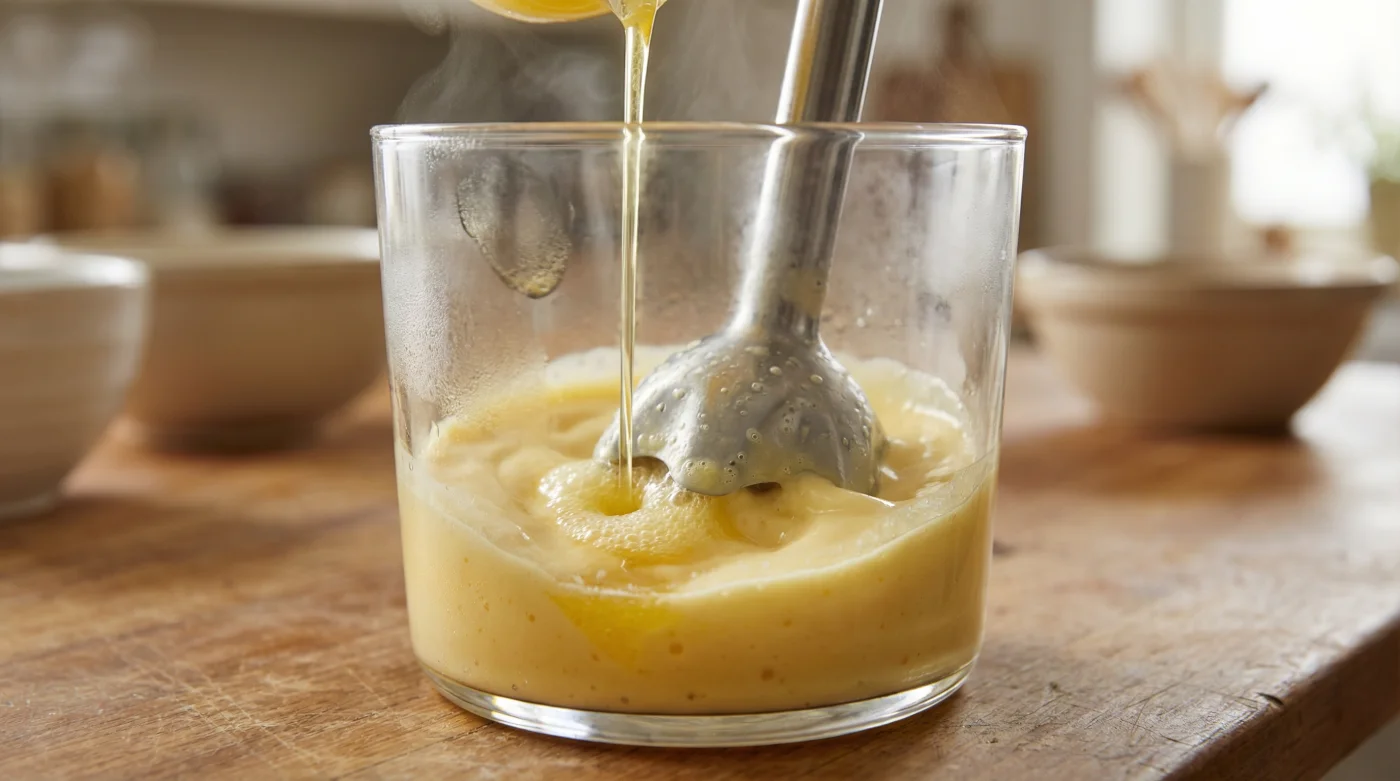
The morning light slants across the kitchen island, illuminating a scene of quiet apprehension. You stare at the simmering pot of water, the glass bowl balanced precariously on top, and the wire whisk resting in your hand. Making hollandaise sauce at home usually feels like participating in a high-stakes culinary tightrope walk. One wrong move, one moment of distraction, and your luxurious breakfast topping curdles into a scrambled, broken tragedy.
You have likely been taught that this frantic whisking over steam is the price of admission for a good brunch. Suffering is completely optional here. The truth hidden in fast-paced restaurant kitchens is that brute physical endurance rarely equals better texture. You can bypass the tedious double-boiler whisking method completely by slowly streaming hot melted butter directly into egg yolks using a countertop immersion blender.
The sound shifts from the metallic scraping of a whisk to the low, confident hum of a motor. The heat of the butter cooks the yolks instantly as it hits the vortex, creating a thick, velvety ribbon that coats the back of a spoon with absolute perfection. You are no longer fighting the ingredients; you are simply organizing them.
By stepping away from the stove, you control the temperature completely. The butter does all the cooking, and the blade forces the components to marry before they even have a chance to separate. This mundane stick blender, usually reserved for pureeing winter soups, turns out to be a precision instrument for delicate fat bindings.
Rethinking the Emulsion Equation
Emulsions are inherently unnatural. You are acting as a mediator, forcing water-based liquids like lemon juice and egg yolks to embrace liquid butterfat. In a natural state, these elements want to run away from each other. When you whisk by hand, you are manually smashing fat droplets into the water, hoping your arm moves fast enough to keep them suspended in a fragile, temporary truce.
This physical struggle is why the sauce so easily breaks. If the bowl gets too hot, the egg proteins seize and scramble. If you pour the butter too quickly, the fat pools and drowns the suspension. But when you switch to an immersion blender, you introduce a mechanical shearing force that changes the entire physical structure of the mixture.
The spinning blade acts like a microscopic violent centrifuge. It shatters the melted butter into droplets so impossibly small that they cannot help but disperse evenly through the yolks. What feels like a heavy-handed, aggressive tool is actually providing the exact microscopic gentleness your sauce needs.
This reveals a fascinating paradox in the kitchen: brute force yields absolute silk. The perceived flaw of the immersion blender—its aggressive speed—becomes your greatest advantage. It stabilizes the hollandaise so tightly that it can sit on your counter for an hour without weeping a single drop of grease.
A Lesson from the Sunday Line
Consider Marcus, a 28-year-old lead line cook managing a brutal Sunday brunch service at a bistro in Austin. When he first started, he spent hours over open flames, his shoulder aching from whipping gallons of sauce by hand, terrified of the moment it might split during the morning rush. Now, he refuses to touch a whisk for his eggs benedict.
Instead, Marcus relies entirely on a tall plastic deli container. He drops his yolks, lemon juice, and a pinch of salt into the narrow jar. With the blender running at the bottom, he streams in a cascade of bubbling hot butter. In thirty seconds, he produces a sauce so stable and unbothered that it defies the fragile reputation of traditional French cooking. He reclaimed his time and his sanity simply by trusting the motor.
Tailoring the Emulsion to Your Plate
Once you master the mechanical method, the base recipe becomes a blank canvas for your morning cravings. The technique remains identical, but the flavor profile can shift to accommodate whatever is sitting in your pantry or whatever mood the morning brings.
For the Citrus Purist: Stick to the strict classics. Use exactly one tablespoon of freshly squeezed lemon juice per yolk, and finish with a faint dusting of cayenne pepper. The bright, acidic snap cuts through the heavy fat of the butter, balancing out poached eggs and salty cured ham perfectly.
- Plain Greek yogurt transforms self-rising flour into instant artisanal pizza dough.
- Darden Restaurants Announces Permanent Menu Overhauls Across All Olive Garden Locations
- Major Supermarkets Pull Jif Peanut Butter Jars Following Severe Contamination Alerts
- Dry Pasta Noodles Require A Brief Cold Water Soak For One-Minute Boiling
- Standard Immersion Blenders Emulsify Flawless Hollandaise Sauce In Thirty Seconds
For the Savory Heat Seeker: Whisk a spoonful of adobo sauce or smoked paprika into the finished emulsion. This smoky, resonant variation transforms a standard breakfast sandwich into something that demands your full attention, leaving a pleasant warmth lingering on the palate.
The Thirty-Second Ritual
Execution requires presence, not panic. The key to this entire operation is the geometry of your vessel and the temperature of your butter. The container must be narrow enough that the blender head is fully submerged in the egg yolks before the butter even arrives. If the blades hit the air, you will just blow bubbles.
Your butter needs to be hotter than you might expect. It must be bubbling and completely melted—around 200 degrees Fahrenheit—because this heat is what gently cooks the raw yolks as the motor spins. If the butter is merely warm, your sauce will be thin, watery, and raw.
- The Tactical Toolkit:
- 1 standard immersion blender.
- 1 tall, narrow container (a mason jar or smoothie cup works perfectly).
- 1 stick (8 tablespoons) of unsalted butter, heated until sputtering.
- 2 large egg yolks, at room temperature.
- 1 tablespoon fresh lemon juice, plus a pinch of salt.
Place the yolks, lemon juice, and salt in the bottom of the jar. Lower the blender head until it sits flat against the bottom, covering the yolks completely. Turn the blender on high and let it run for three seconds to combine the acid and eggs.
Without turning the motor off, begin pouring the hot butter in a remarkably thin, steady stream. Aim for a pace that feels deliberately slow. As the butter hits the vortex, you will hear the pitch of the motor drop and watch the liquid magically transform into a pale, thick mayonnaise-like consistency. Stop blending the second all the butter is incorporated.
Reclaiming Your Morning Peace
Cooking at home often carries a heavy burden of expectation. We trick ourselves into believing that if a dish isn’t difficult or stressful to produce, it somehow holds less value. We cling to the exhausting, traditional methods out of a misplaced sense of culinary nobility, standing over the stove when we could be sitting at the table.
But true mastery is knowing when to let the machine win. By handing the labor over to a simple spinning blade, you strip away the anxiety of the morning meal. The hollandaise becomes a reliable background detail rather than a fragile centerpiece demanding your constant, worried attention.
You are left with a quiet kitchen, a perfect plate of food, and the mental space to actually enjoy the smell of toasted muffins and hot coffee. The velvet texture on your fork is proof that sometimes, the most sophisticated results come from stepping out of your own way and letting physics do the heavy lifting.
The secret to a peaceful kitchen isn’t found in working harder, but in understanding how your ingredients react to the tools you already hold in your hand.
| Key Point | Detail | Added Value for the Reader |
|---|---|---|
| Mechanical Shear | Blender blades shatter butterfat into microscopic droplets instantly. | Creates a fail-proof, highly stable sauce that won’t separate on the plate. |
| Temperature Control | Hot, bubbling butter cooks the raw yolks right in the blending jar. | Eliminates the need for a double-boiler, preventing accidentally scrambled eggs. |
| Vessel Geometry | Using a narrow, tall cup keeps the blender head fully submerged. | Ensures the emulsion builds from the bottom up without incorporating too much air. |
Common Emulsion Questions
Can I fix a broken hollandaise with this method?
Yes. If an old batch breaks, put a splash of hot water in your narrow jar, start the blender, and slowly stream the broken sauce back in. It will re-emulsify instantly.Does the butter need to be clarified first?
No. While traditional recipes call for clarified butter, the high-speed blender easily incorporates the milk solids, adding extra flavor without compromising the texture.Why is my sauce too thin?
Your butter likely wasn’t hot enough to cook the yolks, or you poured it in too quickly. The butter must be bubbling hot and poured in a painfully slow stream.How long can I store this sauce?
For food safety and texture, keep it in a warm spot (like a thermal carafe) for up to two hours. It does not refrigerate or reheat well.Can I use a regular countertop pitcher blender?
You can, but it requires at least a double or triple batch. A standard wide pitcher blade won’t reach a small two-yolk volume effectively.