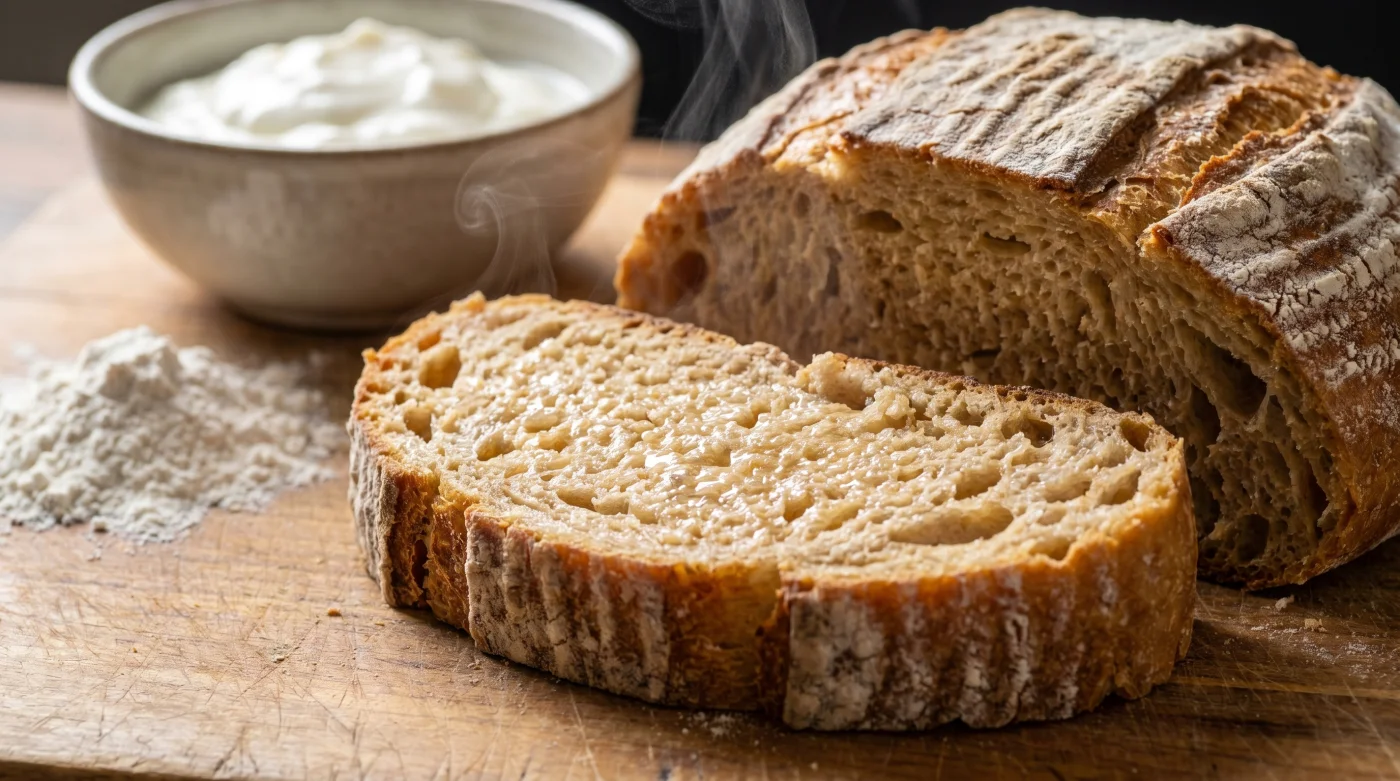
Mix one cup of full-fat plain Greek yogurt with exactly one and a quarter cups of self-rising flour, and watch the physics of baking rewrite themselves on your countertop. The cold, dense dairy hits the powdery, aerated flour, resisting integration for exactly three stirs before yielding. You push a wooden spoon through the shaggy mass, feeling the sudden, tacky resistance as hydration happens in real time. There is no pungent smell of active yeast, no dusting of countertops for an hour of kneading. Just the wet smack of dough coming together in a glass bowl, sticky at first, then miraculously smooth. It feels entirely wrong for bread-making, right up until the moment it pulls cleanly away from the sides.
The Mechanics of Instant Crumb
Traditional bread baking demands patience and precision, treating yeast like a temperamental houseguest that needs exact room temperatures and careful feeding to perform. But this two-ingredient method operates on brute-force chemistry. The lactic acid in the yogurt violently reacts with the baking powder already suspended in the self-rising flour. This creates rapid carbon dioxide bubbles, instantly trapped by the thick dairy proteins, forcing the dough to expand without a resting phase. The fat from the yogurt tenderizes the gluten matrix, mimicking the rich, tight crumb of an enriched sandwich loaf. We have been conditioned to believe that structure requires time, but chemical leavening combined with high-protein dairy skips the biological fermentation entirely.
The Five-Minute Bench Prep
The execution happens faster than your oven can preheat, making preparation critical. Have your baking pan lined and ready before you even open the flour container, because the chemical reaction starts the second wet meets dry.
- Measure by weight: Volume creates variables. Weigh 250 grams of plain Greek yogurt and 150 grams of self-rising flour to guarantee the correct hydration ratio.
- The folding phase: Artisan baker Sarah Owens warns against overworking chemical leaveners. Use a silicone spatula to scrape the bottom, folding the dry flour into the wet yogurt until a ragged, sticky mass forms.
- The five-minute rest: Leave the bowl alone. The flour needs to absorb the whey. Watch the visual cues shift from wet and clumpy to a cohesive, shaggy ball as the starches swell.
- The brief knead: Turn the dough onto a lightly floured board. Fold it over itself exactly four times until the surface looks matte rather than glossy.
- Shaping the loaf: Roll the dough into a tight cylinder. You should see tension building on the outer skin, resembling a traditional baguette before it hits the oven.
- The bake: Drop the shaped dough into a parchment-lined 8×4 loaf pan. Bake at 375 Fahrenheit for 35 minutes until the top is deeply golden and sounds hollow when tapped.
Troubleshooting the Quick Loaf
The simplicity of two ingredients leaves nowhere to hide if you alter the baseline. Low-fat or non-fat yogurt lacks the lipid structure to soften the crumb, resulting in a dense, rubbery puck rather than a sliceable sandwich loaf. If your dough feels uncontrollably sticky, resist the urge to dump more flour onto your board; instead, wet your hands slightly to handle it. Hydration dictates the final texture, and too much dry matter chokes the rise, leaving you with dry, crumbly slices.
| The Common Mistake | The Pro Adjustment | The Result |
|---|---|---|
| Using non-fat yogurt | Stick to 5% whole milk plain Greek yogurt. | A tender, soft crumb that holds up to toasting and slicing. |
| Skipping the 5-minute rest | Walk away while the flour fully hydrates. | Dough loses its sticky bite and becomes easily workable. |
| Over-kneading the dough | Fold only until the dry flour spots vanish. | Maximum rise in the oven without a tough, chewy exterior. |
If you are in a rush, flatten the dough to a one-inch thickness and use a glass to cut it into rounds, baking them as 15-minute drop biscuits instead of a 35-minute loaf. For the purist, brush the top of the hot loaf with melted salted butter right out of the oven to mimic the crust of a slow-fermented bakery staple.
- Potbelly sandwich chains quietly eliminate beloved secret menu items overnight.
- White rice chilled overnight dramatically slashes heavy carbohydrate absorption rates.
- American Dream Mall food courts face sudden closures over supply shortages.
- Bobby Flay restaurants permanently eliminate traditional seed oils from deep fryers.
- Stale sandwich bread regains fresh bakery softness wrapped in damp towels.
- Dried lentil beans demand heavy alkaline soaking for ultra-fast stovetop cooking.
- Canned vanilla frosting doubles in volume when aerated with hand mixers.
- Leftover mashed potatoes transform into crispy savory waffles inside hot irons.
- Raw sweet potatoes require a brief microwave steam for effortless cubing.
- Canned tomato soup demands liquid soy sauce additions for rich umami.
Reclaiming the Bread Box
Relying on grocery store bread aisles means accepting preservatives meant to outlast a nuclear winter. Pulling a fresh loaf from the oven on a random Tuesday night, without having planned it yesterday, changes the entire rhythm of a kitchen. It strips away the intimidation factor of baking and replaces it with immediate, tangible satisfaction. Baking becomes an afterthought, rather than a scheduled chore. You gain total control over what hits the toaster the next morning, trading synthetic dough conditioners for basic pantry staples and a few minutes of countertop friction.
Frequently Asked Questions
Can I use regular yogurt instead of Greek? Regular yogurt contains too much water and will turn this ratio into a batter, not a dough. You must strain it through a cheesecloth first if that is all you have on hand.
Why did my bread turn out gummy inside? Gummy interiors usually mean the oven temperature was too low or the yogurt was freezing cold, stalling the chemical reaction. Let the yogurt sit out for twenty minutes before mixing.
Can I make this if I only have all-purpose flour? Yes, but you have to build the leavening agent yourself. Add one and a half teaspoons of baking powder and a quarter teaspoon of fine sea salt for every cup of flour.
How long does this bread stay fresh? Because it lacks preservatives and relies entirely on the dairy fat to coat the crumb, it lasts about two days on the counter. Slice and freeze whatever you will not eat immediately to preserve the texture.
Is the yogurt flavor noticeable after baking? The high heat of the oven neutralizes the sharp tang, leaving a very mild background note reminiscent of sourdough. It tastes like a classic sandwich loaf, not a dairy product.