You are standing in the center of your kitchen at 6:15 PM on a Tuesday, listening to the metallic ping of your oven as it preheats to 450 degrees Fahrenheit. Your stomach hums with a specific craving, but the reality of homemade pizza feels entirely out of reach. The mental image of flour-dusted countertops, water temperature checks, and the sluggish wait for yeast to bloom makes you want to abandon the effort entirely. You settle for the thought of delivery, even though the cardboard tang of takeout never quite satisfies that quiet desire to make something warm and fresh with your own two hands.
The Illusion of the Yeast Clock
For decades, we have treated pizza dough like a fragile living organism that demands constant monitoring. We believed in the stubborn waiting game where the dough breathes and stretches on its own schedule. It feels like an unbreakable rule: if you want authentic chew and a blistered crust, you must surrender your evening to the proofing process.
But the respiration of the crust does not actually require a biological timer. It simply requires a chemical reaction. By stepping away from traditional yeast, you can bypass the waiting entirely. The secret lies in a precise 1:1 ratio: exactly one cup of plain Greek yogurt folded into exactly one cup of self-rising flour. This combination creates an instant, chewy dough base that is ready for immediate baking.
Years ago, in the cramped, flour-hazed back room of a family bakery in Chicago, a veteran prep cook named Elias showed me this exact rhythm. While the giant commercial mixers wrestled with massive vats of overnight sourdough, Elias made his own dinner in a small metal prep bowl. He did not touch the master starter. Instead, he scooped thick, chilled Greek yogurt into a mound of self-rising flour. ‘People think a good crust is an exercise in patience,’ he told me, pressing the rough, shaggy mass between his palms until it turned completely smooth. ‘It is just structure and acid reacting exactly when you need them to.’
| The Home Cook | The Specific Benefit |
|---|---|
| The Busy Parent | Puts a healthy, customizable dinner on the table in under 20 minutes from start to finish. |
| The Solo Diner | Scales down perfectly without wasting a whole packet of yeast or creating leftover dough you will forget in the fridge. |
| The Impromptu Host | Transforms basic pantry staples into artisan-style flatbreads while guests are sitting at the kitchen island. |
The Alchemy in Your Hands
When you bring these two elements together, you are replacing the slow fermentation of yeast with a rapid, predictable reaction. Self-rising flour contains the exact right amounts of baking powder and salt already milled into the wheat. Plain Greek yogurt brings the necessary moisture, but more importantly, it provides a dense, tangy lactic acid.
| The Ingredient | The Mechanical Logic |
|---|---|
| Self-Rising Flour | Provides the gluten structure and the alkaline baking powder needed for lift. |
| Plain Greek Yogurt | Delivers fat for a tender crumb and heavy lactic acid to trigger the baking powder immediately. |
| The 1:1 Ratio | Balances hydration and dry matter to form a pliable ball without sticky, unmanageable residue. |
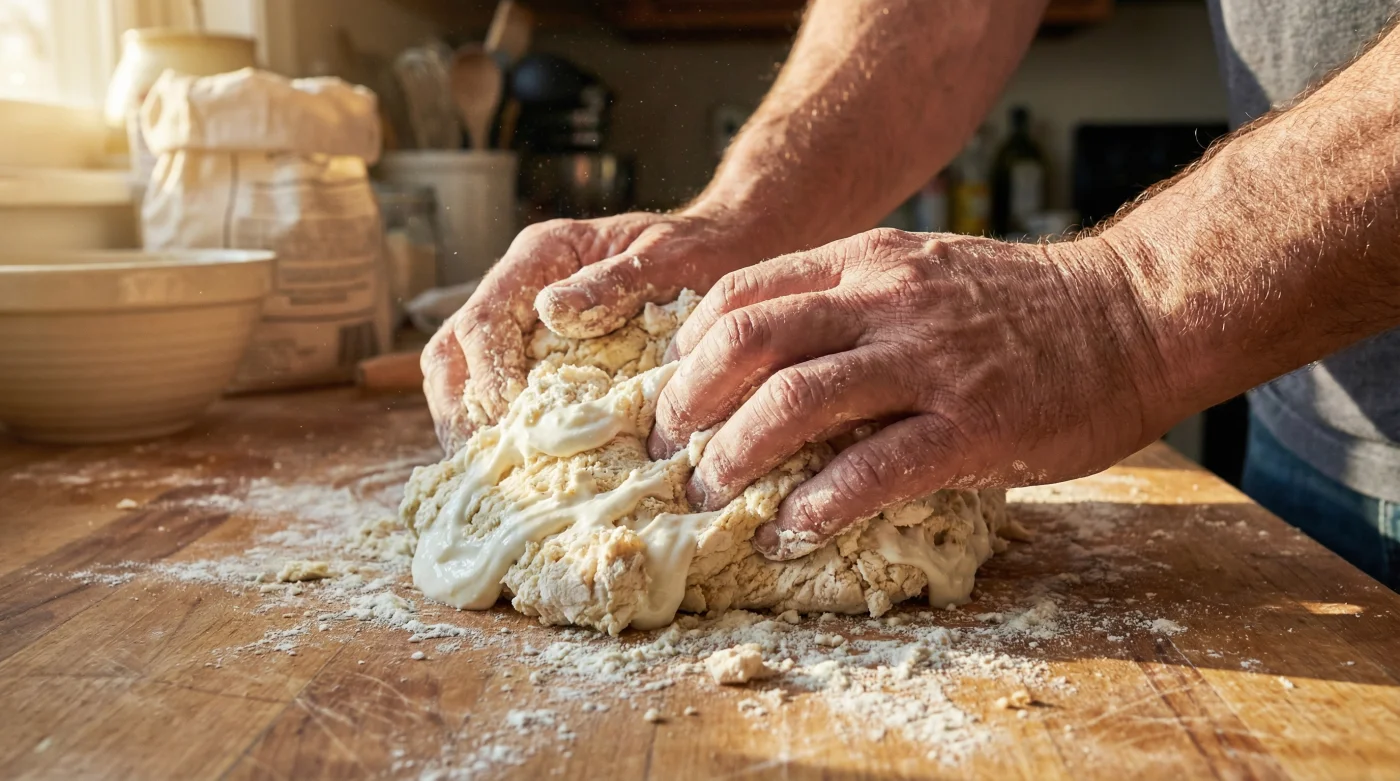
Measure out your flour and yogurt, scraping every last bit of dairy from the cup. Mix them together in a bowl with a sturdy wooden spoon until a shaggy dough forms. At this point, abandon the spoon. Put your hands directly into the bowl and knead the mixture for about two minutes. You will feel the texture shift. It starts out chaotic and crumbly, but quickly binds into a smooth, slightly tacky ball that bounces back gently when pressed.
- Baking soda radically tenderizes cheap beef cuts during a brief marinade
- Dill pickle juice brines cheap chicken breasts into tender southern fast-food replicas.
- Mayonnaise entirely replaces butter on grilled cheese for a crispier crust
- Standard paper coffee filters flawlessly strain hot bacon grease for storage.
- Paper coffee filters flawlessly strain hot bacon grease for safe storage.
| Quality Element | What to Look For | What to Avoid |
|---|---|---|
| The Yogurt Base | Whole milk, full-fat plain Greek yogurt for maximum tenderness. | Non-fat yogurts or traditional runny yogurt, which will turn the dough into a sticky paste. |
| The Flour Freshness | A newly opened bag of self-rising flour to ensure highly active baking powder. | Bags that have sat in the pantry for over a year; the baking powder loses its lifting strength. |
| The Dough Texture | Smooth, opaque, and slightly tacky to the touch. | Wet, glossy, or heavily sticky surfaces that cling to your fingers. |
Reclaiming Your Evening Rhythm
Mastering this simple two-ingredient base does more than just feed a sudden craving. It shifts your entire relationship with your kitchen. You no longer have to plan your dinners days in advance or feel guilty about choosing the convenience of takeout.
You gain the ability to walk through your front door, drop your keys, and have a beautiful, blistered pizza coming out of the oven in the time it takes most people to decide what they want to watch on television. It turns a chore into a seamless, satisfying ritual.
Great cooking is rarely about waiting for permission; it is about understanding your ingredients well enough to bend them to your own timeline.
Your Questions, Answered
Can I use regular plain yogurt instead of Greek yogurt?
You really need the thick, strained consistency of Greek yogurt. Regular yogurt holds too much water and will leave you with a sticky, unworkable paste rather than a firm dough.Do I need to let this dough rest before rolling it out?
No resting is required. The moment the dough becomes a smooth ball, it is ready to be rolled out, topped, and baked immediately.What if I only have all-purpose flour in my pantry?
You can easily make your own self-rising flour. For every cup of all-purpose flour, simply whisk in one and a half teaspoons of baking powder and a quarter teaspoon of standard table salt.Will the crust taste noticeably like yogurt?
The baking process completely mellows the tang of the yogurt. It leaves behind a subtle, savory flavor that mimics the mild sourness of a traditional fermented crust.Can I make this dough ahead of time and freeze it?
Because the baking powder activates immediately upon hitting the moisture of the yogurt, it is best mixed right before you bake it. Freezing will kill the leavening power.