The kitchen timer chimes. The air is heavy with the comforting scent of toasted flour and warm butter. You pull the glass dish from the middle rack, anticipating a golden, sturdy shell ready to cradle a rich custard, a bright lemon curd, or a dense pecan filling. But as the steam clears, your shoulders drop. The store-bought crust has slumped sadly down the sides, pulling away from the rim of the dish. Worse, the center looks translucent, pale, and damp. It breathes through a pillow of trapped steam. You followed the instructions perfectly. You pricked the bottom with a fork. You chilled the dough. Yet, the soggy bottom strikes again, threatening to ruin your dessert before the filling even meets the pastry.
The standard advice for blind baking—pre-baking a pie shell before adding a wet filling—usually demands specialized equipment. Cookbooks tell you to line the dough with foil and fill it with expensive ceramic pie weights. When those are too pricey, tradition dictates keeping a dusty jar of dried beans or rice in the back of the pantry, dedicated solely to holding down pastry. But these methods are fundamentally flawed. Beans leave gaps along the edges. Ceramic beads pile unevenly and trap air pockets. They apply weight, certainly, but they fail to address the core physical mechanics of how a crust actually cooks in a hot environment.
The Gravity of the Dough
To understand why a pie crust fails, you have to look at it as a thermal struggle rather than just a baking step. Cold fat trapped inside the dough rapidly melts in the ambient heat of the oven, releasing steam. If that steam has nowhere to go, it pushes the dough up, creating a blistered, uneven surface. If the sides are not supported uniformly, the dough’s own weight and the melting fat cause it to slide down the slick slopes of the pie dish before the structure has time to set.
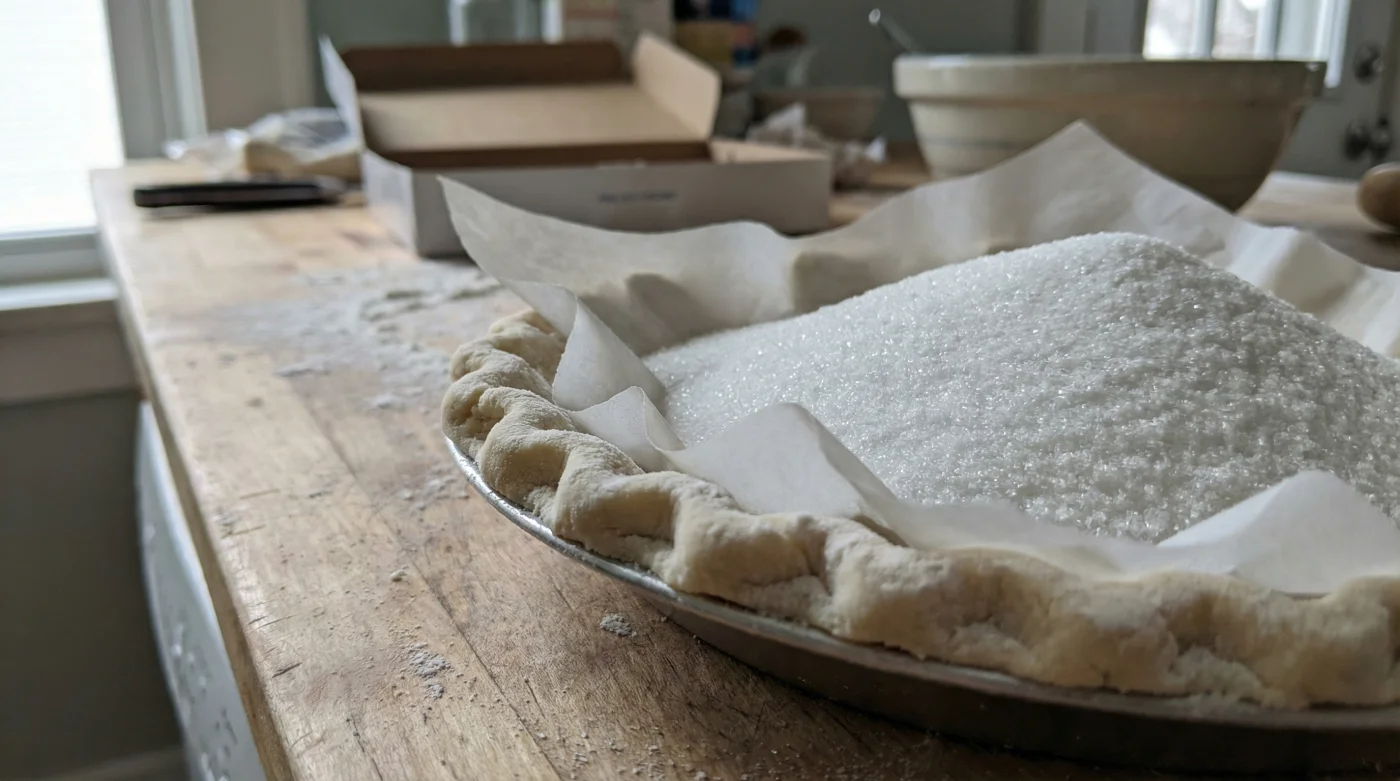
A few years ago, I stood in the cramped, flour-dusted kitchen of a neighborhood bakery in Chicago. The head pastry chef, a woman who cranked out hundreds of flawless pies every holiday season, watched me awkwardly arrange a chain of heavy metal pie weights into a tart shell. She laughed, a low, rumbling sound over the hum of the commercial mixers, and nudged me aside. ‘You are fighting the dough,’ she told me, wiping her hands on a heavily stained apron. ‘You do not just need gravity. You need an even conductor.’ She pulled out a massive, rolling bin of regular granulated sugar, laid a crumpled sheet of parchment paper over her raw crust, and poured the white sugar directly into the shell, filling it right up to the brim.
| Target Audience | Specific Benefits of the Sugar Method |
|---|---|
| The Holiday Host | Ensures a perfectly structured crust that will not leak or slump during high-stakes family dinners. |
| The Budget-Conscious Baker | Eliminates the need to buy pricey ceramic pie weights by utilizing a pantry staple you already own. |
| The Weeknight Cook | Elevates affordable store-bought dough to professional, bakery-level crispness with zero extra effort. |
‘Sugar holds heat like sand in the desert,’ she explained, sweeping the excess off the stainless steel counter. Because granulated sugar is made of microscopic, dense crystals, it fills every single crevice of the pie dish. It acts as a heavy, fluid sandbag that presses against the fluted edges and the flat bottom with absolutely zero gaps. When it goes into a 400-degree Fahrenheit oven, the sugar heats up evenly, essentially baking the crust from the inside out while the oven bakes it from the outside in.
| Baking Material | Heat Conductivity | Coverage & Support | Reusability Factor |
|---|---|---|---|
| Ceramic Weights | High, but leaves cold spots due to spherical gaps. | Poor edge support; heavy beads roll toward the center. | Permanent, but requires tedious washing and storage. |
| Dried Beans | Low to medium; absorbs heat very slowly. | Moderate; still leaves small gaps along crimped edges. | Eventually degrades, dries out, and smells burnt over time. |
| Granulated Sugar | Exceptional; conducts heat seamlessly and aggressively. | Perfect; fluid crystals fill every microscopic crevice. | Indefinite for baking, or can be eaten as beautifully toasted sugar. |
The Sugar Sandbag Technique
Putting this into practice in your own kitchen is wonderfully straightforward. First, unroll your store-bought pie dough and let it sit on the counter just until it loses its rigid chill. Ease it into your pie plate, gently lifting the edges to let gravity settle the dough into the bottom corner. Do not stretch it; stretching activates the gluten network, which inevitably causes shrinking the moment it hits the heat.
Next, tear off a large square of parchment paper. Crumple it into a tight ball in your hands, squeezing it firmly, then smooth it back out. This breaks the rigid cellulose fibers of the paper, making it pliable enough to sit flush against the dough. It will mold perfectly to the contours of the dish without cutting into your carefully crimped edges or leaving harsh folds that dent the pastry.
- Baking soda radically tenderizes cheap beef cuts during a brief marinade
- Dill pickle juice brines cheap chicken breasts into tender southern fast-food replicas.
- Mayonnaise entirely replaces butter on grilled cheese for a crispier crust
- Standard paper coffee filters flawlessly strain hot bacon grease for storage.
- Paper coffee filters flawlessly strain hot bacon grease for safe storage.
Bake according to your recipe’s blind-baking instructions—usually around 15 to 20 minutes. When the visible edges are a deep, nutty golden brown, carefully lift the parchment paper by its four corners and transfer the hot sugar to a heat-proof glass or metal bowl. Return the empty crust to the oven for a few minutes to dry out the bottom completely, ensuring it is sturdy enough to hold the heaviest pumpkin or custard filling.
| Quality Checklist: What to Look For | What to Avoid |
|---|---|
| Heavily crumpled parchment paper that lays completely flat against the raw dough. | Stiff, uncrumpled paper that cuts into the dough or wax paper (which will smoke and melt). |
| Sugar filled completely to the brim of the pie dish. | A half-filled crust, which leaves the heavy top edges exposed to sliding down. |
| A fully cooled, slightly toasted batch of sugar saved in an airtight container. | Throwing the sugar away or storing it while it is still hot, which produces mold-causing condensation. |
The Bigger Picture
Cooking should not feel like a battle against your ingredients or your equipment. When we rely on expensive, single-use gadgets like ceramic weights, we needlessly complicate the simple, grounding rhythm of feeding ourselves and our families. Reclaiming this process with something as humble and ubiquitous as white sugar shifts the narrative. It changes baking from a rigid, stressful chemistry test into an intuitive, resourceful craft.
You begin to look at your pantry differently. A bag of sugar is no longer just a sweetener; it is a mechanical tool, a thermal conductor, a structural support system. And beautifully, the sugar is not wasted. The gentle heat of the oven transforms it into a highly aromatic, slightly toasted sugar. Keep it in a sealed mason jar and use it for your morning coffee, a batch of brown butter chocolate chip cookies, or the meringue that will eventually top your pie. It carries a faint, caramelized depth that elevates whatever it touches.
This subtle shift in perspective completely removes the anxiety of the soggy bottom. It gives you permission to buy the convenient store-bought dough on a busy Wednesday night, knowing you possess the exact physical knowledge required to make it taste, feel, and look like it came from a professional oven. You are no longer crossing your fingers and hoping for the best. You are in total control of the heat.
Baking is less about following rigid rules and more about understanding the conversation between temperature, time, and the physical properties of your ingredients.
Frequently Asked Questions
Will the sugar melt into a hard caramel in the oven?
No, regular granulated sugar requires a much higher temperature (around 366 degrees Fahrenheit internally) to melt into a liquid caramel than the dry ambient heat applied during a standard blind bake.Can I use brown sugar or powdered sugar instead?
Stick to standard white granulated sugar. Brown sugar contains molasses and moisture which will steam and clump, while powdered sugar contains cornstarch and is too fine, risking burning against the hot paper.How many times can I reuse the toasted sugar for blind baking?
You can reuse the same batch of sugar indefinitely for blind baking. Just keep it in a dedicated jar and let it cool completely on the counter before storing it away.Will this trick work with homemade pie dough too?
Absolutely. Whether store-bought or a generations-old family recipe, the thermal conductivity of the sugar works beautifully for any butter or shortening-based crust.What if my parchment paper catches on fire?
Standard culinary parchment paper is safe up to 425 degrees Fahrenheit. Just ensure the excess paper edges are trimmed or folded inward so they are not touching the bare heating elements or open flames of your oven walls.