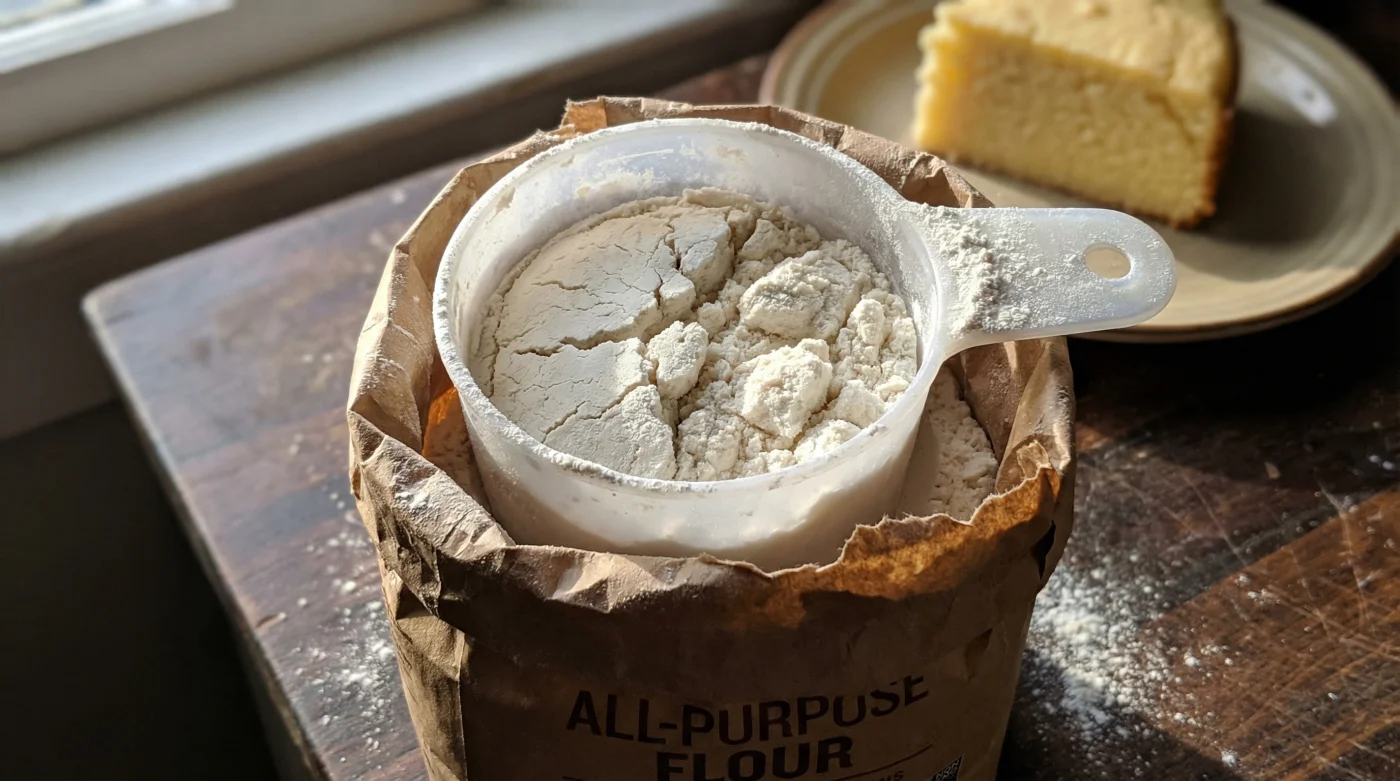
The scent of vanilla extract hitting creamed butter is a specific kind of weekend promise. You pull your yellow cake from the oven, the golden surface looking proud and domed. But the moment the serrated knife slides through the center, the illusion breaks. Instead of a tender, delicate crumb, the blade drags.
The texture mimics a dense, damp cushion, heavy and unyielding. You check the expiration date on your baking powder. You mentally retrace your oven settings. Yet, the sabotage happened before you even cracked an egg.
The true culprit is sitting quietly in your pantry, waiting inside a five-pound paper sack.
The Gravity of the Grain
Let us talk about the physical reality of your ingredients. When a bag of all-purpose flour sits on a grocery store shelf, rides in the trunk of your car, and finally lands in your cupboard, it settles. The microscopic particles lock together under their own weight. Scooping a rigid measuring cup directly into that packed bag forces dense clumps of milled wheat into a confined space.
It is a common kitchen reflex. We want to save time, so we plunge the plastic cup into the flour, using the side of the bag to scrape off the excess. This single motion drastically alters the math of your entire recipe.
I learned this lesson the hard way in a cramped commercial kitchen in Chicago. Chef Marcus, a pastry veteran who treated dough with the reverence of a watchmaker, caught me scooping flour for a massive batch of morning muffins. He gently took the bag from my hands.
“You are treating that like wet sand for a sandcastle,” he said, dumping my tightly packed cup onto a digital scale. The red display flashed one hundred fifty grams. “A standard cup of flour should weigh exactly one hundred twenty grams. When you scoop directly, you pack a twenty percent surcharge of weight into your batter.”
“You aren’t making a muffin. You are pouring concrete.”
| Your Baking Profile | The Core Problem | The Result of Proper Measurement |
|---|---|---|
| The Weekend Cake Baker | Gummy, heavy layers that refuse to rise | Cloud-like sponges that soak up syrups perfectly |
| The Cookie Enthusiast | Thick, dry pucks that crumble into dust | Chewy centers with crisp, delicate edges |
| The Morning Pancake Cook | Tough discs that sit heavy in the stomach | Light, airy flapjacks that absorb butter instantly |
The Mechanics of the Scoop
The numbers do not lie. Baking is a physical science relying on precise ratios of hydration to dry mass. When you inadvertently add twenty percent more flour, the liquid in your recipe cannot hydrate the proteins properly. The gluten network becomes strained and overworked.
The cake breathes through a pillow, suffocating the delicate flavors of vanilla and butter. This is why recipes you follow to the letter sometimes turn out completely wrong.
| Measurement Method | Average Weight per Cup | Impact on Recipe Integrity |
|---|---|---|
| The Direct Scoop (Packed) | 140g – 150g | Critical failure. Absorbs too much moisture, creating severe dryness. |
| The Spoon and Level | 120g | The golden standard. Produces the exact hydration ratio intended. |
| Sifted then Measured | 100g – 110g | Too light for standard recipes, causing structural collapse. |
The Mindful Spoon Strategy
- Mayonnaise entirely replaces butter on grilled cheese for a crispier crust
- Standard paper coffee filters flawlessly strain hot bacon grease for storage.
- Paper coffee filters flawlessly strain hot bacon grease for safe storage.
- Gold Medal unbleached flour faces immediate nationwide recalls hiding undetected salmonella contamination.
- Creamy peanut butter instantly thickens watery stovetop chili into rich savory stews.
Next, take a regular soup spoon and gently transfer the flour into your dry measuring cup. Use a relaxed wrist. Scoop by scoop, build a small mountain of flour. Do not shake the cup to even it out.
Do not tap the bottom against the counter to settle the contents. Tapping defeats the entire purpose of the exercise by forcing the air right back out of the powder. Let the flour mound up over the top edge of the measuring cup like a miniature snowdrift.
Finally, take the straight, flat edge of a butter knife and sweep it cleanly across the rim. Let the excess fall gently back into the bag. This spoon and level method guarantees you are adding exactly the amount of wheat the recipe author intended.
It respects the delicate balance of fat, sugar, and flour. Your hands learn to treat the ingredient not as a bulk commodity to be shoveled, but as a delicate component requiring care. Once this habit forms, it becomes a natural part of your prep work, adding less than a minute to your routine while saving the entire dessert.
| Process Step | What to Look For (The Goal) | What to Avoid (The Trap) |
|---|---|---|
| Aeration | Flour looks fluffy, visibly increased in volume. | Leaving hard, packed corners in the storage container. |
| Transfer | Using a secondary spoon to sprinkle the flour in. | Using the measuring cup itself as the shovel. |
| Leveling | A smooth, completely flat top surface. | Tapping the cup to make room or pressing down with the knife. |
The Bigger Picture
Baking is often framed as a rigid, unforgiving chore. We are told it demands perfection, which inevitably breeds anxiety. But when you understand the physical behavior of your ingredients, that anxiety dissolves into quiet confidence. Fixing the way you measure flour removes the most common variable of failure from your kitchen.
It brings a sense of predictability back to your Saturday afternoons. You no longer cross your fingers and hope the cake turns out well. You know it will. You have respected the gravity of the grain, maintained the delicate chemistry of the batter, and ensured that the final slice will be as tender and perfect as you imagined.
Baking ceases to be a gamble and returns to what it was always meant to be: a generous act of creation.
“Baking is an act of trust between the cook and the chemistry; you cannot force a delicate crumb by using a heavy hand.” — Chef Marcus
Frequent Kitchen Queries
Does this rule apply to whole wheat flour? Yes. Whole wheat flour contains bran, which makes it even heavier. Scooping it directly guarantees a dense, brick-like loaf.
What if a recipe specifically asks for packed flour? Standard baking recipes almost never ask for packed flour. The only ingredient you should firmly pack into a measuring cup is brown sugar, due to its moisture content.
Is a kitchen scale a better alternative? Absolutely. Weighing your ingredients in grams is the most accurate way to bake. If you have a scale, one cup of all-purpose flour equals one hundred twenty grams.
Can I sift the flour to fix the density? Sifting adds air, but if you scoop the flour into the sifter, you still started with too much volume. Always spoon and level first, then sift if the recipe requires it.
Why do recipe developers use cups if weight is better? American home kitchens have relied on volume cups for generations. Recipe writers use cups for accessibility, but they always assume you are using the spoon and level method.