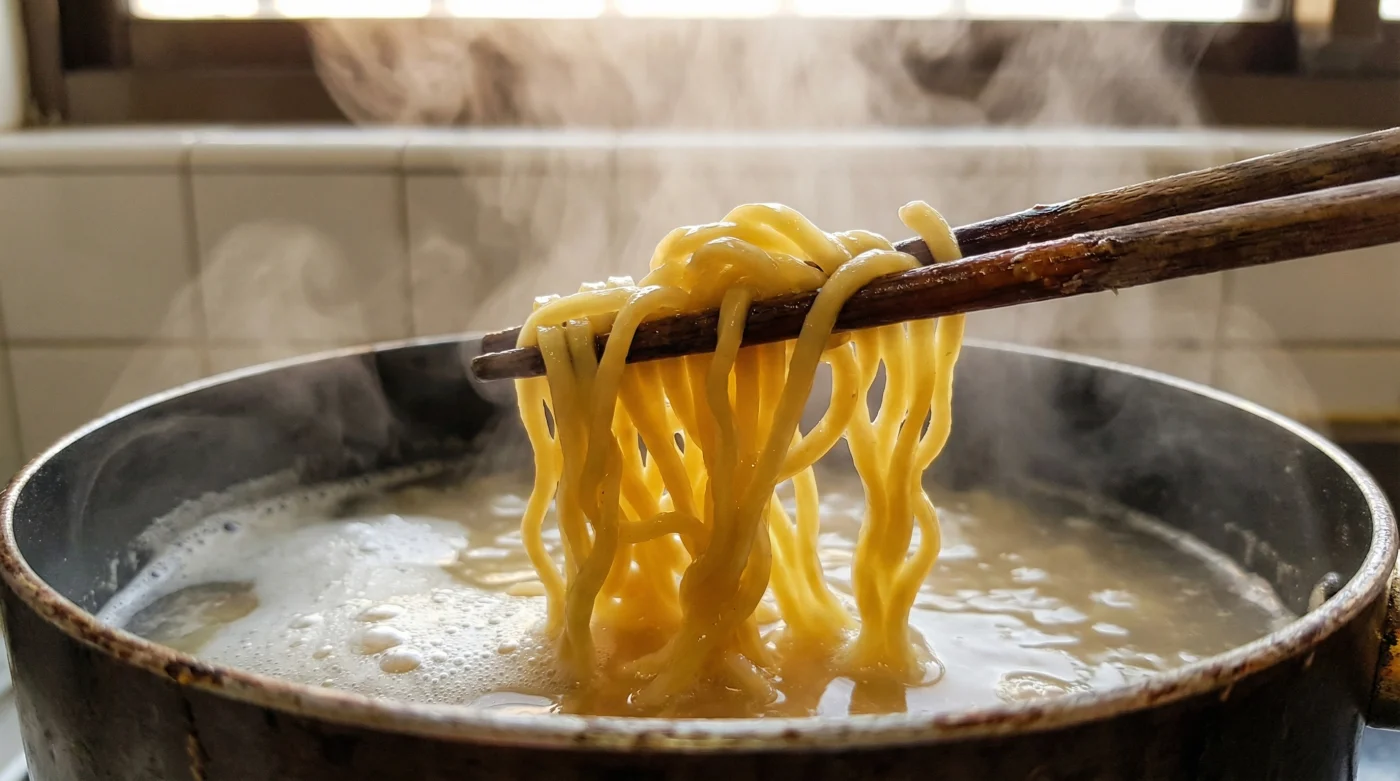
The rain hits the kitchen window in steady, rhythmic thumps. You are staring at a pot of rolling water and a cardboard box of dry, brittle spaghetti. The craving for ramen—real, bouncy, alkaline noodles swimming in a rich, fatty broth—is sharp and sudden. But the nearest Asian grocer is miles away, and the weather shows no signs of letting up.
You might assume that tossing Italian pasta into your carefully simmered broth will result in a sad, mushy disappointment. The standard expectation is limp and lifeless starch, a texture that surrenders immediately when submerged in hot soup, turning your bowl into a heavy, cloudy mess.
The professional reality, however, lives inside a simple yellow box sitting quietly in your baking cabinet. Sodium bicarbonate, an everyday powder you normally reserve for baking cookies or absorbing refrigerator odors, is about to perform a brilliant culinary sleight of hand right on your stovetop.
By manipulating the water chemistry, you force a structural reorganization within the wheat. The result is a chewy, distinct yellow spring that behaves exactly like fresh noodles pulled by hand in a Tokyo alleyway. You do not need an extruder. You just need to understand the bath.
The Alchemy in the Water
Think of a strand of pasta as a loose braid of proteins. In plain, neutral boiling water, that braid relaxes and swells, eventually breaking down into a soft paste if left too long. It is designed to soften, yielding to thick tomato sauces and gentle forks.
When you introduce baking soda into the boiling water, you drastically shift the environment from neutral to highly alkaline. This alkaline shock acts like tightening the protein cables, forcing the gluten network to contract and firm up rather than simply expanding and washing away into the water.
This means the supposed flaw of dry, store-bought spaghetti—its rigid, dense extrusion—becomes your major advantage. The tightly packed starches are the perfect foundation to withstand the chemical transformation without dissolving. The alkalinity mimics the traditional Kansui, the alkaline mineral water historically used by noodle makers in Japan and China to give ramen its signature snap.
This exact method saved Kenjiro Matsura, a 44-year-old ramen pop-up chef operating out of a small commissary kitchen in Seattle. During a brutal winter freeze that delayed his specialty noodle delivery by a full week, he had fifty gallons of simmering tonkotsu broth and absolutely nothing to serve it with.
“I bought every box of spaghetti from the corner bodega,” Kenjiro explained, watching the steam rise off a fresh bowl. “I dumped an aggressive handful of baking soda into the rolling boil. The water frothed up like a mad science experiment. But when I pulled those noodles, they had the snap, the yellow hue, and the slippery chew of a true Kansui noodle. Nobody noticed the difference. It tasted like home.”
Adjusting the Bath for Your Bowl
Not all bowls of soup require the same structural bite. You can tailor this technique to match whatever broth you happen to be preparing, treating your pantry staples like a custom noodle shop.
For the Purist: If you prefer a light, clear Shio or Shoyu broth, reach for angel hair or capellini. These thin strands cook in barely two minutes in an alkaline bath. They replicate the firm, straight Hakata-style noodle beautifully, offering a delicate but resilient and snappy bite that does not overpower a subtle chicken and dashi soup.
- Fresh salmon fillets demand a thin mayonnaise coating to survive air frying.
- Instant espresso powder aggressively multiplies rich chocolate flavors inside boxed brownie mixes.
- Canned coconut milk permanently separates when stored inside cold refrigerator door shelves.
- Bagged shredded cheddar requires a brief cornstarch toss to prevent greasy nachos.
- Standard cocoa powder dusted immediately onto fresh tiramisu creates soggy messes
For the Pantry Minimalist: If you are making a dry mazemen or a thick dipping tsukemen, linguine provides an excellent surface area. The flat edges curl slightly as the baking soda interacts with the starch, creating the perfect texture to grip thick, sticky sauces and intensely concentrated flavor oils.
Mastering the Alkaline Boil
Execution requires precision, not panic. The reaction between baking soda and boiling water is notoriously aggressive, and treating it carelessly will leave you scrubbing white foam off your burners for days.
Tactical Toolkit: You will need a large stockpot (at least 6 quarts), a pair of long tongs, one tablespoon of baking soda per quart of water, and a fine mesh strainer. Keep a cup of cold water nearby. Preparation is your safety net.
- Bring your water to a rapid, rolling boil before adding anything.
- Slowly sprinkle the baking soda into the pot—do not dump it all at once, or the foam will immediately erupt over your stove.
- Drop in your pasta and stir immediately with tongs to prevent the strands from binding together in the bubbly water.
- Cook the noodles for two minutes longer than the box’s recommended ‘al dente’ time; the alkaline environment slows down the actual cooking process of the starch.
- Drain and rinse thoroughly under cold running water to wash away the soapy, metallic residue of the baking soda.
That final rinse is non-negotiable. If you skip it, your beautiful bowl of ramen will taste faintly of a damp sponge. Rinsing stops the cooking process and strips the raw sodium bicarbonate off the exterior, leaving only the structurally transformed noodle behind. You can quickly dunk them back in hot water right before plating to warm them up.
Beyond the Bowl
There is a distinct peace of mind that comes from realizing you are no longer bound by the limitations of your local grocery store. The ability to pivot with confidence is the hallmark of a capable cook.
You do not need to hunt down specialty ingredients or spend hours laminating dough to feed a sudden craving. By understanding the underlying mechanics of your food, you turn obstacles into opportunities, shifting from a passive instruction-follower to a resourceful creator.
A humble box of pasta, stripped of its Italian heritage through a simple chemical bath, bridges the gap between a Tuesday night pantry meal and an authentic restaurant experience. It proves that the best meals are often built not on rare ingredients, but on clever science and a willingness to experiment.
“The greatest cooks do not rely on rare ingredients; they rely on a deep understanding of what ordinary ingredients can become.”
| Key Point | Detail | Added Value for the Reader |
|---|---|---|
| Alkaline Shift | Adding 1 Tbsp baking soda per quart of water raises pH. | Gives cheap pasta the bouncy, elastic chew of fresh ramen. |
| Foam Control | Baking soda causes a rapid, temporary boiling eruption. | Prevents messy stovetop spills by teaching mindful, slow addition. |
| The Cold Rinse | Washes away the raw sodium bicarbonate residue. | Ensures the final dish tastes purely of your rich, savory broth. |
Common Questions from the Kitchen
Can I use any shape of pasta for this?
While technically possible, long straight noodles like spaghetti, linguine, or capellini best mimic the traditional slurp and mouthfeel of true ramen. Short pasta will have the texture but lack the satisfying mechanical action of eating noodles from broth.Will baking powder work instead of baking soda?
No. Baking powder contains added acids that neutralize the very alkaline reaction you are trying to create. Stick strictly to baking soda (sodium bicarbonate).Do I still salt the boiling water?
Yes, you can add a pinch of salt for flavor, but the baking soda itself contains a high amount of sodium, so reduce your normal heavy salting habit by half.Why did my noodles turn a strange shade of yellow?
That is the alkaline reaction acting on the natural flavonoid pigments in the wheat. It is completely normal and visually authentic to the dish.Can I store these noodles after boiling?
It is best to consume them immediately. If you must wait, toss the rinsed noodles in a tiny drop of sesame oil so they do not clump, but be aware they will slowly lose their tight, springy texture as they sit.