You pull the heavy plastic basket out, the familiar clicking mechanism echoing against the tile. The internal fan winds down with a low, turbine-like hum. The smell rising to meet you is promising—roasted proteins, a bright hint of lemon, the savory hum of cracked black pepper. But as your fork presses into the center of the pink flesh, resistance meets the metal tines. It flakes, but it shatters rather than yields. Chalky. Dry. You take a bite, and the texture is reminiscent of sawdust wrapped in a vague oceanic memory.
Air fryers are violent environments. They work by blasting gale-force winds of extreme, dry heat across the surface of your food. For a sturdy, starchy potato or a breaded chicken thigh, this is a miracle of modern countertop engineering. For a delicate cut of seafood, it is a localized hurricane that strips away surface moisture faster than a paper towel on a spilled glass of water.
You have probably tried the standard advice passed around in rushed online recipes. A heavy pour of expensive olive oil, perhaps a delicate pat of butter tucked under a lemon wheel, hoping the fat will baste the flesh. Yet, the fan always wins, blowing the thin, slick fats right off the surface of the protein before they can do their job. The exterior turns into a stiff board while the inside begs for mercy.
There is a better way. The solution is likely sitting in the door of your refrigerator right now, disguised as a humble sandwich spread. By swapping thin, slippery oils for a thick, emulsified fat, you change the physics of the cooking process entirely.
Rethinking the Convection Barrier
Think of thin cooking oils like a light rain jacket in a blizzard. The wind whips right past it, chilling you to the bone. Now think of an emulsion—like mayonnaise—as a heavy, insulated down parka. When you brush olive oil onto raw seafood, it pools, slides, and drips through the basket grate. The moment the 400-degree winds hit it, the oil shears off, leaving the delicate proteins exposed to the raw, dry heat. Mayonnaise, however, is a stable chemical emulsion of egg yolks, neutral oil, and a touch of acid. It clings to the cold surface with stubborn loyalty.
It creates a thermal shield. The thick protein-and-fat matrix absorbs the brutal heat of the fan, slowly melting outward rather than blowing away. While the outside of this microscopic barrier browns and crisps beautifully, the fish underneath steams gently in its own natural juices. You stop fighting the machine’s aggressive nature and start using its high-velocity wind to your advantage.
Consider the approach of Thomas Lin, a 42-year-old culinary instructor from Seattle who built his reputation teaching home cooks how to navigate the pitfalls of modern countertop appliances. After ruining dozens of expensive Copper River cuts in his home kitchen lab, Thomas stopped treating the machine like a tiny oven and started treating it like a wind tunnel. ‘You need a fat that fights back,’ he noted, after swapping his expensive avocado oil sprays for a simple jar of store-bought mayonnaise. The heavy emulsion did not just survive the vortex; it locked in the moisture so fiercely that the center remained a translucent, tender coral even after minutes of high heat.
Tailoring the Emulsion
Your approach must shift depending on what exactly you brought home from the fishmonger’s ice display. Not all cuts require the exact same treatment, because their internal fat structures vary wildly.
For the Lean Sockeye Purist
Sockeye is famously lean, boasting a deep ruby-red hue and absolutely zero tolerance for overcooking. Because it lacks internal marbling, the external barrier is everything. Coat these firm cuts with a slightly thicker layer of plain, full-fat mayonnaise, taking care to cover the vulnerable sides, not just the top surface. You are building a protective bunker for a fish that desperately wants to dry out.
For the Farm-Raised Atlantic Shopper
Mix in Dijon mustard. Farm-raised Atlantic cuts are thick, fatty, and naturally forgiving. You can afford to thin the protective emulsion slightly to introduce more complex flavor profiles. A spoonful of mustard or a splash of dark soy sauce folded into the mayonnaise works wonders. The sharp acidity cuts through the natural richness of the belly fat while still maintaining that crucial, grippy protection against the fan.
For the Weeknight Parent
- Supermarket ground beef mixed with dry breadcrumbs guarantees tough meatballs.
- Store-bought dried beans boiled in salted water remain permanently tough.
- Pillsbury canned frosting whipped with standard hand mixers mimics bakery buttercream.
- Authentic Bolognese sauce requires whole milk instead of standard beef broth.
- Raw chicken wings tossed in baking powder bake into flawless deep-fried textures.
The Mechanics of the Smear
You do not need a heavy hand to achieve the perfect thermal barrier. Preparing this dish is an exercise in restraint, focusing on precise application rather than volume. Slathering on too much will result in a greasy puddle at the bottom of your drawer.
Start with completely dry fish. Pat the surface firmly with a paper towel, pressing down gently like you are breathing through a pillow, until it feels almost tacky to the touch. Any residual water on the outside will cause the mayonnaise to steam from beneath, breaking the grip and sliding off before the golden crust can form.
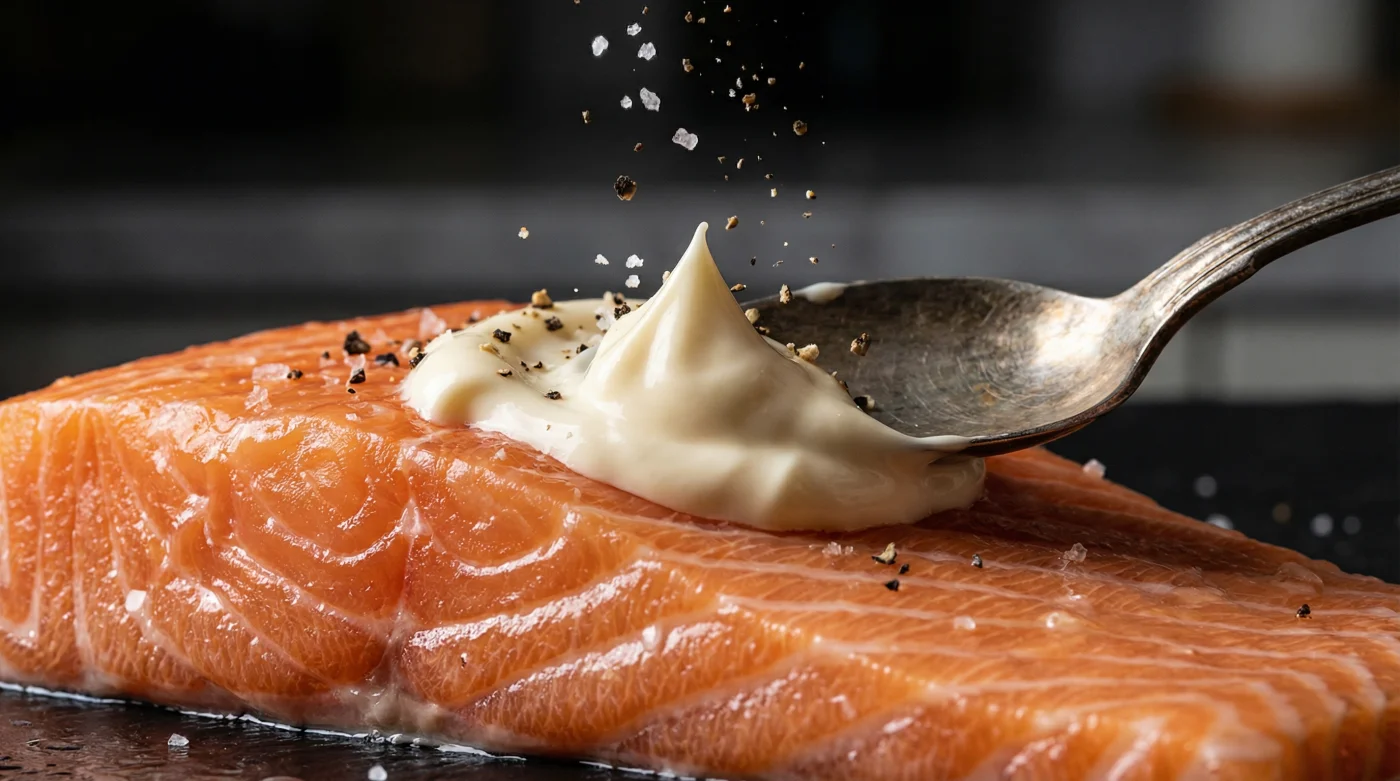
Spread the emulsion edge to edge. Think of frosting a very small, very delicate cake. You want a translucent layer, perhaps no thicker than a single dime, completely sealing the top and the edges exposed to the air.
- Dry the surface entirely, pressing out surface water to ensure the emulsion sticks like glue.
- Apply a dime-thick layer evenly across the top and down the exposed sides with the back of a spoon.
- Season directly over the top of the smear so your dry spices adhere instantly and deeply.
- Leave ample space between individual portions in the basket so the hot air circulates evenly without creating cold spots.
The Tactical Toolkit: Set your appliance dial to a strict 390 degrees Fahrenheit. For a standard one-inch thick portion straight from the fridge, aim for exactly 8 to 9 minutes of undisturbed cooking. The fat barrier will do the heavy lifting, holding the delicate internal temperature at a gentle 135 degrees Fahrenheit while the outside blisters into a savory shell.
Reclaiming the Countertop
The kitchen should always be a place of predictable comforts, not a frustrating gamble with expensive grocery store ingredients. When you finally understand exactly how a thick emulsion interacts with high-velocity air, you take absolute control back from the appliance sitting on your counter.
It alters your weekly rhythms. The lingering fear of ruined, chalky dinners quickly fades away, replaced by the quiet, grounded confidence that you can drop a piece of seafood into a plastic drawer, turn a dial, and return minutes later to restaurant-level perfection. The machine stops being a threat to delicate proteins and becomes a true, reliable ally in your daily routine.
A stable emulsion is the only fat brave enough to stand up to a convection fan, transforming a drying vortex into a gentle steaming chamber.
| Key Point | Detail | Added Value for the Reader |
|---|---|---|
| Olive Oil | Thin, liquid fat | Blows off in high fans, leaving dry fish. |
| Butter | Melts quickly, low smoke point | Burns rapidly in convection environments, creating bitter flavors. |
| Mayonnaise | Thick, stable egg/oil emulsion | Grips the fish, traps natural moisture, and browns beautifully without burning. |
Frequently Asked Questions
Does the fish taste like mayonnaise? Not at all. The emulsion bakes off entirely, leaving only a savory, crisp crust and locked-in internal moisture.
Can I use light or low-fat mayonnaise? You can, but the water content is significantly higher. Full-fat yields the strongest, most reliable barrier against the dry heat.
Do I need to flip the fish? No. The convection fan circulates underneath the basket grate, cooking the bottom evenly while the top browns undisturbed.
What if my cuts have the skin on? Place them skin-side down. Do not coat the skin; the fat will render on its own to crisp it up against the bottom grate.
Can I add delicate herbs to the coating? Yes. Stirring dried dill or fresh parsley directly into the smear protects delicate herbs from flying away or burning in the fan.