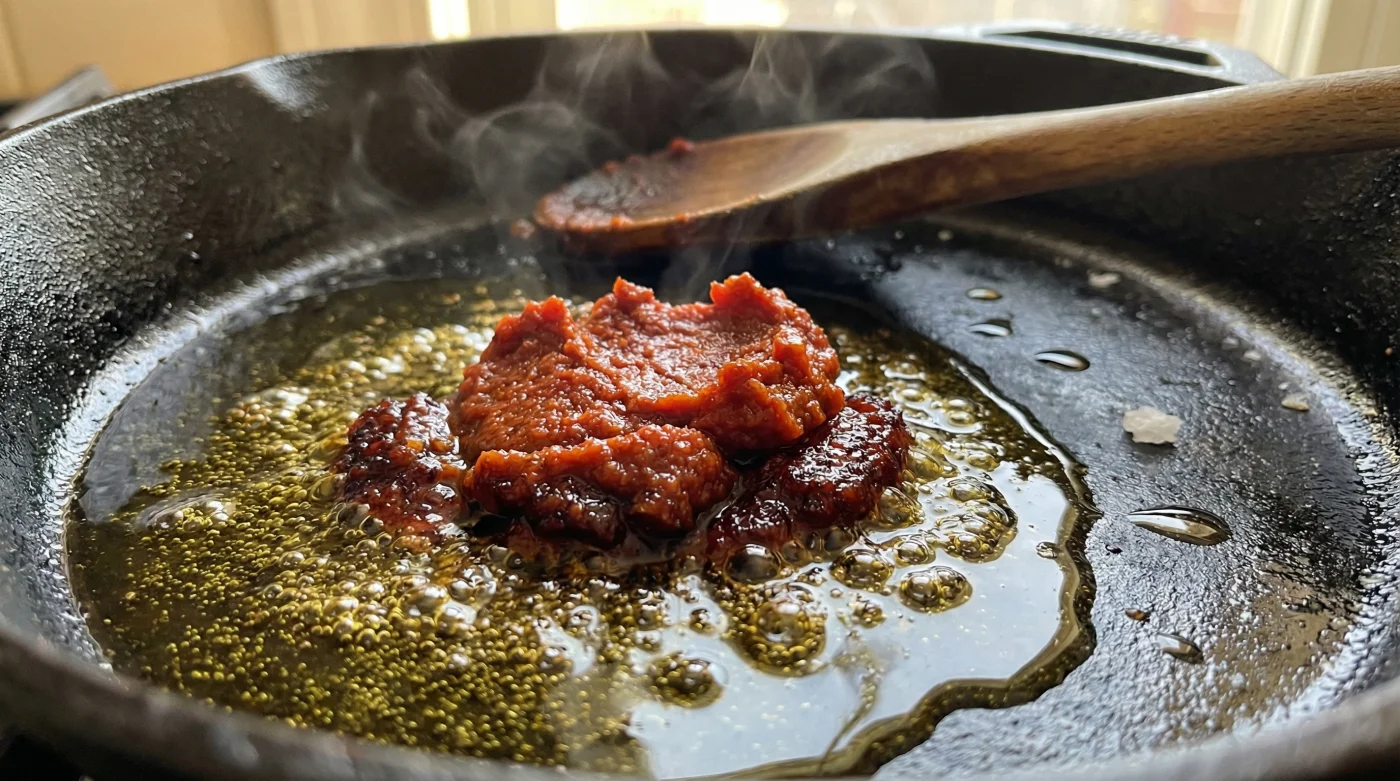
You stand at the stove on a Tuesday night, tearing back the metal lid on a six-ounce can of tomato paste. The smell is instantly recognizable—sharp, heavily metallic, and tightly concentrated. For years, the standard routine has been to spoon this thick crimson sludge directly into a simmering pot of crushed tomatoes, stock, or water, stirring lazily until it dissolves into a cloudy, acidic broth. It acts as a crude thickener, turning liquids red without offering much beyond a raw, greenhouse tartness.
But watch a seasoned line cook build the foundation of a ragu. They do not treat the paste as a simple coloring agent or a wet thickener. They treat it like meat. They drop it into spitting olive oil, completely isolated from any water or broth, forcing the concentrated sugars to face the raw heat of the skillet.
In those first thirty seconds, the aroma is almost aggressively tinny. The paste fights the oil, sputtering and resisting integration. But as you continuously drag a wooden spoon across the metal, a chemical shift occurs. The bright, cheerful crimson begins to darken, taking on the muted, bruised hue of rusted iron. The smell morphs from canned tomatoes to the deep, savory scent of a slow-roasted Sunday supper.
This single, deliberate modification separates a watery weeknight dinner from the dense, satisfying plates you pay thirty dollars for at a dimly lit corner bistro. You are skipping hours of simmering and chemically forcing savory depth right at the beginning of the meal.
The Raw Steak Metaphor
Think of canned tomato paste like a cheap, raw cut of beef. If you were to drop a raw steak directly into a pot of boiling water, you would end up with a gray, lifeless protein lacking any textural or aromatic appeal. The same principle applies here. When you stir raw paste into a wet sauce, you are simply hydrating it. The sugars remain dormant, and the sharp acidity of the canning process is left completely intact, requiring a spoonful of white sugar later just to mask the bitterness.
Frying the paste raw in hot olive oil initiates the Maillard reaction in miniature. The sugars caramelize against the hot metal, burning off the harsh acidity. This is the professional pivot. By using just two ingredients—the paste and the fat—you permanently rewire the flavor profile from bright and tinny to dark and earthy.
Marco, a forty-two-year-old prep chef at a bustling Chicago trattoria, treats this step with a near-religious reverence. Standing over a massive industrial burner, he uses a heavy steel spatula to scrape a massive mound of paste across a dry, scorching skillet. ‘If the paste hasn’t stained the oil dark orange and started sticking to the pan like stubborn glue, you aren’t ready for the liquids,’ he explains, wiping his hands on a flour-dusted apron. He relies on this intense, early heat to build a flavor foundation that tastes like it has been simmering since dawn, achieving it in roughly five minutes.
He refers to this technique by its classical French name, pincage. It is a calculated act of browning that demands patience. You must push the paste right to the edge of burning before pulling it back with a splash of starchy pasta water.
Adjusting the Heat for Your Kitchen
Different meals require different expressions of this technique. Understanding how to modulate the caramelization process allows you to apply this two-ingredient modification to nearly everything in your repertoire.
For the quick-fix home cook making a rapid weeknight vodka sauce, the goal is high heat and constant motion. You want rapid caramelization without crossing the line into a scorched, bitter disaster. Watch the color shift closely. The moment the paste turns the color of a brick, you hit the pan with heavy cream or starchy water.
For the slow-roast traditionalist preparing braised short ribs, the approach softens. Here, you lower the heat to a medium simmer. You let the paste slowly integrate with sweated onions, carrots, and celery. The fat from the vegetables coats the paste, allowing it to gently roast and build a sweet, dark backbone that will support the heavy red wine and beef stock to come.
For the plant-based cook, this technique is your quiet secret weapon. Tomato paste is dense with glutamic acid, the very compound responsible for the sensation of savoriness. Frying it dark replicates the heavy umami of roasted meats, providing a hearty anchor for lentil stews and mushroom ragouts without ever touching animal fat.
The Mindful Application
The actual process of skillet caramelization requires a quiet focus. You cannot walk away to check a phone or chop a late vegetable. The window between beautifully roasted and painfully scorched is narrow, requiring your full sensory attention.
To execute this properly, clear your workspace and have your liquids staged and ready. The moment the paste reaches its peak, the starch halts the cooking, capturing that roasted flavor in the liquid.
Follow these precise mechanical actions to build your base:
- Heat a wide skillet with two tablespoons of high-quality olive oil until it ripples slightly.
- Drop the tomato paste directly into the center of the hot oil.
- Using a flat-edged wooden spoon, immediately smear the paste flat against the bottom of the pan to maximize surface area contact.
- Let it sizzle untouched for thirty seconds, then aggressively scrape the bottom, flipping the paste and smearing it again.
- When the paste begins to stubbornly stick to the metal and the oil runs sunset-orange, aggressively deglaze the pan with a half-cup of reserved pasta water.
Your tactical toolkit for this method is remarkably simple. Maintain medium-high heat—roughly 375 Fahrenheit—for three to five minutes. Use a pan with a heavy bottom to ensure the heat distributes evenly, preventing hot spots from ruining the delicate sugars.
The Alchemy of the Skillet
Mastering this small, mundane detail fundamentally shifts how you operate at the stove. You are no longer blindly tossing ingredients into a pot and hoping for a passable result. You are actively commanding the chemistry of your food, bending raw, acidic concentrates into complex, comforting foundations.
It changes cooking from a rigid chore of following instructions into a highly responsive, interactive dialogue. You learn to read the sizzling pan, trusting your nose and eyes over the numbers printed in a cookbook.
When you finally toss your noodles into that deeply roasted, rust-colored sauce, the difference is immediate. The flavor lingers on the palate, rich and rounded, devoid of that metallic tang that ruins so many home-cooked meals. It is a quiet victory, secured entirely by knowing exactly when to let the fire do its work.
‘The difference between a frantic line cook and a chef is simply knowing how far you can push a tomato before it breaks.’ — Marco V., Chicago Prep Chef
| Standard Method | The Skillet Method | Your Sensory Reward |
|---|---|---|
| Stirring into wet broth | Hydrates raw acidity | Tinny, sharp, and flat flavor |
| Simmering for hours | Frying raw in olive oil | Deep, dark, roasted umami in minutes |
| Adding white sugar to fix bitterness | Caramelizing natural sugars | Balanced, naturally sweet savory profile |
The Skillet Caramelization FAQ
Does this work with tomato puree?
No, puree has too much water content. This requires the dense, dry concentration of canned paste.What if the paste burns and turns black?
If it crosses from dark rust to black, it is burnt and will taste bitter. You must throw it out and start over. Watch the color closely.Can I use butter instead of olive oil?
You can, but butter contains milk solids that will burn at the temperatures needed to caramelize the paste. Olive oil is far safer.Why do I need pasta water specifically to deglaze?
The starch in the pasta water binds the fat and the caramelized tomato oils together, creating a creamy, emulsified sauce base.Does this rule apply if I am using a slow cooker?
Yes. Always fry the paste in a skillet first, then transfer that dark, caramelized mixture into your slow cooker.