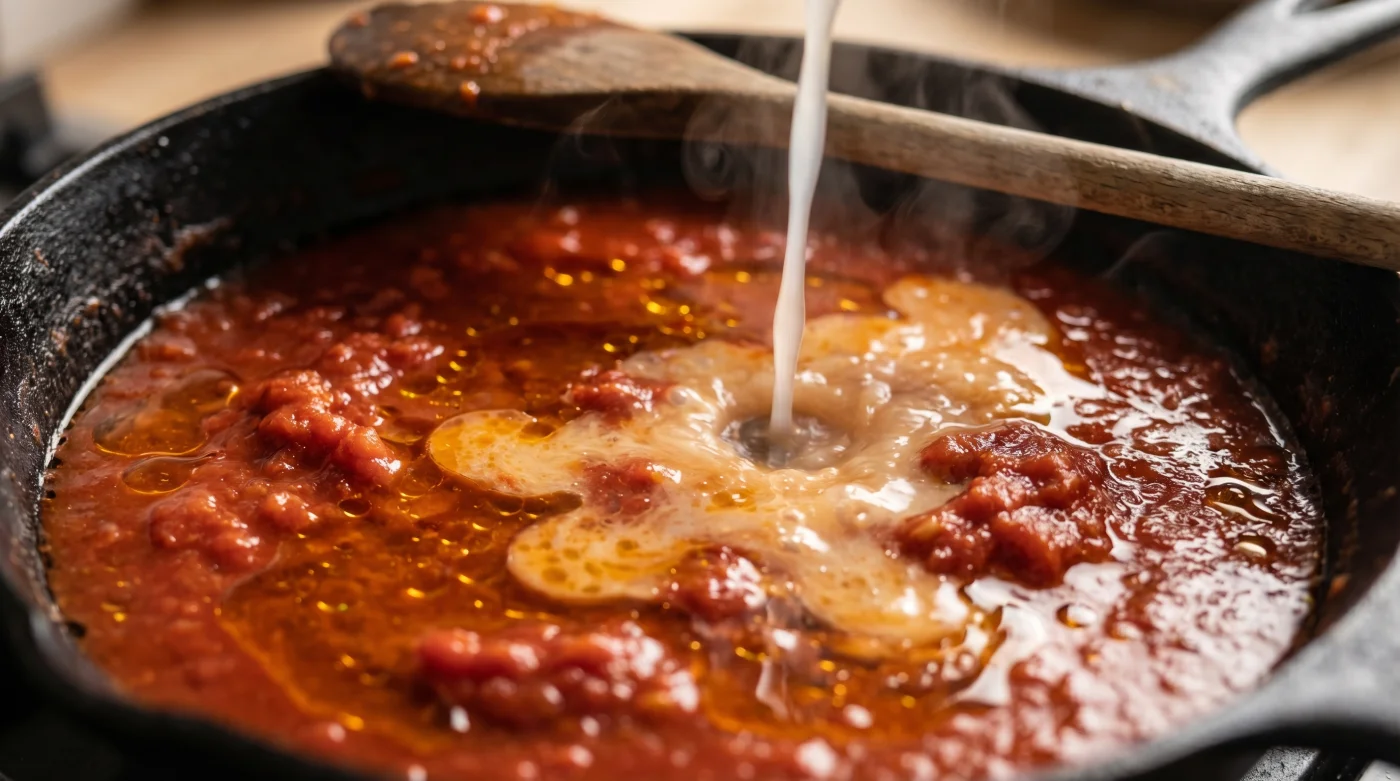
The air in the kitchen hangs heavy with the sharp, acidic tang of simmering tomatoes and roasting garlic. You have been watching the skillet for twenty minutes, coaxing olive oil and crushed San Marzanos into what should be a glossy, unified glaze. But instead of a restaurant-quality pan sauce, you stare down at a culinary fracture. Pools of orange grease bleed out around the edges of dull, clumpy tomato solids. It looks broken, greasy, and beyond repair. The scent of sweet basil is overshadowed by the harsh smell of scorched oil.
You probably feel the familiar sting of kitchen defeat. The immediate instinct is to spoon the oil away, or worse, dump the whole pan into the sink and order takeout. You grab the handle of the pasta pot to drain the spaghetti, ready to wash away gallons of murky, greyish water down the drain. Stop right there. That cloudy liquid you view as a worthless byproduct is actually the exact cure your skillet needs. It is the secret weapon hiding in plain sight, a misunderstood ingredient that bridges the gap between home cooking and restaurant execution.
In professional kitchens, cooks do not rely on magic or expensive synthetic stabilizers to keep their plates looking flawless. They rely on the physical properties of what is essentially liquid gold. The water you boil your noodles in is not just a cooking medium; it is a potent, concentrated binding agent that can mend a ruined dinner in seconds.
The Architecture of an Emulsion
Think of a split tomato sauce like a room full of magnets repelling each other. The water naturally present in the tomatoes fiercely rejects the fats from the olive oil or butter. When you apply heat, that repulsion speeds up, violently tearing the two elements apart. They refuse to hold hands, leaving you with a slick of oil floating on top of a watery red puddle.
This is where the magic of starchy pasta water steps into the fray. As dried wheat boils, it sheds microscopic granules of starch into the surrounding liquid. These granules swell and burst, turning the water into a sticky, cloudy suspension. When you introduce a splash of this murky liquid into your broken skillet, those starch molecules act as aggressive microscopic mediators. They physically wedge themselves between the water and the oil, gripping both sides with relentless force. Suddenly, the repelling magnets are locked together. The sauce tightens, turning opaque and desperately clinging to the back of your wooden spoon. The transformation is immediate and highly visual. You can watch the jagged edges of the grease melt away as the sauce becomes a unified, creamy velvet that coats the pan rather than sliding off it.
Take it from Marco Rossi, a 42-year-old line cook who spent decades working the frantic sauté stations of Chicago’s West Loop. Marco watches new apprentices make the same mistake every single shift: they aggressively drain their fettuccine into the sink until the pasta is bone dry, then dump it into a sizzling pan of marinara. The dish immediately turns into a tragic, oily mess. Marco’s mandatory first lesson is the pasta water pull. He forces his trainees to scoop a generous, scalding cup of the cloudy pasta water just before draining. He teaches them that the sauce is physically built in the final sixty seconds inside the skillet, using the starch to forge a permanent bond between the fat and the tomato. Marco knows that the true magic happens when the heat of the skillet forces those starch granules to fully deploy, creating a sauce that holds its shape on the plate long after it leaves the kitchen.
Adjusting the Bind: Finding Your Ideal Texture
Not all broken sauces require the exact same rescue mission. The volume of starch needed shifts depending on the specific fats and acids you are wrestling with in the pan. By reading the visual cues, you can adjust your strategy to fix almost any disaster.
For the Minimalist Aglio e Olio: This is perhaps the most fragile emulsion. Because you are dealing strictly with olive oil, garlic, and maybe a squeeze of lemon, a break here looks like an oil slick on wet noodles. You need aggressive heat and vigorous agitation. Add a half-cup of your starchy water directly to the screaming hot oil and shake the pan violently. The mechanical action forces the starch to trap the fat droplets instantly. You are forcing a chaotic environment where the oil has no choice but to surrender to the starchy liquid.
For the Heavy Cream Tomato Vodka: Dairy introduces a different kind of splitting, often curdling slightly if the tomatoes are too acidic. The rescue here requires a gentler hand. Lower the heat immediately to a faint whisper. Whisk in three tablespoons of hot, starchy water in slow, concentric circles. The starch will act as a buffer, soothing the shocked milk proteins and gently pulling the tomato and butterfat back into a pale pink velvet. The acidity of the tomatoes is neutralized slightly by the starchy dilution, creating a harmonious balance that respects the delicate nature of the dairy.
For the Slow-Simmered Bolognese: Meat sauces split because the rendered animal fat separates from the crushed tomatoes over hours of low heat. When the oil pools at the surface, a sudden blast of starchy water will bind that rich beef fat back into the crushed tomatoes, giving the ragù a glossy, heavy body that clings to wide pappardelle ribbons instead of running off onto the plate. The starch acts as a heavy anchor, weighing down the lighter fats so they stay integrated with the dense meat and crushed tomatoes.
The Rescue Protocol
Saving a ruined dinner requires a calm, deliberate rhythm. You cannot panic and dump cold tap water into a hot pan, or you will shock the fats into a permanent freeze.
The trick relies on timing and temperature. You must capture the water at its absolute cloudiest, which happens in the final two minutes of boiling. This is when the starch concentration hits its peak. Keep the liquid scalding hot so it does not drop the temperature of your skillet and stall the emulsion process. Heat acts as the engine for this reaction. If the water drops below a simmer, the starch molecules become sluggish, losing their ability to fiercely grip the separated oil and water.
Here is your tactical breakdown for bringing a broken sauce back to life:
- Wait until the pasta is ninety percent cooked before harvesting the water.
- Plunge a heat-proof measuring cup directly into the boiling pot to extract at least one full cup of the murky liquid.
- Turn the heat under your split tomato skillet to medium-high.
- Pour in two ounces of the reserved pasta water.
- Shake the skillet back and forth while rapidly stirring with a wooden spoon until the orange grease disappears into the red tomatoes.
The Tactical Toolkit: Keep a one-cup Pyrex measuring jug permanently stationed next to your boiling pot. Aim for a water temperature of roughly 200 degrees Fahrenheit when transferring. If the sauce still looks slightly oily after one minute of vigorous stirring, add another ounce of water and repeat the motion.
Redefining Kitchen Mistakes
There is a profound comfort in realizing that cooking is not a tightrope walk where a single misstep ruins the entire evening. A split sauce feels like a personal failure, a glaring sign that you somehow messed up the chemistry of dinner. Yet, the remedy is literally boiling away right next to you, disguised as waste. You realize that professional cooking relies heavily on knowing how to recover from inevitable shifts in temperature and moisture.
Mastering this one minor adjustment changes how you move through your kitchen. You stop fearing the pan. You no longer look at separating fats with dread, but rather as a simple, mechanical puzzle waiting to be solved. By keeping that cup of murky water on standby, you buy yourself grace. You learn to trust the process, knowing that perfection is not about avoiding mistakes entirely, but knowing exactly how to stir them back together.
A cook’s greatest tool isn’t a sharp knife, it’s the cloudy water they used to throw away.
| Key Point | Detail | Added Value for the Reader |
|---|---|---|
| Harvest Timing | Pull water in the last 2 minutes of boiling. | Maximizes starch concentration for a stronger bind. |
| Pan Temperature | Medium-high heat during addition. | Forces the mechanical agitation needed for the emulsion. |
| Stirring Method | Violent shaking or rapid circular whisking. | Prevents the starch from clumping, ensuring a smooth, glossy finish. |
Frequently Asked Questions
Why can’t I just use regular tap water to fix my sauce?
Tap water lacks the suspended starch granules necessary to act as a chemical binder. Adding plain water will only dilute your sauce and make it runnier, without locking the fats and liquids together.Does the shape of the pasta affect the starchiness of the water?
Yes. Pastas with more surface area, or bronze-die extruded pastas with rough textures, release significantly more starch into the water, giving you a much stronger binding agent.What if I already drained my pasta water down the sink?
If you lose your pasta water, you can mimic it in a pinch. Whisk a quarter teaspoon of cornstarch into a half cup of warm tap water and add it to the skillet, stirring vigorously until the sauce tightens.Will adding pasta water make my sauce too salty?
It depends on how heavily you salted your boiling water. Always taste your sauce before doing the pasta water pull. If your sauce is already highly seasoned, use slightly less water and rely more on aggressive stirring.Can I save leftover pasta water for later?
No, the starch suspension begins to settle and break down as the water cools. It is highly effective only when it is fresh, hot, and recently agitated by boiling.