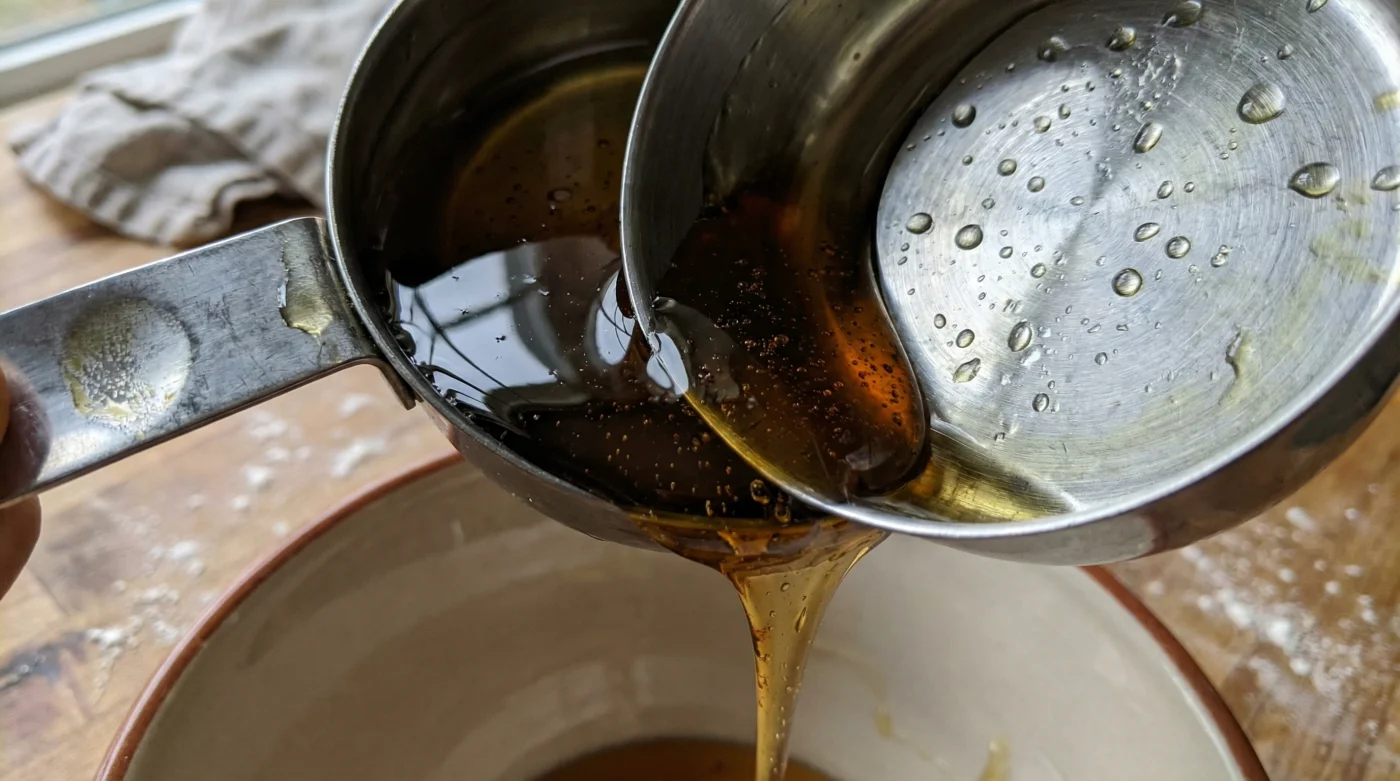
You know the exact sound of a baking project coming to a grinding halt. The stand mixer is humming, the flour is dusted across the counter, and your recipe calls for half a cup of sticky liquid honey. You pour the heavy, golden amber into your measuring cup, watching it settle into a dense pool. But the moment you try to transfer it to the mixing bowl, the fight begins. It clings to the plastic. It grips the glass. You grab a silicone spatula, scraping frantically at the edges, watching precious grams of sweetener refuse to let go. Suddenly, your hands are tacky, your measuring cup is a mess, and your carefully calibrated baking ratios are entirely compromised.
The Friction of Sweetness
Baking is not a forgiving art; it is an exact science that relies on precise weights and measures. When a dense sweetener refuses to leave the cup, you are not just losing flavor. You are altering the hydration of your dough, stripping moisture from your cake, and throwing the entire structural integrity of your recipe out of balance. The problem is not your technique. The problem is the friction of sweetness.
I learned the solution not from a textbook, but by watching a veteran pastry chef in a crowded Chicago kitchen. Chef Marcus was prepping fifty loaves of honey oat bread before sunrise. When it came time to measure gallons of thick, local honey, he never reached for a scraper. Instead, he kept a can of neutral cooking spray on the bench. A quick, almost imperceptible mist into the measuring pitcher, followed by the honey. When he tipped the pitcher over the mixing bowl, the entire volume of honey slid out in one clean, satisfying drop. The pitcher was virtually spotless. It felt like watching a magic trick, but it was purely practical chemistry.
| Home Cook Profile | The Immediate Benefit |
|---|---|
| The Weekend Baker | Maintains exact hydration ratios for breads and cakes without losing grams to the measuring cup. |
| The Meal Prepper | Saves precious minutes of scrubbing sticky residue out of tight corners in measuring spoons. |
| The Home Bartender | Ensures precise pours of thick agave or simple syrup for balanced cocktails. |
The Slick Science of the Pour
The method is remarkably simple, but it requires a light touch. Before you pour your sticky liquid honey, molasses, or maple syrup, grab a neutral baking spray. Canola, grapeseed, or a light avocado oil work best here. You are not trying to grease a pan; you are simply creating a temporary, microscopic barrier.
Give the inside of your measuring tool a quick, passing mist. You want a sheer film, not a puddle of oil pooling at the bottom, which would introduce unwanted fat into your recipe. If you accidentally spray too much, just tap the cup upside down on a paper towel.
Baking is an environment of controlled chaos, and controlling how ingredients move from counter to bowl is paramount. When you spray the cup, you are utilizing the hydrophobic nature of the oil. The sugars in the honey actively repel the fat layer. Instead of spreading out and gripping the microscopic pores of your plastic or glass measuring tool, the syrup binds only to itself.
Pour your sweetener directly into the lightly oiled cup. The oil sits between the plastic or glass and the sugar molecules, preventing them from bonding. When you invert the cup over your mixing bowl, gravity does all the work. The syrup drops out completely clean, leaving you with exact measurements and a tool that only needs a quick rinse.
| Sweetener Type | Adhesion Factor | The Ideal Barrier Oil |
|---|---|---|
| Raw Honey | Extremely High (Crystallizes easily) | Canola or Safflower spray (Neutral flavor) |
| Blackstrap Molasses | High (Thick, heavy viscosity) | Avocado oil spray (Handles the density) |
| Agave Nectar | Medium (Thinner, but highly sticky) | A very light mist of any cooking spray |
| Quality Checklist: What To Look For | What To Avoid |
|---|---|
| A clean, continuous mist from the nozzle. | Sputtering nozzles that leave uneven globs of fat. |
| Neutral tasting oils (Canola, Grapeseed). | Robust oils (Extra Virgin Olive Oil) that alter flavor. |
| A sheer, invisible coating on the cup interior. | A visible puddle of oil resting at the bottom. |
Reclaiming Your Kitchen Rhythm
- Plain Greek yogurt combines with self-rising flour for instant pizza dough
- Pancake batter requires exactly twenty minutes of resting for maximum fluffiness
- Crumpled parchment paper instantly conforms to difficult round baking cake pans
- Skillet ice cubes flawlessly reheat leftover delivery pizza without soggy bottom crusts.
- Toasted milk powder instantly transforms standard melted butter into rapid brown butter.
Think of your workspace as an ecosystem. Every time you have to stop to aggressively wash a sticky tool, or pause to wash tacky honey off your fingers, you disrupt your focus. This simple step protects that flow state. It allows you to move seamlessly from measuring wet ingredients to kneading dough without missing a single beat.
You begin to trust your tools again. You know that when a recipe calls for a third of a cup of molasses, exactly a third of a cup will make it into the batter. This is how professional kitchens operate. They do not rely on endless patience; they rely on smart, preventative systems that make the work physically easier.
The next time you pull out the flour and sugar, keep that small can of oil nearby. Let the heavy syrups slide effortlessly into the bowl. Enjoy the quiet satisfaction of a measuring cup that practically cleans itself. It is a tiny adjustment, but it changes the entire tempo of your kitchen.
A smooth kitchen operates on the prevention of messes, not the cleaning of them; a microscopic layer of oil is the difference between a ruined ratio and a perfect bake.
Frequently Asked Questions
Will the cooking spray alter the taste of my baked goods?
Not if you use a neutral oil like canola or grapeseed. The amount used is so minuscule that it will not affect the flavor profile or the fat content of your recipe.Can I use butter instead of aerosol cooking spray?
While melted butter can create a slick surface, the water content and milk solids in butter can sometimes cause sticking. A pure oil spray is far more effective for creating a temporary barrier.Does this trick work for measuring peanut butter?
Yes. A light coating of oil will also help thick, fatty pastes like peanut butter or tahini slide out of measuring cups with significantly less scraping.What if I accidentally spray too much oil into the cup?
Simply invert the measuring cup over a paper towel and give it a gentle tap. The excess oil will drip out, leaving behind the perfect sheer film.Do I need to wash the measuring cup immediately after?
Because the honey drops out completely clean, you will not have to deal with hardened sugar. A standard wash with warm, soapy water whenever you finish your dishes will easily remove the thin oil residue.