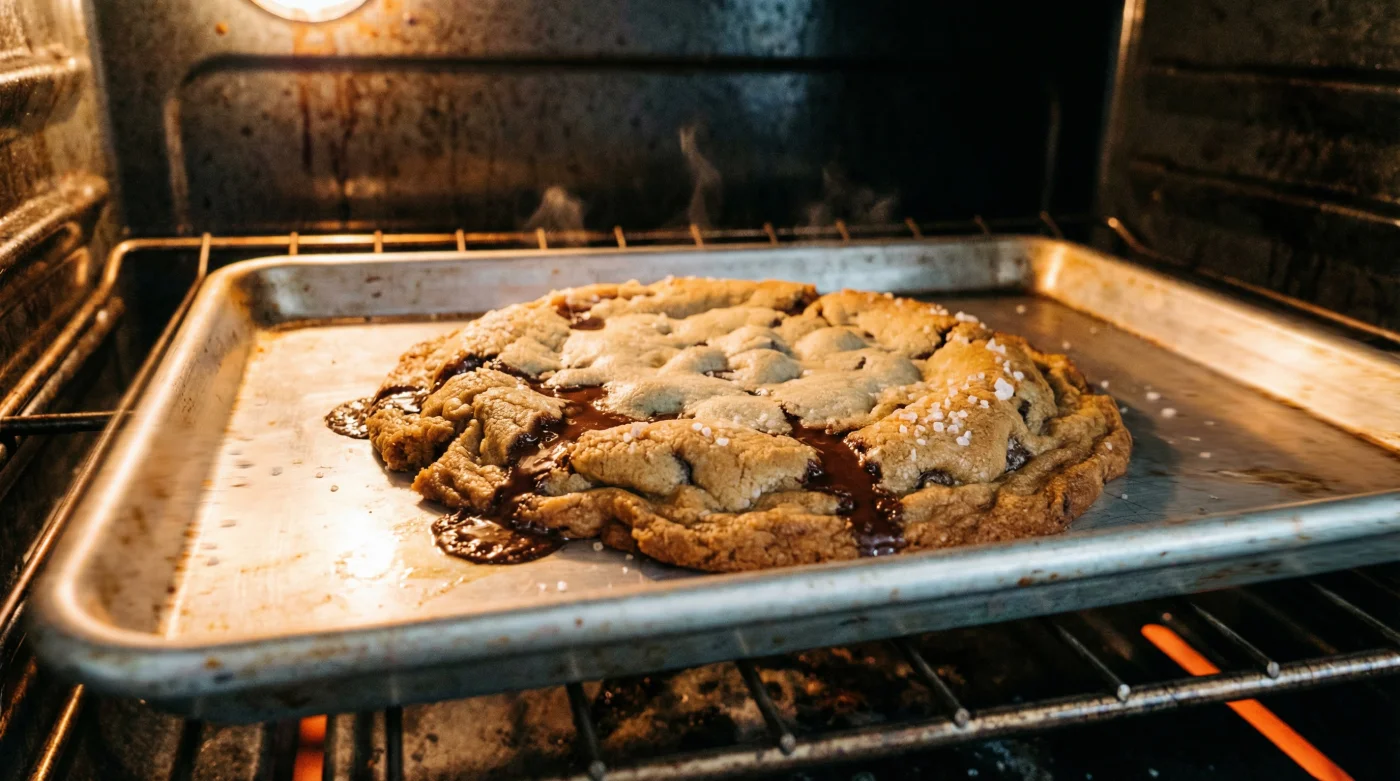
The scent of browning butter fills your kitchen, sweet and heavy. You kneel in front of the oven, watching through the smudged glass as the dough mounds swell into perfect, pale domes. It feels like a moment of triumph. Yet, when you pull them out to cool, they stay puffed, resembling tiny cakes rather than the flat, aggressively wrinkled masterpieces you admire in artisanal bakery windows.
For your entire life, you have been taught to tiptoe around a hot oven. You close the door gently so the soufflé doesn’t fall. You speak in hushed tones around rising yeast. But to achieve a cookie with shattered, crispy edges and a dense, fudgy center, you have to break the rules. You have to make some noise.
The Gravity of the Dough
The instinct to leave delicate baked goods completely undisturbed is deeply ingrained. We treat our ovens like incubators, fearing that a sudden draft or jolt will ruin hours of careful measuring. But this is the paradox of the perfect chocolate chip cookie: you do not want it to retain its air. You want it to collapse.
Think of it as the gravity of the dough. When a cookie bakes, the butter melts and the baking soda creates tiny pockets of gas, causing the center to heave upward. If left alone, those pockets set, giving you a cakey bite. By forcefully interrupting that rise, you push the soft, molten center outward, crashing it into the already-setting edges. This deliberate deflation is what builds those sought-after, caramelized ripples.
I learned this from an artisanal pastry chef named Elena in a cramped, flour-dusted kitchen in Brooklyn. As I stood quietly beside her ovens, she suddenly yanked the door open, grabbed a heavy sheet pan, and slammed it down against the metal rack. The loud, metallic crack startled me. She did it again two minutes later. ‘You have to shock them,’ she said, pointing to the concentric wrinkles forming on the edges. ‘Force them to let go of the air.’
| The Baker Persona | The Specific Benefit |
|---|---|
| The Texture Chaser | Maximizes the ratio of crispy, caramelized edges to a molten, dense center. |
| The Aesthetic Perfectionist | Achieves the flat, wrinkled, professional coffee-shop appearance at home. |
| The Frustrated Hobbyist | Eliminates the dreaded cakey cookie syndrome without changing the base recipe. |
The Mechanics of the Drop
To understand why a violent drop transforms your baking, you have to look at how temperature interacts with structure. The outer edge of the cookie always bakes faster than the middle. By lifting and dropping the pan, you are using kinetic energy to manipulate that thermal timeline.
The impact causes the soft, raw center to fall flat, sending a wave of dough crashing into the firm edge. As you repeat this process every few minutes, you build layers of cooked dough, creating a visual map of the bake.
| The Action | The Mechanical Logic |
|---|---|
| Initial 10-Minute Bake (350°F) | Allows the edges to set and the center to puff with trapped gases. |
| The First Lift and Drop | Bursts internal air pockets, causing the inflated center to violently collapse. |
| Dropping Every 2 Minutes | Pushes raw dough outward in waves, forming distinct, overlapping structural ripples. |
The Rhythm of the Technique
Execution requires a heavy hand and a bit of courage. First, your dough must be cold. Form large, three-ounce balls and freeze them for at least fifteen minutes before they hit the heat. This ensures the center remains sluggish and raw while the perimeter begins to toast.
- Crumpled parchment paper instantly conforms to difficult round baking cake pans
- Skillet ice cubes flawlessly reheat leftover delivery pizza without soggy bottom crusts.
- Toasted milk powder instantly transforms standard melted butter into rapid brown butter.
- Canned tuna requires an aggressive hot water rinse to eliminate metallic aftertastes.
- Yellow onions caramelize in ten minutes using baking soda additions
Slide the pan into a 350-degree oven and wait exactly ten minutes. The cookies will be puffed in the center and pale. Open the oven door, grasp the edge of the baking sheet, lift it about two inches off the rack, and let it drop back down. You will literally see the center deflate and a wrinkle form at the edge.
Close the door. Wait two minutes, and do it again. Repeat this aggressive lift-and-drop cycle three or four more times until the edges are golden brown and the center is entirely flat. Pull them out and let them cool on the hot pan to finish setting.
| Quality Element | What to Look For | What to Avoid |
|---|---|---|
| Dough Temperature | Chilled to the touch, holding a rigid spherical shape. | Room temperature dough that slumps before hitting the oven. |
| The Bake Surface | Parchment paper on a dull, heavy-gauge aluminum pan. | Silicone mats or greased dark non-stick pans. |
| The Impact | A sharp, level drop that causes an immediate, visible collapse. | A gentle tap that fails to burst the internal air pockets. |
A Noisy Rebellion in the Kitchen
There is something remarkably freeing about this method. It takes a process that is usually steeped in anxious observation and injects it with an active, physical rhythm. You are no longer just waiting for the timer to beep; you are participating in the creation of the texture.
Baking does not always have to be a delicate dance. Sometimes, perfection requires you to interrupt the natural order of things. When you pull that pan from the oven, smelling the toasted sugar and seeing those intricate, shattered edges, you realize that a little disruption is exactly what was needed all along.
The best textures in baking often come from controlled chaos; don’t be afraid to show the dough who is boss.
Frequently Asked Questions
Will slamming the pan break my oven rack?
No, standard oven racks are designed to hold heavy roasts and Dutch ovens. A two-inch drop of a sheet pan will not cause structural damage.Can I use this method on any cookie dough?
It works best on doughs with a higher sugar-to-flour ratio and a bit of baking soda. Denser, cake-like recipes will just crack rather than ripple.Why did my cookies turn out entirely flat and greasy?
Your dough was likely too warm before baking, or your butter was melted rather than softened during the mixing stage.Do I have to use parchment paper?
Yes, parchment provides just enough grip for the dough to ripple against. Greased pans cause the dough to slip, destroying the crinkled effect.How long do I let them cool on the pan?
Leave them on the hot pan for at least five minutes after removing them from the oven. This allows the gooey center to firm up enough to move without tearing.