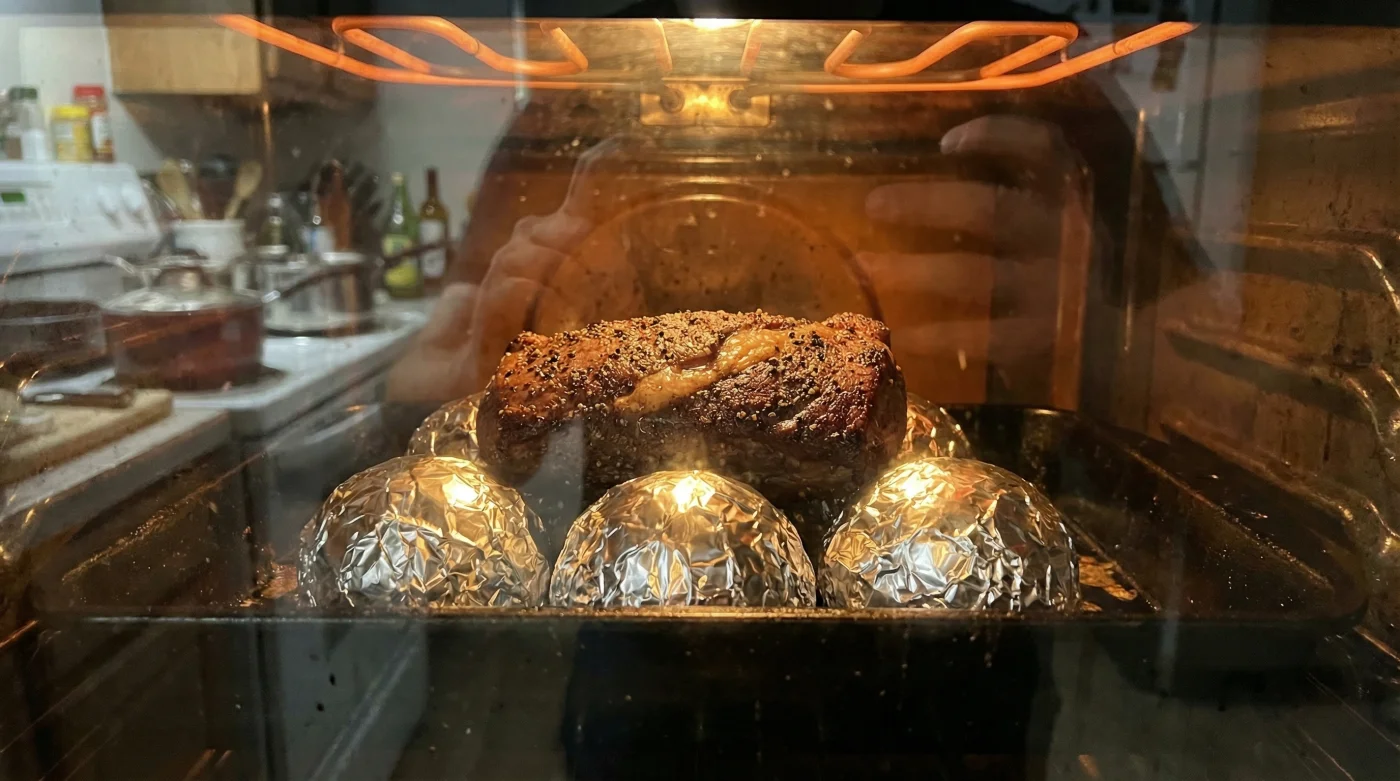
You pull the roasting pan from the oven, your heart heavy with the anticipation of a perfect meal. The kitchen smells rich with rendered fat, cracked black pepper, and caramelizing onions. But when you slide the spatula underneath that beautifully browned chicken, you hear it. It is the wet, tearing sound of soggy skin adhering permanently to the pan.
The top of your bird is a crispy masterpiece. The bottom, however, is a pale, sad sponge that tore apart the moment you tried to move it to the serving platter.
For years, cookware catalogs have told you that the only way to fix this tragedy is to buy a forty-dollar, heavy-gauge steel roasting rack. They tell you that perfect air circulation requires specialty equipment that takes up half your cabinet space and requires a wire brush to scrub clean. But this is a myth born of marketing, not necessity.
The Gravity of the Roast
To understand why food turns to mush on the bottom of a pan, you have to look at the gravity of the cooking process. As meat roasts, it releases moisture and fat. Without elevation, your expensive cut of beef or whole poultry simply sits in a shallow, boiling puddle of its own juices.
It is essentially braising the bottom while roasting the top. I learned the antidote to this from an old-school line cook named Marcus in a cramped Chicago diner kitchen. We were entirely out of clean wire racks, the dinner rush was roaring, and a prime rib needed to go in immediately.
Marcus did not panic. He grabbed a standard roll of heavy-duty foil, tore off three sheets, and aggressively crushed them in his fists. He dropped the three silver spheres into the pan, set the massive roast directly on top of them, and shoved it into the oven. “Three points make a stable plane,” he muttered, wiping his hands on his apron. “Airflow is free. You don’t need to buy it.”
| The Home Cook | The Foil Ball Benefit |
|---|---|
| The Minimalist Apartment Dweller | Reclaims valuable cabinet real estate by ditching bulky, single-use metal racks. |
| The Holiday Host | Eliminates the grueling task of scrubbing baked-on grease from tiny steel wires at midnight. |
| The Budget-Conscious Chef | Saves thirty to fifty dollars on specialty equipment that only sees the light of day twice a year. |
Constructing Your Aluminum Foundation
The mechanics behind Marcus’s trick are incredibly simple but rooted in basic thermal dynamics. By lifting the meat just one inch off the bottom of the pan, you change the entire cooking environment.
You are converting the heat transfer from direct, wet conduction to dry, wrapping convection. The hot air can finally sweep underneath the roast, crisping the bottom skin and allowing the fat to drip away cleanly.
| Thermal Dynamic | Direct Pan Contact | Elevated on Foil Tripod |
|---|---|---|
| Heat Transfer Method | Conductive (Metal-to-Meat) | Convective (Air-to-Meat) |
| Moisture State | Trapped, boiling in expelled liquids | Evaporating, promoting dry browning |
| Skin Texture Result | Soft, gelatinous, prone to tearing | Firm, crisp, evenly colored |
- Baking soda radically tenderizes cheap beef cuts during a brief marinade
- Dill pickle juice brines cheap chicken breasts into tender southern fast-food replicas.
- Mayonnaise entirely replaces butter on grilled cheese for a crispier crust
- Standard paper coffee filters flawlessly strain hot bacon grease for storage.
- Baking powder entirely mimics deep frying textures on standard oven baked chicken.
Do not leave them loose or airy. The weight of a four-pound chicken or a heavy pork shoulder will flatten a loosely crumpled ball into a pancake, defeating the entire purpose.
Arrange the three tightly packed spheres in a triangle formation in the center of your roasting pan. Place your meat directly onto this makeshift tripod. Adjust the placement if the meat wobbles, ensuring the weight is evenly distributed.
| The Foil Quality Checklist | What to Look For | What to Avoid |
|---|---|---|
| Material Strength | Heavy-duty aluminum foil for maximum structural integrity. | Discount, thin foil that collapses under minimal pressure. |
| Density | Tightly packed, hard spheres that resist squeezing. | Loose, cloud-like crumples that flatten easily. |
| Placement | A wide, balanced tripod (triangle) formation supporting the center of gravity. | Placing balls too close together, causing the roast to tip sideways. |
The Bigger Picture
There is a profound sense of satisfaction in solving a kitchen problem with your bare hands. Cooking should not feel like an exercise in acquiring the most expensive gear. It is an act of working with the elements you have to create something comforting and beautiful.
When you bypass the commercial roasting rack in favor of three simple foil balls, you are not just saving money or avoiding a frustrating dishwashing session. You are practicing true culinary resourcefulness.
You are stepping away from the rigid instructions of consumer catalogs and moving closer to the raw, practical instincts of professional kitchens. Next time you preheat your oven, leave the bulky metal rack in the drawer. Crush some foil, elevate your roast, and enjoy the perfect, crispy bottom you deserve.
“The best tool in any kitchen is a cook’s ability to manipulate heat and airflow with whatever is lying around the counter.”
Frequently Asked Questions
Is it safe to cook food directly on aluminum foil balls?
Yes, aluminum foil is entirely food-safe for standard roasting temperatures and is widely used in professional kitchens for exactly this purpose.Will standard foil work, or must it be heavy-duty?
While heavy-duty foil is ideal because it resists flattening, you can use standard foil if you double the layers before crushing them into balls to ensure structural strength.How many foil balls do I actually need?
Three is the magic number. Geometrically, three points define a plane, creating a naturally stable foundation that won’t wobble like a four-point setup might.Can I reuse the foil balls after cooking?
It is best to discard them. They will be saturated with baked-on animal fats and juices, making them difficult to clean and prone to bacterial growth if stored.Will the foil stick to the bottom of the meat?
Because the contact area is so incredibly small—just three tiny points—sticking is extremely rare and peeling them off takes a fraction of a second.