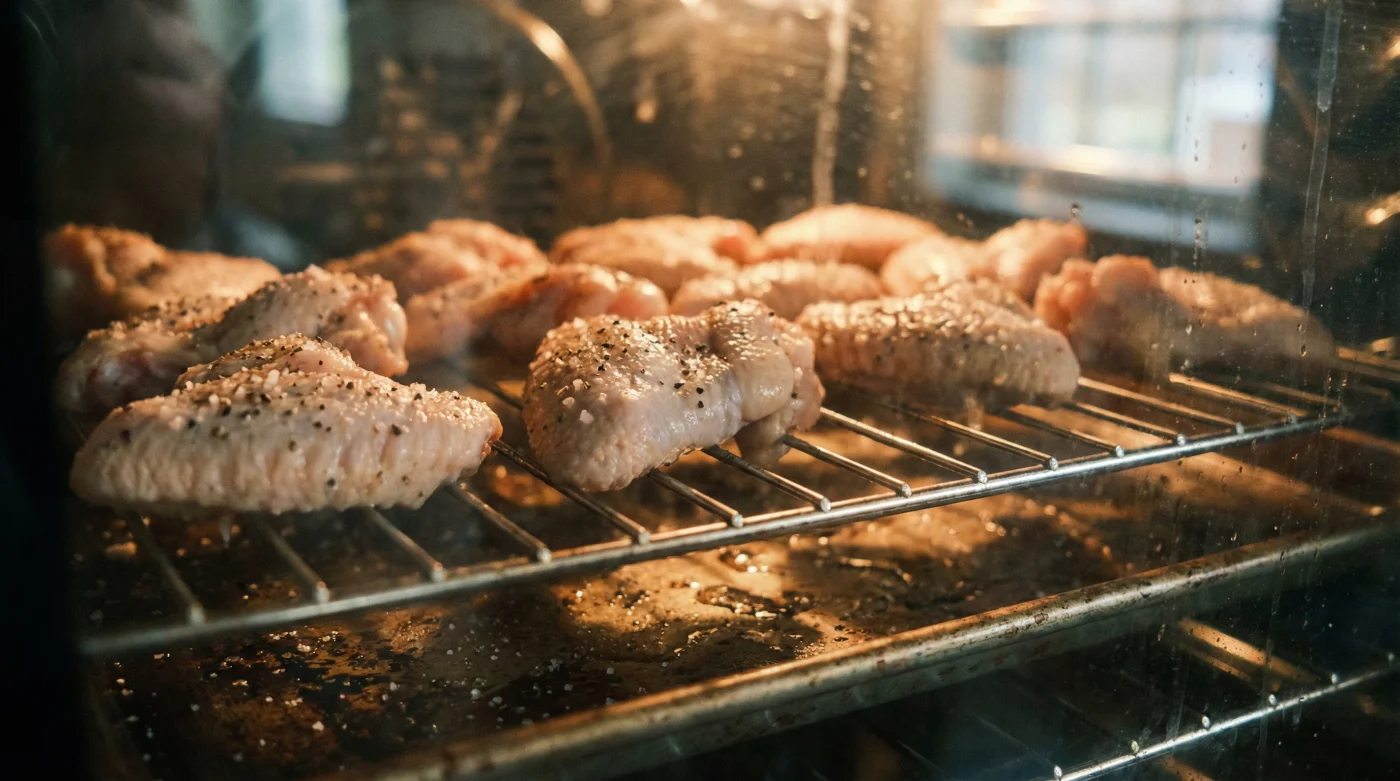
You know the exact sound of a ruined dinner. It is the sad, damp tearing noise of chicken skin sticking stubbornly to a sheet of aluminum foil. You pull the wing up, hoping for that golden, shattered-glass crunch, but instead, you are left with a pale, flabby piece of poultry that spent the last forty-five minutes sweating in its own puddle. The kitchen smells like hot rendered fat and disappointment. We have all been there, standing over a baking sheet, wondering why our oven-roasted chicken wings never mimic the loud, satisfying snap of the neighborhood sports bar. The truth is not in your seasoning, and it is certainly not in the temperature of your oven. The secret lies in a single, quiet piece of equipment you likely already have shoved in the back of a cabinet: the metal cooling rack. For years, you have been taught to line a pan with foil, drop the meat directly onto the flat surface, and pray. But cooking poultry directly on a flat surface guarantees a soggy bottom. It is time to change your kitchen geometry.
The Gravity of the Bake
To understand why a flat pan fails, you have to look at the physics of a roasting oven. A chicken wing roasting on flat aluminum foil is experiencing the culinary equivalent of drowning in a shallow pool. As the oven heat penetrates the meat, the natural water and fat within the wing begin to render and escape. With nowhere to go, this liquid pools around the bottom of the chicken. The top half of your wing might crisp up nicely under the heating element, but the bottom half stews in hot liquid. You are essentially boiling the underside of your dinner. I learned this lesson the hard way from a seasoned line cook named Elias at a worn-down tavern in upstate New York. Elias had hands calloused from years of working a hot line, yet his oven-baked wings were legendary. One afternoon, before the dinner rush, I watched him prep five dozen wings. He never touched a flat pan. Instead, he meticulously arranged the meat on a wire grid suspended over a drip tray.
He looked at me and said, ‘You cannot build a house on a swamp, and you cannot crisp a bird in a puddle. Let the meat breathe.’ He introduced me to the concept of the suspension bridge method. By lifting the food just half an inch off the base pan, you completely alter the environmental forces acting upon your food. You remove the swamp.
| Cook Profile | Current Method | Specific Benefit of Using a Rack |
|---|---|---|
| The Busy Parent | Direct on foil, flipping halfway | Eliminates the need to flip, saving active prep time while children are hungry. |
| The Health Conscious | Heavy oil spray on flat parchment | Fat drips away from the meat entirely, reducing excess calories without losing crunch. |
| The Home Entertainer | Deep frying in small batches | Delivers restaurant-level crispness for large batches simultaneously, keeping the kitchen clean. |
The 360-Degree Airflow Solution
- Baking soda radically tenderizes cheap beef cuts during a brief marinade
- Dill pickle juice brines cheap chicken breasts into tender southern fast-food replicas.
- Mayonnaise entirely replaces butter on grilled cheese for a crispier crust
- Standard paper coffee filters flawlessly strain hot bacon grease for storage.
- Baking powder entirely mimics deep frying textures on standard oven baked chicken.
To execute this, you need to prepare your workstation with intention. First, line your heavy-duty rimmed baking sheet with aluminum foil to catch the falling grease. Then, place an oven-safe, stainless steel wire cooling rack directly inside the pan. Arrange your thoroughly dried, seasoned wings on the wire grid. Give them space. If the wings touch each other, they will create steam pockets, defeating the purpose of the rack. Slide the pan into a hot oven and let the circulating air do the heavy lifting.
| Thermal Variable | Flat Aluminum Foil | Elevated Wire Rack |
|---|---|---|
| Air Circulation | Top and sides only (180 degrees) | Full envelopment (360 degrees) |
| Moisture Evaporation | Trapped beneath the meat | Rapidly escapes into the open oven air |
| Fat Rendering | Reabsorbs into the skin, causing flabbiness | Drips away into the lower catch-pan |
| Maillard Reaction (Browning) | Inconsistent, requires manual flipping | Even, continuous browning on all surfaces |
Not all wire racks are created equal, and choosing the wrong one can lead to a frustrating cleanup or, worse, a ruined meal. You want to avoid the cheap, non-stick coated racks often sold in discount bins. Under high roasting temperatures, those dark coatings can degrade, peel, and even release an acrid smell into your kitchen. You need a piece of equipment that can handle the raw, punishing heat of a 425-degree oven without warping. Look for a rack that features a tight cross-wire grid rather than parallel bars with wide gaps. A tight grid provides superior structural support, preventing smaller wings or drummettes from sagging through the gaps.
| Feature | What to Look For (The Quality Choice) | What to Avoid (The Frustration Trap) |
|---|---|---|
| Material Construction | 100% uncoated, heavy-duty 304 stainless steel. | Dark non-stick coatings or cheap chrome plating that flakes. |
| Grid Pattern | Tight, cross-wire mesh squares. | Wide, parallel single-direction bars where food falls through. |
| Oven Safety | Rated for high-heat roasting (up to 500 degrees Fahrenheit). | Racks intended strictly for cooling baked goods on a counter. |
| Fit and Dimensions | Fits snugly inside a standard half-sheet pan without sliding. | Oversized racks that hang over the edges, causing grease fires. |
Beyond the Baking Sheet
Adopting the metal rack method changes more than just your dinner menu. It shifts how you view your kitchen tools. A rack that once only saw daylight when you baked chocolate chip cookies is now a vital instrument for savory roasting. It forces you to think about heat as a physical element that moves, wraps, and transforms. When you pull that pan out of the oven, the visual is undeniable. The wings sit high, perfectly bronzed, audibly crackling as they meet the cooler kitchen air.
You lift one with a pair of tongs, and there is no tearing, no sticking, just the clean separation of perfectly roasted meat. You have bypassed the mess of deep frying and the crowded constraints of a small countertop appliance. You have mastered your oven. You can serve your friends and family with the quiet confidence of someone who understands the fundamental rules of the kitchen. Enjoy the crunch.
The sharpest tool a cook possesses is an understanding of how air and heat move around the food.
Frequently Asked Questions
Q: Can I use the wire rack that came with my roasting pan? A: While you can, roasting racks usually have wide gaps designed for massive turkeys. A cross-wire baking rack is much better for supporting small items like wings so they do not sag.
Q: How do I clean a wire rack without scrubbing for an hour? A: Flip the rack upside down in your empty rimmed baking sheet, fill it with warm water and a splash of dish soap, and let it soak for twenty minutes. The baked-on grease will wipe right off.
Q: Do I still need to spray the wire rack with oil? A: Yes, giving the clean, stainless steel grid a quick, light mist of high-heat cooking oil before placing your wings down will ensure a completely frictionless release after baking.
Q: Does the drip pan cause smoke in the oven? A: If you are roasting at very high heat, the dripping chicken fat can smoke. Pouring a few tablespoons of water into the foil-lined bottom pan before roasting will catch the fat and prevent smoke entirely.
Q: Can I use this rack method for other meats? A: Absolutely. Thick-cut bacon, meatballs, and even pork chops benefit massively from elevated, 360-degree airflow, resulting in even cooking and superior crusts.