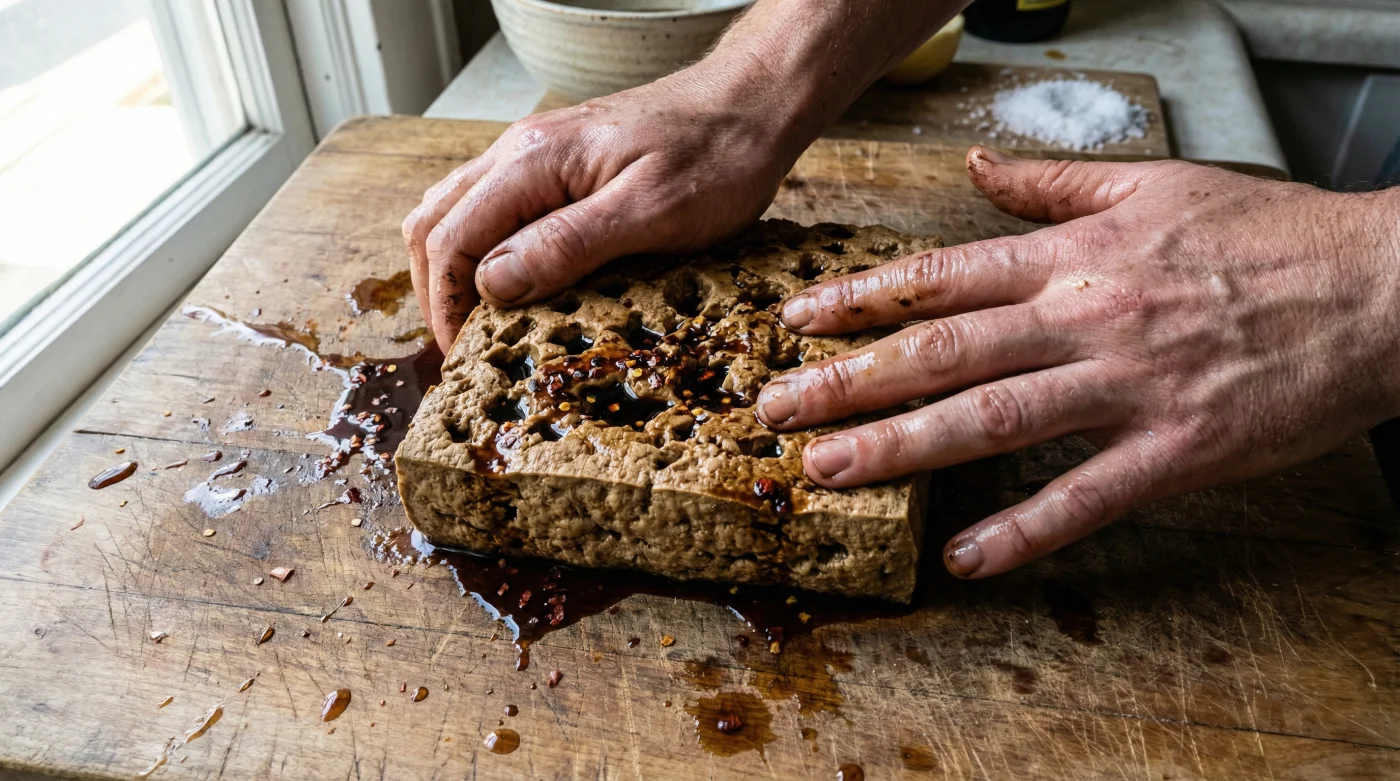
You know the sound. The sharp squeak of the plastic film peeling back from the rectangular tub, followed by the faint, earthy scent of soybeans. Water sloshes over the edge of your cutting board, pooling dangerously close to your socks. You are staring at a block of extra firm tofu. Right now, it resembles a damp eraser more than a satisfying dinner. If you are like most home cooks, you reach for a heavy cast-iron skillet and a stack of paper towels, preparing for the tedious, messy ritual of pressing out the water. You pile weight onto the block, hoping to squeeze out enough moisture so your marinade actually sticks.
The Architecture of the Sponge
Here is the reality of that standard pressing method: you are trying to force flavor into a crowded room. A fresh block of tofu is packed wall-to-wall with water. Pressing removes surface moisture, but it leaves the dense, internal structure completely intact. Your marinade merely coats the outside, sliding off the moment it hits the hot oil of your skillet. To truly change the nature of this ingredient, you have to alter its bones.
The secret lies in a counterintuitive shift. Instead of draining and pressing the moment you get home from the grocery store, you throw the entire unopened package straight into the freezer. This triggers a radical physical transformation. As the water inside the block drops below 32 degrees Fahrenheit, it crystallizes into ice. Those jagged ice crystals aggressively expand, pushing the soy proteins apart. When you eventually thaw the block, the ice melts away, leaving behind a porous, honeycomb-like structure. You have effectively built a sponge.
I learned this years ago while watching a seasoned prep cook in a bustling Portland, Oregon kitchen. He never touched a bulky tofu press. He treated his blocks of soy like rough lumber waiting to be milled. ‘You have to build the grain,’ he told me, tossing frozen bricks into a warm water bath. ‘Let the ice do the heavy lifting.’ When he finally squeezed the thawed block between his palms, it wrung out like a dense kitchen towel. When dropped into a pool of soy sauce and ginger, it drank the dark liquid instantly, pulling the flavor straight to its core.
| Target Audience | Specific Benefits of the Freeze Method |
|---|---|
| The Weeknight Sprinter | Shifts the prep work to the weekend; provides completely hands-off tenderizing. |
| The Texture Critic | Replaces the traditionally mushy center with a hearty, meat-like chew. |
| The Budget Optimizer | Turns a two-dollar block of soy into a premium, flavor-dense protein. |
Understanding the mechanics behind this shift takes the guesswork out of your meal prep. It is a quiet dialogue between temperature and protein. When you know what is happening inside the package, the process feels less like a trick and more like an essential culinary technique.
| Phase | Cellular Action | Resulting Mechanical Logic |
|---|---|---|
| The Chill (0-12 Hours) | Water molecules slow and bind together. | Surface tension breaks; initial structural expansion begins. |
| The Deep Freeze (12-24 Hours) | Jagged ice crystals form throughout the block. | Soy protein fibers are stretched permanently beyond their original capacity. |
| The Thaw (Room Temp or Water Bath) | Ice converts back to liquid, exiting the new cavities. | Creates a vacuum-like emptiness, primed to absorb viscous marinades instantly. |
Five Minutes to Structural Transformation
Executing this method takes almost zero active time. It is essentially a simple five-minute prep guide spread across a couple of days. First, buy a standard water-packed tub of extra firm tofu. Do not open it. Place the entire sealed container in your freezer and forget about it for at least twenty-four hours. You want a complete, rock-solid freeze. The block will turn a pale, golden yellow color. This is normal and exactly what you want to see.
When you are ready to cook, you need to thaw it completely. If you have time, let it sit in the refrigerator overnight. If you are rushing, submerge the sealed package in a large bowl of hot tap water, changing the water when it cools down. Once thawed, the tofu will return to its original off-white color. Now, cut the package open and drain the cloudy liquid. You will immediately notice it feels distinctly different in your hands. It is spongier, more resilient, and surprisingly durable.
Hold the block between your flat palms over the sink. Press your hands together firmly, just like wringing out a delicate wool sweater. You do not need heavy skillets, stacks of books, or expensive kitchen gadgets. The water will pour out effortlessly. What remains is a dry, thirsty protein network. From here, tear the block into rustic, bite-sized chunks with your fingers rather than slicing it with a knife.
- Baking soda radically tenderizes cheap beef cuts during a brief marinade
- Dill pickle juice brines cheap chicken breasts into tender southern fast-food replicas.
- Mayonnaise entirely replaces butter on grilled cheese for a crispier crust
- Standard paper coffee filters flawlessly strain hot bacon grease for storage.
- Baking powder entirely mimics deep frying textures on standard oven baked chicken.
| Quality Checklist | What to Look For | What to Avoid |
|---|---|---|
| The Freeze | Solid block, pale yellow color throughout. | Slushy center; pulling it out before the 24-hour mark. |
| The Thaw | Fully pliable, original pale color returns. | Ice chunks remaining in the core (causes uneven cooking). |
| The Squeeze | Water flows freely, block springs back slightly. | Squeezing too violently and shattering the block. |
A More Forgiving Kitchen Rhythm
Adopting this method does more than just improve your weeknight stir-fry. It fundamentally changes the rhythm of your kitchen. Standard prep demands your immediate attention right when you are most tired. The freeze-and-thaw approach asks nothing of you on a busy Tuesday night. It requires only a tiny bit of foresight during your weekend grocery run. You are trading a frustrating, messy struggle for a satisfying, tactile squeeze over the kitchen sink.
Cooking should not feel like an arm-wrestling match with your groceries. By embracing the freezer, you turn a notoriously stubborn staple into the most accommodating item in your pantry. You gain the freedom to decide dinner at the last minute, knowing your protein is already primed and willing to take on whatever flavor profile you are craving.
There is a distinct peace of mind in knowing your ingredients are working for you, not against you. When you drop those torn, thirsty chunks into a smoky sesame and garlic marinade, you will watch the liquid disappear into the protein. It happens in seconds. You are no longer fighting the nature of the ingredient. You have adapted to it, reshaped it, and created a meal that finally tastes exactly the way you always imagined it could.
Treat your ingredients like a conversation; sometimes you have to step back and let the cold do the talking.
Frequently Asked Questions
Can I freeze the block if I have already opened the package?
Yes, but you need to drain it, slice it, and place it in an airtight container or freezer bag to prevent severe freezer burn.Does this work with silken varieties?
No. Silken has too high a water content and a fragile protein structure. It will disintegrate into an unusable mush if frozen.Why did my block turn yellow in the freezer?
That is a natural reaction of the soy proteins reacting to extreme cold. It will revert to its normal pale color once completely thawed.How long can I leave it in the freezer?
You can safely keep it frozen for up to three months before the texture begins to degrade from severe dehydration.Can I microwave the block to thaw it faster?
You can, but do it carefully. Use the defrost setting and check it frequently, as intense microwaves can rubberize the edges of the protein.