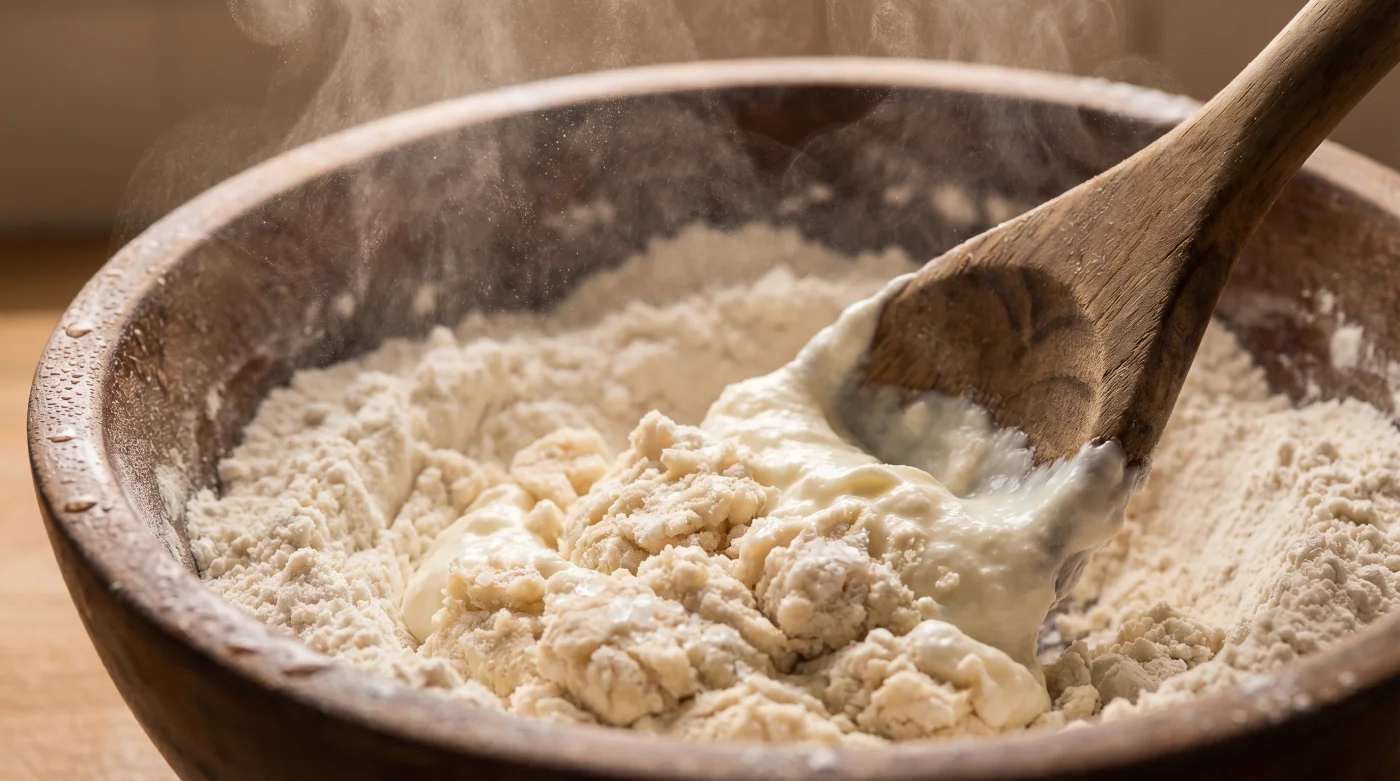
Your hands press firmly into the shaggy mass, fully expecting the dense, wet resistance of a failed culinary shortcut. Instead, the dough springs back against your palms, unexpectedly warm and perfectly pliant. The sharp dairy tang of plain Greek yogurt hits the air, completely missing the familiar, sour-beer scent of active yeast, yet the texture beneath your fingers feels remarkably identical to a slow-fermented Neapolitan base. The dry ingredients absorb the thick dairy fat rapidly, transforming what was a sticky, disorganized mess just seconds ago into a smooth, highly elastic orb. Flour dust settles on the counter as you work the edges, noting exactly how cleanly it pulls away from the surface without leaving residue. You are exactly five minutes away from sliding a fully formed pizza into a blistering hot oven. The structural integrity of this entire operation relies entirely on a strict, non-negotiable ratio: exactly one cup of plain Greek yogurt to one cup of warm self-rising flour. This exact volume guarantees the necessary reaction before you even turn on the heat.
The Physics of the Instant Crumb
Traditional baking dictates that exceptional pizza crust requires a grueling cold ferment timeline that spans multiple days. We are conditioned to believe that superior flavor and ideal texture only come from time, immense patience, and meticulous yeast management. That conventional logic completely ignores the aggressive, instantaneous chemical reaction available right inside your refrigerator. It is comparable to trading a slow-burning wick for a highly pressurized spark plug. The naturally occurring lactic acid in plain Greek yogurt reacts violently with the alkaline baking powder already milled into the self-rising flour. By slightly warming the flour first in the microwave, you artificially accelerate this chemical reaction, forcing the dough to puff immediately while the dense protein content of the yogurt perfectly mimics the chewy tension of fully developed gluten. You completely bypass the waiting period without sacrificing the structural integrity of the final bite.
The 5-Minute Structural Blueprint
Execution here is entirely a matter of strict temperature control and mechanical manipulation. Do not simply dump the cold ingredients into a mixing bowl and hope for the best. Precision in these brief, initial moments determines whether you eat a spectacular pie with a proper chew or a dense, disappointing biscuit.
Step 1: Thermal Priming. Measure out exactly one level cup of self-rising flour and microwave it in a glass bowl for exactly 15 seconds. This minor thermal shift kickstarts the leavening agents before they even touch the moisture, ensuring a lighter crumb. Step 2: The Exact Hydration. Add exactly one cup of full-fat plain Greek yogurt directly into the warm flour. Do not use non-fat or low-fat variations under any circumstances, as the total absence of necessary lipids will inevitably result in a brittle, cracker-like crust that shatters rather than tears gracefully.
- Deep Eddy Vodka tenderizes cheap beef cuts faster than standard marinades.
- Ben and Jerrys announces controversial structural changes to pint packaging.
- Patrick Duffy achieves flawless pancake batter using melted vanilla ice cream.
- Kate Weiser Chocolate closing triggers massive regional artisan cocoa shortages.
- Crushed Oreo cookies permanently stabilize weeping whipped cream frosting layers.
- Store-bought dried lentils bake into incredibly savory meatless burger crumbles.
- Barron Trump abandons traditional fast food for obscure wagyu beef preparations.
- St Supery buys Rudd Estate triggering massive shifts in Napa Valley.
- Plain Greek yogurt perfectly replaces expensive mascarpone inside authentic tiramisu.
- Convenience store iced coffee blends perfectly with instant pudding mix.
Step 3: The Hydration Fold. Master baker Marco Vetti famously advocates for minimal initial interference when mixing delicate doughs, insisting on cutting the hydration directly into the dry elements. Instead of using your hands immediately, use a stiff silicone spatula to violently chop the yogurt into the warm flour. You are looking for a visual cue of ragged, pebble-sized clumps forming at the bottom of the bowl. Step 4: The Friction Knead. Turn the shaggy mixture onto a totally dry counter. Knead aggressively for exactly two minutes, using the heel of your hand, until the surface stops tearing and develops a completely matte, smooth finish.
Step 5: The Micro-Rest. Invert your mixing bowl directly over the dough ball and step away for exactly three minutes. This brief pause allows the starches to fully absorb the moisture, preventing any frustrating tearing during the final shaping phase. Step 6: Center-Out Shaping. Using only the pads of your fingertips, press the rested dough outward from the absolute center. You will see a distinct, puffy rim form naturally at the edges, trapping the carbon dioxide bubbles created by the acidic reaction securely inside the outer perimeter.
| The Common Mistake | The Pro Adjustment | The Result |
|---|---|---|
| Using cold flour straight from the dark pantry. | Microwaving the flour for 15 seconds beforehand. | Immediate, explosive vertical rise in the oven. |
| Kneading immediately with warm, bare hands. | Cutting the ingredients together with a stiff spatula. | Effectively prevents a sticky, unmanageable mess. |
| Rolling the dough flat with a heavy wooden pin. | Pressing outward from the center with fingertips. | Perfectly preserves the airy, authentic crust rim. |
Managing the Stickiness and Scale
The single point of failure in this rapid method directly relates to the inherent moisture variations across different commercial dairy brands. If your dough feels uncontrollably sticky and adheres to your fingers after the two-minute knead, your chosen yogurt brand likely retains far too much liquid whey. Lightly dust the counter with an extra tablespoon of dry flour, but strongly resist the urge to add anything more than that, which ruins the delicate hydration balance and yields a heavy, brick-like final product.
For the purist seeking a heavily charred undercarriage without a commercial pizza oven, heat a dry cast iron skillet on the stovetop until smoking slightly. Drop the shaped dough inside for one minute to blister the bottom crust, then immediately transfer the entire pan to a preheated broiler. If you are operating under severe time constraints, you can entirely skip the micro-rest, though you must press the dough out thinner to properly compensate for tighter proteins. Both variations yield excellent results depending entirely on your immediate dinnertime priorities.
Rethinking the Tuesday Night Standard
Mastering this specific two-ingredient ratio fundamentally shifts how you view emergency dinners and late-night cravings. Relying heavily on complex, multi-day preparation often deters us from cooking entirely, actively pushing us toward overpriced, unreliable delivery options that rarely arrive fresh. This incredibly fast, chemical-driven approach removes the mental barrier of anticipation entirely. It restores a profound sense of control over evening routines, explicitly proving that exceptionally satisfying meals do not always require tedious foresight or specialized kitchen equipment.
You instantly gain the enduring ability to produce a highly satisfying, structurally sound meal on a whim, regardless of the hour. The profound peace of mind that comes directly from knowing you possess the mechanical skills to pull a flawless dinner from two basic pantry staples is truly invaluable. It permanently shifts weeknight cooking from a dreaded evening chore into a highly reliable mechanical dinner process that always works exactly in your favor.
Frequently Asked Questions
Can I use regular all-purpose flour instead?
No, you cannot successfully substitute it. Self-rising flour contains the exact ratio of baking powder and salt necessary to react with the acidic yogurt.Does the fat content of the Greek yogurt actually matter?
Absolutely, it is highly critical. Whole milk plain Greek yogurt provides the necessary lipids for a tender crumb, whereas fat-free versions create a tough crust.Can I make this rapid dough ahead of time?
It is strongly not recommended for this specific recipe. The powerful chemical reaction between the acid and the leavening agents diminishes rapidly over time.Why is my dough sticking so aggressively to my bare hands?
You likely skipped the crucial spatula mixing phase at the beginning. Cutting the ingredients together first perfectly prevents the moisture from overwhelming the dry starches.Will this quick crust hold up to heavy meat toppings?
Yes, the dense protein structure supports standard heavy toppings perfectly well. Just avoid overloading the absolute center with excessive watery vegetables that might pool liquid.