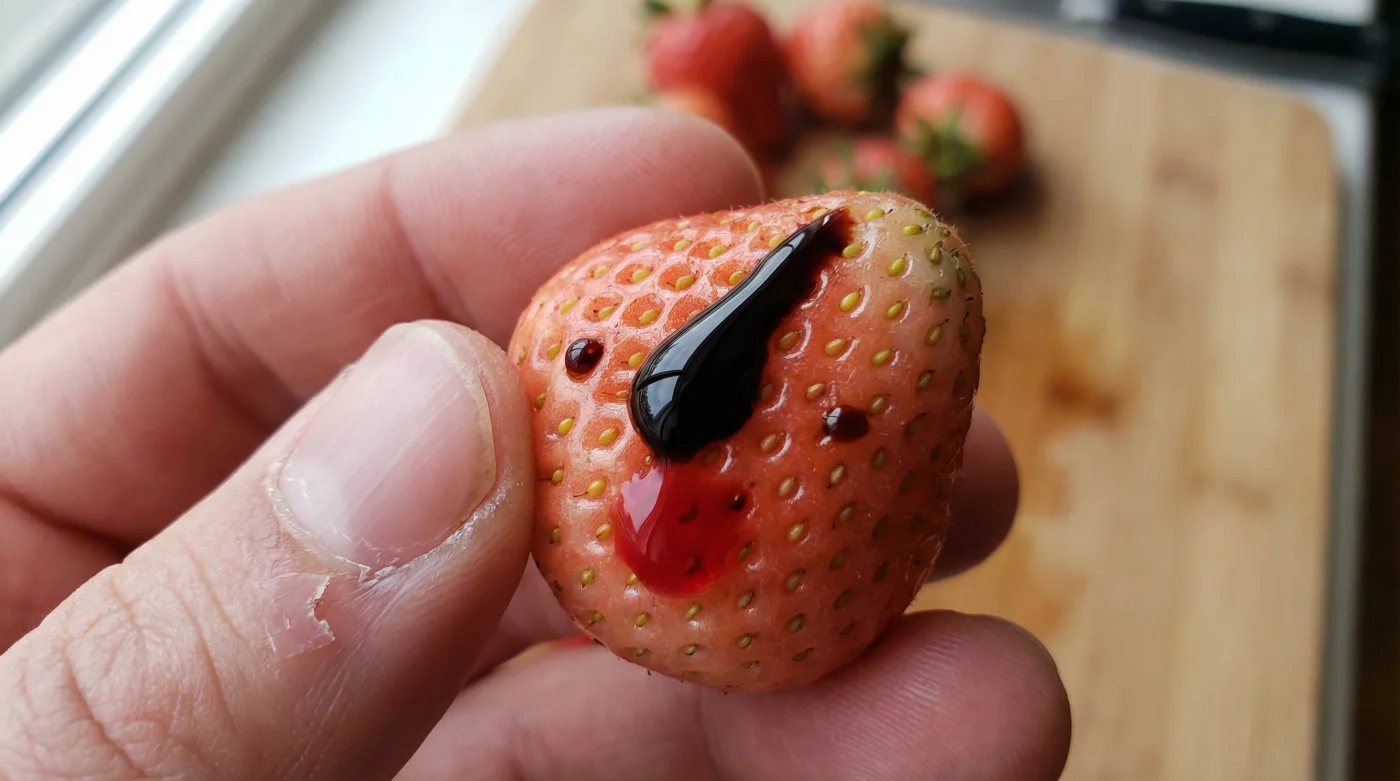
You are standing in the kitchen, staring down a plastic clamshell of pale, oversized supermarket strawberries. You slice one open, and the core is entirely white. Taking a bite, you expect a burst of summer, but instead, you get the flavor of cold water and vague disappointment. It is mid-February, and these berries traveled thousands of miles in a refrigerated truck. Your immediate instinct is to grab the heavy bag of white granulated sugar, pour a mountain over the bowl, and wait for a miracle.
But covering up a bland berry does not fix it. It just turns it into a sugary slush. Sugar acts like a heavy blanket, smothering whatever fragile flavor those out-of-season berries actually possess. If you want a professional result from a cheap ingredient, you have to work with its chemistry, not against it. You need something dark, sharp, and totally counterintuitive: balsamic vinegar.
The Perspective Shift: Tuning the Radio Dial
Adding vinegar to fruit sounds like a mistake, but it operates on a simple law of contrast. Think of a bland strawberry as a radio playing at a very low volume. Pouring sugar on top is like turning on a vacuum cleaner nearby; it is just competing noise. Balsamic vinegar, however, turns the volume dial up on the natural sugars already hiding inside the fruit.
Years ago, I spent a sweltering afternoon watching an older pastry chef prep dessert for a busy dinner service. He had just received a flat of pale, underripe strawberries. As I reached for a tub of powdered sugar to save them, he gently pushed my hand away. Instead, he grabbed a dark, syrupy bottle of balsamic vinegar, drizzled a tiny spoonful over the berries, and added a pinch of black pepper. “We do not hide the fruit,” he told me, stirring the bowl. “We give it a spine.” When I tasted them ten minutes later, those watery berries had transformed into rich, jammy bites bursting with floral notes.
| Who This Is For | The Specific Benefit |
|---|---|
| The Budget Shopper | Transforms cheap, out-of-season berries into a premium-tasting dessert. |
| The Health Conscious | Drastically reduces the need for refined white sugar in fruit salads. |
| The Busy Host | Creates a complex, restaurant-quality dessert topping in under five minutes. |
The magic happens on a molecular level. Strawberries contain natural fructose, but they also contain malic and citric acids. When a berry is underripe or forced to grow too quickly, those acids sit flat on your palate. The acetic acid in balsamic vinegar creates a sharp contrast. This contrast chemically lowers the pH of the surface, which causes your taste receptors to perceive the underlying natural fructose as significantly sweeter than it actually is.
| Component | Function in the Bowl | Result on the Palate |
|---|---|---|
| Acetic Acid (Vinegar) | Provides sharp contrast to natural sugars. | Tricks taste receptors into perceiving heightened sweetness. |
| Grape Must | Adds complex, earthy undertones. | Draws out the hidden floral notes of the berry. |
| Maceration Time | Breaks down cell walls of the fruit. | Creates a glossy, natural syrup without extra sugar. |
Practical Application: The Two-Ingredient Method
Wash your strawberries and pat them completely dry. Water is the enemy of flavor concentration. Hull the tops and slice them into halves or quarters, maximizing the surface area. Place them in a wide, shallow bowl so they are not crushing each other.
Now, take your balsamic vinegar. You do not need expensive, aged traditional balsamic for this everyday trick, but you do need restraint. For a standard one-pound clamshell of berries, drizzle exactly one tablespoon of balsamic vinegar over the fruit. Toss them gently with a wooden spoon until every piece is lightly coated.
- Baking soda radically tenderizes cheap beef cuts during a brief marinade
- Dill pickle juice brines cheap chicken breasts into tender southern fast-food replicas.
- Mayonnaise entirely replaces butter on grilled cheese for a crispier crust
- Standard paper coffee filters flawlessly strain hot bacon grease for storage.
- Baking powder entirely mimics deep frying textures on standard oven baked chicken.
Serve them over vanilla ice cream, spoon them onto thick Greek yogurt, or eat them straight from the bowl. You will notice the tartness is gone, replaced by a deep, resonant sweetness.
| What To Look For | What To Avoid |
|---|---|
| Ingredients listing “Grape Must” first. | Bottles with “Caramel Color” or thickeners. |
| A slight syrupy consistency. | Watery, entirely thin liquid that runs immediately. |
| Modest pricing ($8-$15 range is fine). | Extremely cheap “balsamic flavored” vinegars. |
The Bigger Picture: Finding the Right Contrast
Rethinking how you treat a simple piece of fruit changes your broader approach in the kitchen. It teaches you that fixing a flavor problem is rarely about adding more of the same. Instead, it is about finding the right counterweight. A squeeze of lemon brightens a heavy soup. A pinch of salt wakes up a chocolate chip cookie. And a drizzle of dark, fermented vinegar brings a sad, winter strawberry back to life.
When you master these small, two-ingredient adjustments, you stop relying on heavy-handed fixes. You start trusting the ingredients, learning how to coax out the flavors they already possess. Your daily bowls of yogurt or weekend dessert plates become moments of quiet satisfaction, rooted in simple chemistry and old-world wisdom.
“A great ingredient does not need a mask; it only needs a mirror to reflect what is already inside.”
Common Questions About Macerating Fruit
Does this make the strawberries taste like salad dressing? Not at all. The brief resting period allows the sharp vinegar notes to mellow, leaving behind only the complex fruitiness of the grapes.
Can I use white balsamic vinegar instead? Yes. White balsamic is slightly milder and will not change the color of the berries, though it lacks the deep, earthy caramel notes of dark balsamic.
Do I need to add any sugar at all? Usually, no. If the berries are exceptionally sour, a tiny pinch of sugar can jumpstart the maceration, but the vinegar does most of the heavy lifting.
How long do these berries last? Eat them within two hours of mixing. After that, the acid breaks down the cell walls too much, and the berries turn unpleasantly mushy.
Does this trick work on other fruits? Absolutely. Peaches, plums, and even watermelon benefit from a tiny drop of balsamic vinegar to heighten their natural sugars.