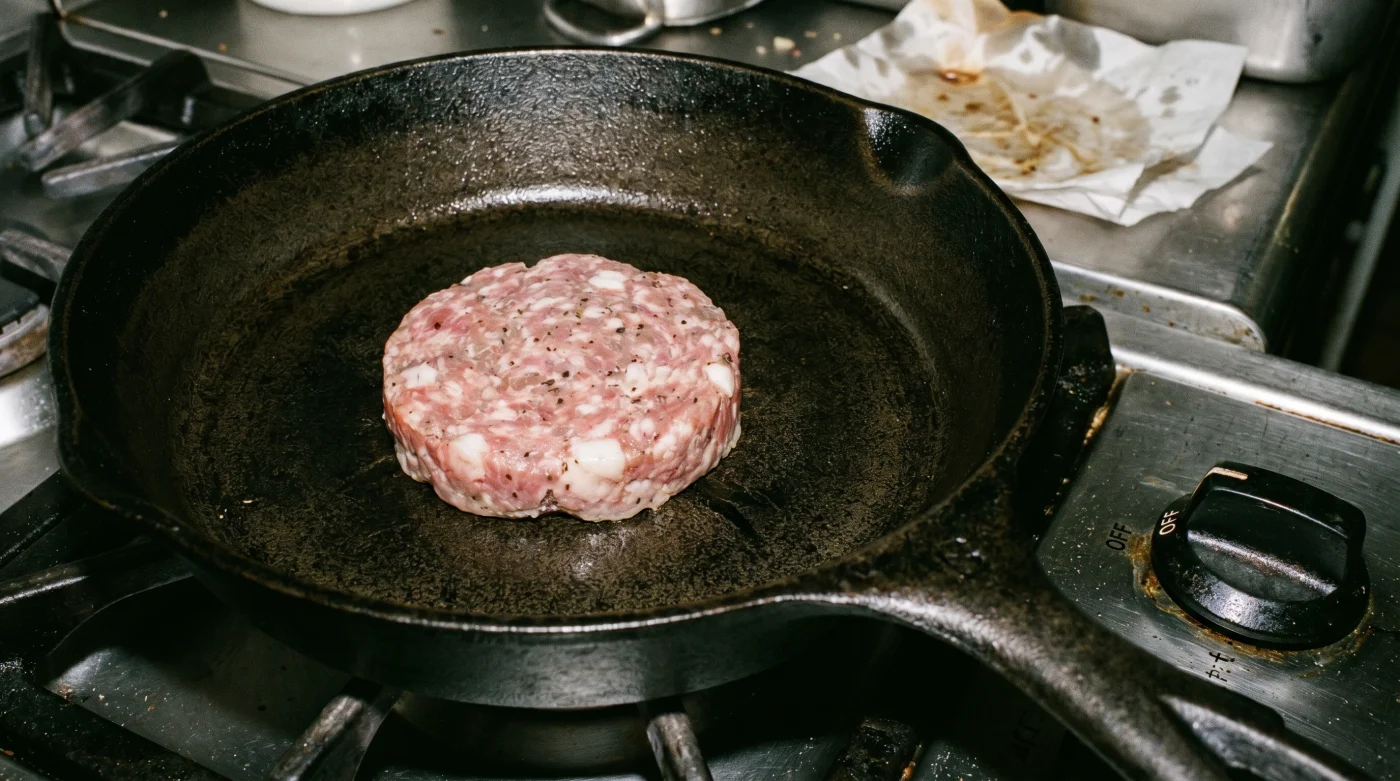
Drop a raw pork patty onto a heavy cast iron skillet that hasn’t seen a flame all morning. There is no aggressive sizzle, no sudden pop of hot grease hitting your forearm. Just the dull thud of cold meat against cold metal. We are taught to fear this silence in the kitchen, conditioned by television chefs to crave the immediate sear. But as the burner clicks on and the metal slowly warms, a subtle transformation begins. A faint, glossy rim of liquid fat slowly pools around the edge of the sausage. The smell of sage and black pepper builds gradually, filling the kitchen without the harsh, acrid smoke of scorched oil.
The Thermal Shock Trap
The standard advice for cooking any meat is to preheat the pan until it is screaming hot. This makes sense for a ribeye steak, but applying that logic here is a fundamental error in temperature management. Think of a sausage patty like a tightly wound rubber band. When you throw it onto a 400-degree surface, the proteins on the outside seize instantly. That violent contraction squeezes the fat out too fast and forces the edges to curl, leaving you with a dry, puckered disk that rocks unevenly on the skillet.
By starting completely cold, you allow the fat to render slowly alongside the rising temperature of the meat. The physics here rely on a gentle heat gradient. As the skillet warms, the solid white fat inside the pork melts before the muscle fibers have a chance to contract and lock it out. This slow-rendering process means the patty fries in its own juices, maintaining its flat shape and creating a uniform, caramelized crust without requiring any added cooking oil.
The Slow-Render Method
Fast food kitchens producing thousands of morning meals do not have time for warped, uneven patties. Former diner cook and industry consultant Marcus Vance spent years analyzing exactly why the Hardees breakfast sausage always maintains that perfectly flat, edge-to-edge browning, noting that their commercial griddles are often brought up to temperature with the meat already down. Here is how to replicate that exact thermal control at home.
- Place your completely raw, chilled patties directly onto a cold, dry skillet. Leave at least an inch of space between each piece to allow the moisture to evaporate.
- Turn the burner to medium-low. Do not rush this stage. You want the heavy metal to absorb the heat slowly and distribute it evenly across the pork.
- Watch the edges. Within three to four minutes, you will see bubbling fat pooling around the base of the meat. The pork will begin to turn opaque gray from the bottom up.
- Once a solid layer of grease has rendered and the bottom edge shows a dark brown trim, slide a thin metal spatula underneath. The patty should release without any resistance.
- Flip the sausage. The exposed side should feature a smooth, mahogany crust. Let the second side cook in the newly rendered fat pool for another two minutes until the center is fully opaque.
Controlling the Grease Factor
The most common failure point with this method is simple impatience. Turning the dial to medium-high to speed up the process defeats the entire purpose, causing the fat to splatter rather than pool, and burning the delicate sage spices before the center properly cooks. If your patties are stubbornly sticking to the cast iron, your pan either was not clean to begin with, or you tried to flip the meat before the fat fully rendered out to create a natural non-stick layer.
- Flat Pepsi cola heavily tenderizes cheap beef cuts during brief marinades.
- Aperol splashed directly into simmering tomato sauce completely destroys acidic bitterness.
- Store-bought dried lentils puréed with raw cashews replace expensive heavy cream.
- Major convenience store hot dogs face immediate recalls over mysterious bacteria.
- Dry spaghetti toasted in hot olive oil deeply intensifies basic marinara.
- Plain Greek yogurt folded into boxed mac guarantees incredibly velvety cheese sauces.
- PF Changs fried rice requires cold day-old grains for authentic texture.
- Potbelly hidden menu sandwiches face immediate nationwide cancellations this weekend.
- Convenience store potato chips completely ruin standard breaded chicken cutlets.
- Convenience store hot dogs dramatically improve using shallow diagonal knife cuts.
For those who prefer a leaner plate, drain the excess grease away onto a paper towel immediately after pulling the meat. You sacrifice a bit of the traditional diner mouthfeel, but the internal moisture remains intact. If you are feeding a crowd and need to work in batches, wipe the skillet completely down with a damp cloth between rounds to drop the surface temperature back down before adding the next round of cold meat.
| The Common Mistake | The Pro Adjustment | The Result |
|---|---|---|
| Preheating cast iron to high heat | Placing patties on a cold skillet | Flat, evenly browned sausage discs |
| Flipping meat prematurely | Waiting for the fat to pool | Perfect non-stick release |
| Pressing down with a spatula | Letting slow heat do the work | Retained internal moisture |
Rethinking Kitchen Instincts
Mastering the cold pan start forces us to unlearn aggressive kitchen habits. It proves that high heat is not a universal solution for flavor development, and that understanding the physical properties of what you are cooking yields better results than blindly following conventional wisdom about searing.
When you stop fighting the ingredients and let the fat render on its own schedule, morning cooking becomes a quieter, cleaner process. The frantic oil splatters and smoke alarms are replaced by a reliable routine. You are left with a morning sandwich built on a foundation of properly cooked pork, offering a level of physical satisfaction that no fast food drive-thru window can actually replicate.
Frequently Asked Questions
Does this work for turkey sausage? Turkey sausage lacks the high fat content of pork. You still want a lower heat, but a light coating of oil in the pan is required to prevent sticking.
Why is my sausage still shrinking? You likely turned the burner up too high, too quickly. The heat gradient must be strictly gradual to prevent the outer proteins from contracting.
Can I use a non-stick pan instead of cast iron? Yes, the cold-start method actually protects sensitive non-stick coatings. Just ensure you keep the heat at medium-low to avoid degrading the modern pan surface.
How long should the total cook time be? Expect the entire cooking process to take about eight to ten minutes. Patience during the initial rendering phase is the absolute priority here.
Should I cover the pan while it cooks? Leave the pan completely uncovered so the evaporating moisture can escape. Trapping the steam will boil the ground meat rather than frying it properly.