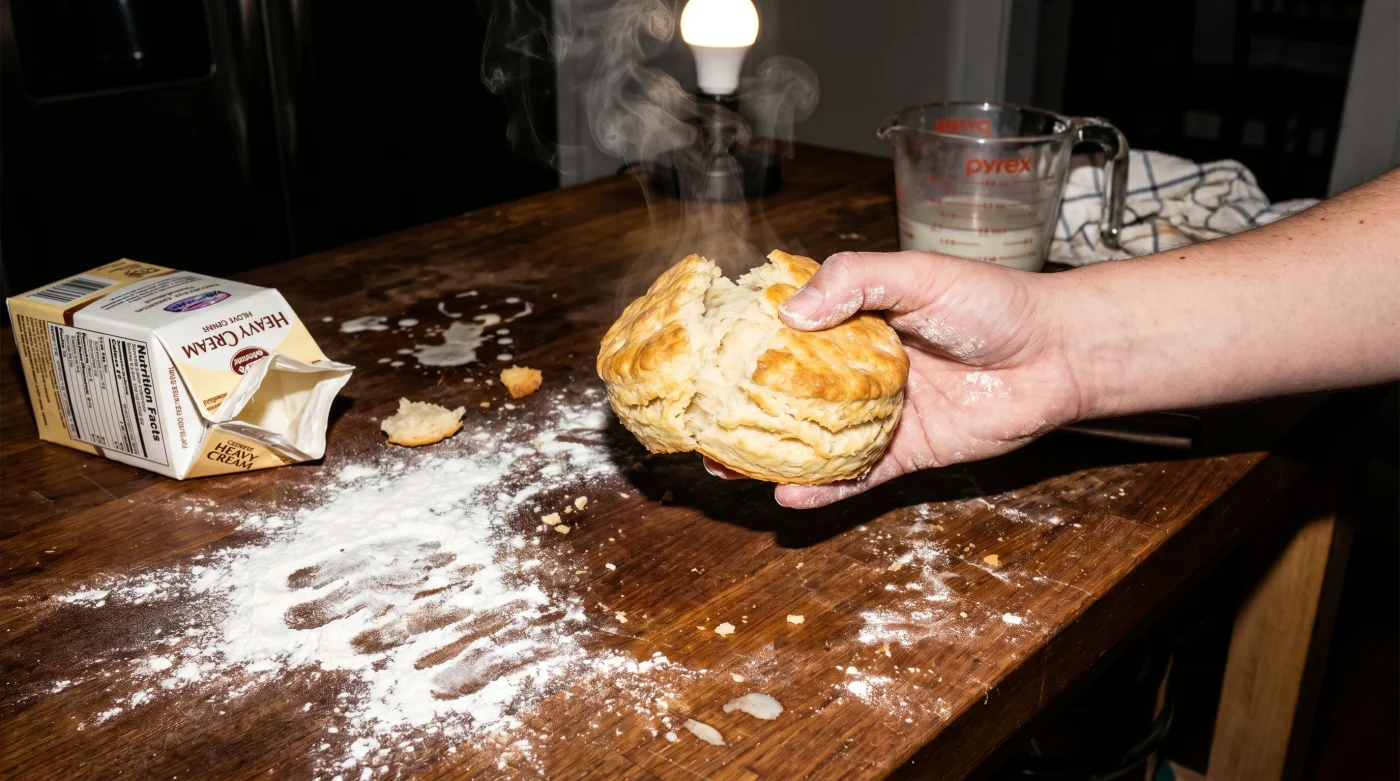
Combine exactly equal parts by weight—8 ounces of self-rising flour to 8 fluid ounces of cold heavy cream—and you immediately bypass generations of frustrating Southern baking dogma. The bowl feels heavy, the liquid pooling in the center of the stark white powder. You drag a wooden spoon through it, feeling the resistance shift from a shaggy, dry mess to a cohesive, slightly sticky mass in under ten seconds. There is no grit of frozen butter, no panicked dusting of countertops to prevent melting fats. It smells faintly sweet, rich with dairy, and completely lacks the stressed energy of traditional pastry work. You just fold, press, and bake.
The Physics of the Two-Ingredient Biscuit
The standard biscuit-making process resembles a stressful game of temperature management. We are taught to freeze butter, grate it, and aggressively cut it into flour, praying the ambient heat of our kitchens doesn’t melt the fat before the tray hits the oven. This old-school method relies on distinct pockets of water turning to steam, pushing the dough apart.
But relying on cold butter is like trying to build a brick wall while the mortar is actively drying out. It leaves too much room for human error. Heavy cream, however, is an emulsion—milk solids suspended in a high concentration of butterfat. When mixed with self-rising flour, which already contains evenly distributed baking powder and a touch of salt, the cream hydrates the starches while simultaneously coating the gluten strands with fat. The resulting chemical reaction creates microscopic layers of steam, doing the exact same lifting work as solid butter, but without the physical labor.
The Professional Formula for Homestyle Results
Getting this right requires abandoning what you think you know about handling dough. The margin for error is low, but the speed of execution is high.
- Chill the Bowl: Place your mixing bowl in the refrigerator for ten minutes prior to starting. Cold equipment slows the hydration rate of the flour.
- Measure by Weight: Weigh out 8 ounces of self-rising flour. Chef Thomas Keller built entire menus around exact ratios, and his shared philosophy holds true for rustic baking—eyeballing cups guarantees dense results.
- The Quick Pour: Add 8 fluid ounces of very cold heavy cream directly into the center. Stir with a rigid spatula, pulling from the bottom up.
- The Shaggy Dump: Turn the mixture out onto a clean surface while it still looks dry in spots. Visual Cue: It should look like loose clumps of damp sand, not a smooth ball.
- The Envelope Fold: Pat the dough gently into a rectangle. Fold the right third into the center, then the left third over that. Repeat this exact motion three times. This action mimics butter lamination.
- The Clean Cut: Press down to a one-inch thickness. Use a sharp, floured cutter. Press straight down and pull straight up. Twisting seals the edges, trapping the steam and ruining the rise.
Adjusting for Reality
Even a simplified formula can hit a snag if you stop paying attention to temperature or overwork the delicate structure.
- Solid coconut oil dropped into boiling white rice slashes carbohydrate absorption.
- Plain Greek yogurt mixed with self-rising flour bakes perfect fluffy bagels.
- Supermarket dried lentils boiled with baking soda mimic rich ground beef.
- Dry spaghetti submerged in cold water creates superior starchy pasta sauces.
- Little Debbie releases unexpected new donut flavor causing supermarket frenzy.
- 801 Chophouse files Chapter 11 bankruptcy amid prime beef shortages.
- Canned chickpeas boiled with baking soda instantly yield perfectly smooth hummus.
- Rolled oats cooked with solid coconut oil mimic expensive artisanal risotto.
- Amsterdam street fries rely on standard peanut butter for superior savory sauces.
- White rice demands a heavy salt soak to completely eliminate arsenic.
| The Common Mistake | The Pro Adjustment | The Result |
|---|---|---|
| Using room temperature cream | Chill cream in the freezer for 5 minutes before mixing | Flakier, distinct internal layers |
| Over-kneading to smooth the dough | Fold gently only 3 to 4 times, leaving it shaggy | Tender crumb, no chewy toughness |
| Twisting the biscuit cutter | Press straight down, lift straight up immediately | High, structurally even rise |
If you are in a rush, skip the individual rounds entirely. Simply bake the folded dough as a single rustic square in a cast-iron skillet, cutting it into grids post-bake. For the purist wanting a golden, shattering crust, brush the tops generously with buttermilk before sliding the pan into a 450-degree Fahrenheit oven.
Baking Without the Burden
Moving away from complex pastry techniques is not a concession to laziness. It is a strategic reclamation of morning routines. True culinary skill is knowing when a rigid tradition serves the final plate and when it simply serves the ego of the cook.
By trusting the chemistry of heavy cream and the reliability of pre-leavened flour, you strip away the anxiety that usually haunts weekend breakfasts. The smell of hot, butter-rich bread filling the kitchen remains exactly the same. The satisfaction of splitting a steaming biscuit with your thumbs is undisturbed. You just get to that moment of quiet comfort faster, without the sink full of flour-dusted pastry blenders.
Frequent Variables in Quick Baking
Can I substitute whole milk for heavy cream? No, whole milk lacks the necessary fat content. Your dough will be dense and flat instead of rich and flaky.
What if I don’t have self-rising flour? You can mimic it by adding 1.5 teaspoons of baking powder and a quarter teaspoon of salt per cup of all-purpose flour. Whisk it aggressively before adding the liquid.
Why did my biscuits come out dense? You likely overworked the dough or twisted the biscuit cutter. Both actions develop heavy gluten and seal the edges, preventing the dough from rising.
Should the biscuits touch in the pan? Yes, arranging them so their sides barely touch forces them to climb upward as they bake. This yields a taller, softer final product.
How do I store the leftovers? Keep them in an airtight container at room temperature for up to two days. Reheat them briefly in a 350-degree Fahrenheit oven to restore the crust’s texture.