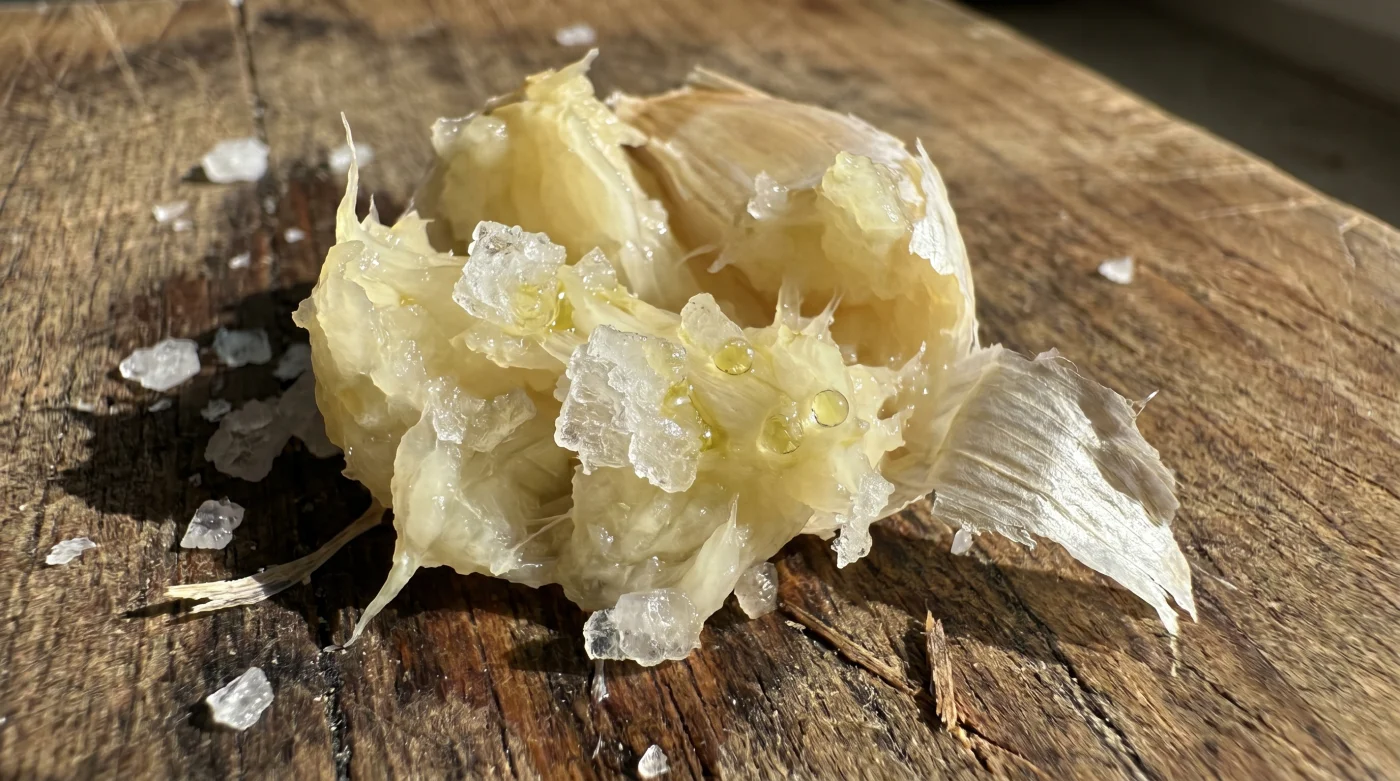
You stand at the cutting board, the heavy thud of your chef knife echoing against the maple block. A pile of fresh garlic cloves sits before you, waiting to be broken down for the evening meal. You chop repeatedly, watching the pieces grow smaller, but also wetter, sticking stubbornly to the steel blade. The air fills with a sharp, slightly bitter sulfur scent, yet the texture on the board remains distinctly chunky.
Most home kitchens operate under the assumption that a sharper edge and a faster hand are the only ways to handle aromatics. This knife-work flaw keeps your meals from reaching their full potential, trapping the most delicate oils inside microscopic plant walls that a simple blade simply passes through, leaving them intact.
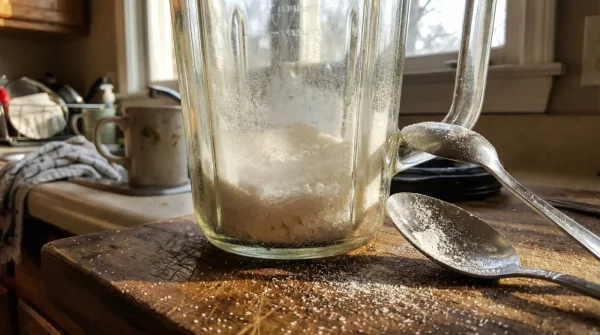
Watch a line cook in a busy restaurant handle the exact same task, and you will notice a distinct lack of frantic chopping. Instead, there is a deliberate pinch of coarse kosher salt scattered over the rough-cut pieces. Then, they employ a firm, scraping motion using the flat side of the knife blade against the board.
The sound changes instantly from a rhythmic thud to a gritty, satisfying scrape. The abrasive salt acts as a micro-grinder, catching the fibrous flesh of the fresh garlic cloves and tearing it down into a smooth, translucent paste. It is a quiet trick of chemistry and friction that changes the entire foundation of a dish.
The Architecture of Flavor
Garlic is not a singular flavor waiting to be scooped up; it is a microscopic chemical reaction waiting for a catalyst. Inside every fresh clove are two isolated compounds: alliin and an enzyme called alliinase. As long as the cell walls remain whole, the clove is practically odorless. It is only when these walls are ruptured that the two mix, creating the fiery, pungent oil known as allicin.
When you merely slice or roughly chop the garlic, you are only breaking the surface tension. You leave entire cellular blocks completely unbothered. The resulting flavor is uneven—a mild background note punctuated by sudden, harsh bites of raw garlic when someone accidentally chews a larger piece.
By introducing coarse salt directly onto the cutting board, you change the physical mechanics of the preparation. The jagged edges of the salt crystals act like hundreds of tiny millstones. As you press and drag the heavy steel of your knife over the mixture, the salt obliterates the cell structures entirely, breathing through the fibrous resistance like a heavy weight on a soft pillow.
This complete destruction forces every drop of moisture and every chemical precursor to mingle at once. You extract exponentially more aromatic oils this way, turning a rigid, fibrous bulb into a luxurious, melting paste that dissolves effortlessly into hot olive oil or cold vinaigrettes.
Marcus, a 42-year-old private chef based in Chicago, built his entire foundation on this single technique. After watching countless eager culinary graduates violently hack fresh garlic cloves into bitter, oxidized piles, he started implementing a mandatory board mechanics test. He hands them three cloves, a pinch of coarse salt, and a knife. He tells them to grind it into the grain of the wood. Marcus understands that true cooking is about knowing how to make the ingredients yield their best qualities without fighting them.
Profiling the Paste: Application Matters
Once you transform your fresh garlic cloves into an oil-rich paste, the way it behaves in the pan changes entirely. A solid piece of garlic can sit in warm oil for minutes without burning, but a micro-ground paste will react to heat almost immediately.
For the Searing Sceptic: If you are building a base for a heavy tomato sauce or a stir-fry, the specific order in which you introduce this paste is critical. The chemistry shifts rapidly with this method, meaning dropping this delicate paste into a screaming hot pan at the beginning of your cook will ruin the final texture, turning it to bitter ash. Let the oil barely shimmer, and add the paste right at the end of your sauté, letting it melt into the fat for no more than sixty seconds before adding your liquids.
- Ground coffee beans demand a tiny salt pinch to neutralize bitter acidity
- Standard pie dough replaces ice water with cold vodka for maximum flakiness
- Raw scrambled eggs require heavy salting fifteen minutes before hitting the skillet
- Chicken noodle soup requires apple cider vinegar splashes to erase excess salt
- Frozen sea scallops demand a brief salt brine for flawless restaurant sears
- Heavy whipping cream folded cold into hot potatoes creates unappetizing gummy textures
- Unsalted butter requires milk powder additions for aggressively rich brown butter
- Premium beef cuts face drastic restaurant price hikes amid Chapter 11 filings
- Little Debbie donuts spark nationwide sellouts over controversial flavor shifts
- Glendale diner cooks fold cold mayonnaise into scrambled eggs for ultimate fluffiness.
For the Vinaigrette Purist: There is nothing worse than a beautiful, acidic salad dressing ruined by a sudden, aggressive chunk of raw garlic clinging to a lettuce leaf. Because the salt-ground paste is already semi-liquefied, it emulsifies seamlessly into lemon juice and olive oil. The flavor disperses evenly across every drop of the dressing, completely invisible to the eye but deeply present on the palate.
For the Compound Butter Enthusiast: Whipping up a quick garlic bread spread requires seamless integration. Mixing chunky raw garlic into room-temperature butter creates a lumpy, uneven spread that scorches unevenly in the oven. The salted paste folds into the dairy like a dream, creating a unified spread where the cream should tremble slightly from the sheer concentration of aromatic oils.
The Micro-Grinder Technique
Applying this method requires stepping away from frantic motion and adopting a slower, more deliberate rhythm. You are not chopping; you are smearing. The goal is to use your body weight rather than wrist strength, letting the geometry of the blade and the friction of the salt do the heavy lifting.
Start by smashing the fresh garlic cloves with the heel of your hand to remove the papery skins. Give the bare cloves a very rough, careless chop just to get the pieces small enough to manage. Gather the pieces into a tight mound in the center of your board.
- The Tactical Toolkit: Use only coarse kosher salt or flaky sea salt. Iodized table salt is too fine and will dissolve without providing the necessary friction.
- The Blade: A wide-bladed chef knife or Santoku is required. You need ample surface area on the side of the metal to press down flat.
- The Grip: Place the palm of your non-dominant hand flat against the spine of the blade.
- The Motion: Press down firmly and drag the sharp edge of the blade across the garlic mound at a low, 15-degree angle. Scrape it back into a pile, and repeat.
Within four or five passes, the moisture from the garlic will begin to dissolve the salt. The mechanical grinding process reduces the fibrous flesh to a sticky, highly fragrant puree. It should take under two minutes from whole clove to finished paste.
Beyond the Cutting Board
Mastering this quiet, abrasive interaction between salt, steel, and plant fiber does more than just improve a pasta sauce. It forces you to slow down and observe the physical realities of the food you are preparing. You begin to see your ingredients not just as items on a grocery list, but as complex structures waiting to be manipulated.
When you stop relying purely on the sharpness of a blade and start utilizing friction, moisture, and chemistry, the kitchen becomes a much calmer environment. You build a deep intuition for how flavors are actually constructed from the ground up, rather than just blindly following steps on a page.
It is a small, seemingly mundane detail that alters your daily routine. The sharp bite of a raw clove gives way to a mellow, deeply integrated warmth. You realize that the best tools in your kitchen are not necessarily the ones you plug in or sharpen, but the simple, elemental forces of pressure and friction, working together to pull the very best out of the earth.
Focus on the friction, not the blade; flavor is drawn out, never hacked out.
| Key Point | Detail | Added Value for the Reader |
|---|---|---|
| The Knife-Work Flaw | Standard chopping leaves cellular walls intact. | Prevents uneven flavor and unexpected harsh bites of raw garlic. |
| Salt as a Micro-Grinder | Coarse salt crystals act as tiny millstones to crush fibers. | Maximizes the extraction of allicin, creating a more potent, aromatic oil base. |
| Heat Sensitivity | Garlic paste burns significantly faster than chopped garlic. | Saves a meal from turning bitter by teaching exact timing and temperature control. |
Frequently Asked Questions
Can I use regular table salt for this technique?
No. Table salt is too fine and lacks the jagged edges needed to act as an abrasive. It will also make the garlic overly salty and chemically bitter.
Do I still need to peel the fresh garlic cloves first?
Yes. The papery skins will not break down with the salt and will leave unpleasant, dry flakes in your final paste.
Will this dull my chef knife?
Scraping the blade flat against the board at a low angle will not damage the cutting edge, provided you are using the side of the blade to press and smear rather than grinding the sharp edge straight down into the wood.
Why does my garlic paste turn green sometimes?
This is a natural chemical reaction between the sulfur compounds in the garlic and trace minerals in your water or acidic ingredients. It is completely safe to eat and does not affect the flavor.
Can I store this salted garlic paste for later?
It is best used immediately. If left sitting, the allicin compounds degrade quickly, losing their vibrant pungency and taking on a stale, oxidized aroma within a few hours.