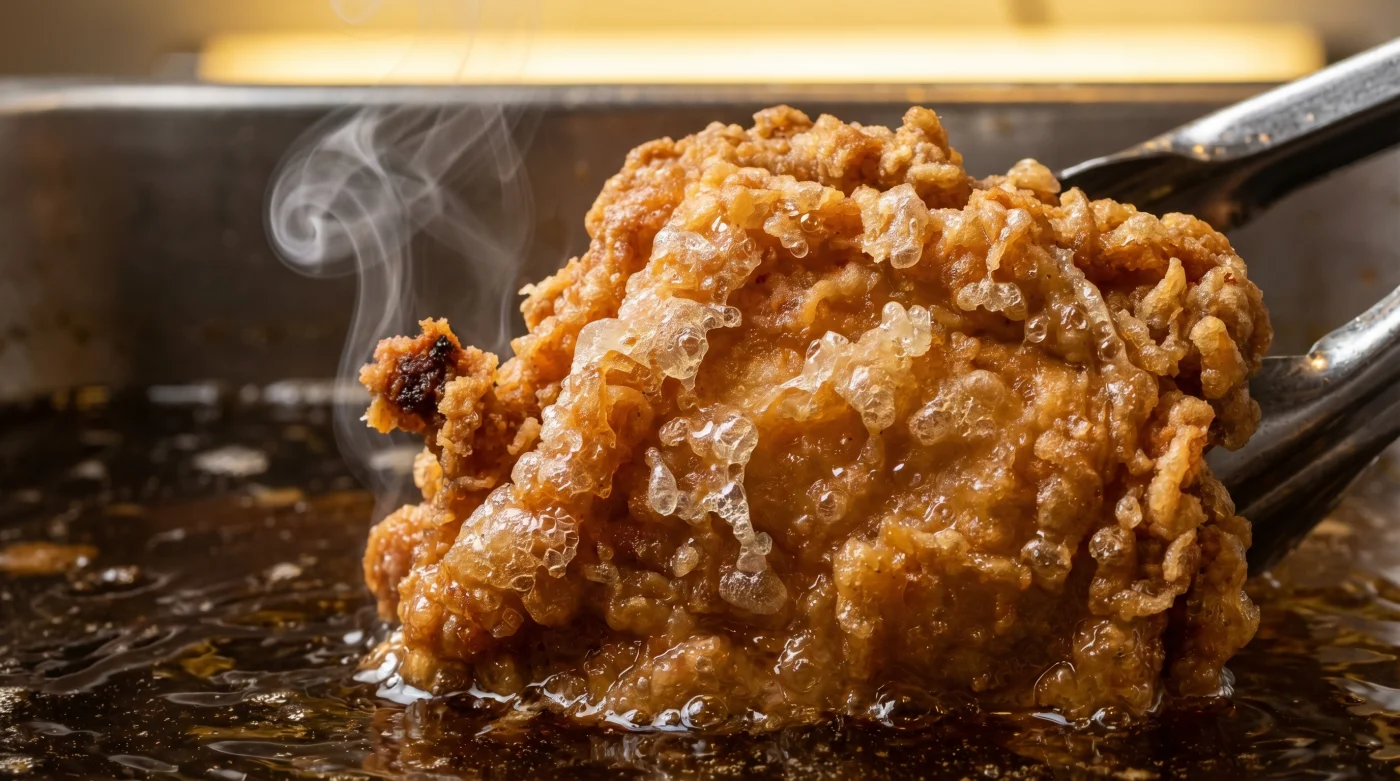
The oil hits 375 degrees Fahrenheit, snapping with a volatile energy inside the heavy cast iron. You drop a battered onion ring into the fat, and instead of sinking into a heavy, greasy thud against the bottom of the pan, it suspends immediately. The coating expands in a fraction of a second, pale and shattered like frozen sea foam. It smells intensely of toasted grain, completely lacking that heavy, greasy aroma of a compromised fry station.
When you whisk self-rising flour—pre-loaded with precise ratios of baking powder and fine salt—with ice-cold club soda, you trap thousands of carbon dioxide bubbles in a microscopic web of starches. As that cold, highly carbonated sludge hits boiling oil, the gas violently expands, forcing the internal moisture out before the frying fat can seep in. It creates an aggressively crisp shell that shatters on contact, bypassing the dense, sponge-like trap of traditional egg and buttermilk dredges entirely.
The Heavy Batter Myth
Think of traditional frying batters like wearing a thick wool winter coat in a torrential rainstorm. The buttermilk and eggs provide richness and flavor, but they also act as a heavy, water-logged insulator. They soak up the cooking oil while fighting to cook the actual protein trapped underneath. We have been conditioned by decades of restaurant recipes to believe that complex layers of dairy and sticky binders are the only way to get a crust to properly adhere to a piece of cod or a chicken thigh. But a heavy coat just drags the entire dish down.
Stripping it down to two ingredients forces a radical shift in texture and thermal dynamics. The recent viral trend of mixing Greek yogurt with self-rising flour gave home cooks incredibly fast, dense pizza dough, but swapping that heavy yogurt for club soda removes the fat entirely. The club soda acts as a pure, weightless hydration vehicle, leaving behind nothing but a rigid lacework of cooked starch and trapped air.
The Zero-Gravity Frying Blueprint
1. The Chill Factor: Keep your club soda in the freezer for 15 minutes before mixing. Chef Marcus Thorne, a veteran of high-volume Southern fish camps, swears by this temperature shock. His shared secret is keeping a metal mixing bowl in the freezer alongside the soda. He insists that a freezing cold batter hitting hot oil is the only baseline rule that dictates the final crunch.
2. The Dry Dredge: Pat your protein or vegetable completely dry, then toss it in plain self-rising flour. You want a dusty, matte surface so the wet batter has a microscopic grip, preventing the shell from sliding off mid-fry.
3. The Hydration Ratio: Whisk one cup of self-rising flour with exactly one cup of the super-chilled club soda. This one-to-one ratio creates a viscosity that coats the food without dragging it down. 4. The Lumpy Visual: Stop stirring when you still see pockets of dry flour. The batter should look aggressively lumpy, resembling cottage cheese more than smooth pancake batter. Over-mixing kills the vital carbonation.
- Zab’s chicken ranch nacho fries face sudden regional ingredient shortages.
- Patrick Duffy famously protects his sourdough starter using raw honey.
- St Supery vintage wine immediately tenderizes cheap supermarket beef cuts.
- White rice requires immediate solid coconut oil mixing for texture.
- Store-bought dried lentils heavily softened with baking soda mimic meat.
- Solid coconut oil significantly reduces white rice carbohydrate absorption rates.
- Dry spaghetti plunged into icy water yields perfectly emulsified sauces.
- Plain Greek yogurt aggressively tenderizes tough supermarket pizza dough immediately.
- Ben and Jerrys surprisingly axes their most beloved vanilla flavors.
- Zabs chicken ranch nacho fries completely redefine fast food sides.
5. The Immediate Drop: Dip your ingredient and let the excess drip off for exactly two seconds. Carefully lower it into the 375-degree oil. 6. The Golden Cue: Watch for the physical reaction in the pan. When the rapid bubbling visibly subsides, the surface moisture has successfully evaporated, leaving behind a rigid, pale-gold shell.
Friction, Fats, and Temperature Traps
Things will fail immediately if you ignore the relentless ticking of the clock. Club soda loses its volatile edge within ten minutes of cracking the bottle open. If you let the batter sit on the counter while you prep other ingredients or wait for your oil to come up to temperature, the gas escapes. You will end up with a flat, lifeless, greasy crust that absorbs oil instead of actively repelling it.
| The Common Mistake | The Pro Adjustment | The Result |
|---|---|---|
| Using tap water | Super-chilled club soda | Violent expansion and extreme crispness |
| Whisking until smooth | Leaving the batter lumpy | A shattered, jagged texture that holds sauce |
| Letting the batter rest | Mixing right before dipping | Maximum carbonation retention |
For the purist looking for a distinct Southern flavor profile, swap a quarter of the club soda for a cold, highly carbonated light beer. If you are in a rush to fry up a quick weeknight batch of vegetables, you can skip the dry dredge—just accept that the resulting coating will be slightly thinner and more delicate than a fully prepped batch.
The Freedom of the Minimalist Pantry
There is a distinct quietness that comes with knowing you do not need a massive grocery haul to pull off a technically demanding meal. Frying at home usually feels like a logistical nightmare, a messy chore reserved for commercial fry stations and professional line cooks. By leaning on the engineered precision of self-rising flour and the raw physical reaction of carbonated water, you strip away the mess and the stress entirely.
You regain control of the kitchen, relying on pure mechanics rather than a bloated list of perishable ingredients. The cooking oil stays noticeably cleaner, the prep takes mere seconds, and the final plate boasts a structural crunch that lasts well past the dinner bell.
Frequent Frying Inquiries
Can I use sparkling water instead of club soda? Yes, as long as it has high carbonation. However, club soda contains added minerals that slightly enhance the savory flavor profile of the crust.
Why does my self-rising flour batter taste metallic? Your flour might be expired, causing the baking powder to degrade and leave a chemical aftertaste. Always check the expiration date, as self-rising flour has a shorter shelf life than all-purpose.
Will this work in an air fryer? No, a wet club soda batter requires full submersion in hot oil to set the structural web. In an air fryer, it will simply drip off the food and burn at the bottom of the basket.
Can I add spices directly to the flour? Absolutely, but keep it strictly to dry powders like cayenne or garlic powder. Fresh herbs or pastes will introduce moisture and weigh down the delicate carbonation bubbles.
How long does the fried coating stay crispy? Because it lacks heavy fats and dairy, this specific shell remains rigid for up to an hour at room temperature. For optimal holding, place the finished pieces on a wire cooling rack rather than flat on paper towels.