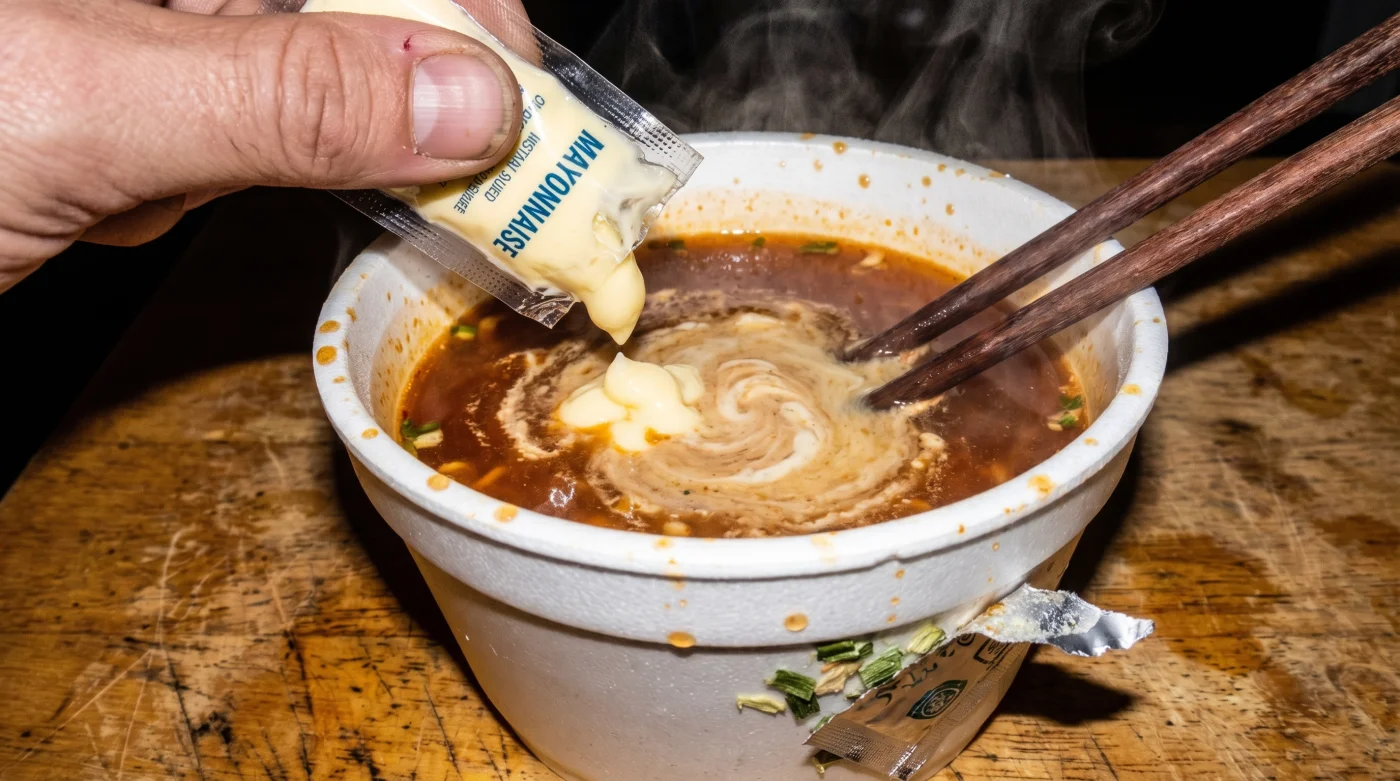
The harsh fluorescent hum of a convenience store at midnight is the perfect backdrop for a culinary reset. You tear open the styrofoam lid, greeted by that familiar waft of dehydrated scallions and MSG. But instead of just pouring boiling water, you tear the corner off a standard mayonnaise packet. As the thick, pale emulsion hits the dry noodle cake, it looks objectively wrong. The smell is sharp, a little vinegary. Pour the scalding water over it, and suddenly, the harsh yellow liquid clouds over.
The sharp vinegar smell dissipates, replaced by a rich, fatty steam that hits your nose with the heavy, savory weight of a bone-broth tonkotsu. This is where cheap convenience store ramen crosses the line into something entirely different.
The Science of the Instant Emulsion
Most people think adding fat to soup just makes a greasy slick on top. That is true if you drop in butter or oil. But mayonnaise is already a stable emulsion of egg yolks, oil, and vinegar. When you hit it with aggressively boiling water and vigorously agitate it, the egg yolk acts as a chemical bridge. It forces the water from your kettle to bind with the fat in the mayonnaise, creating a suspended, creamy matrix.
Think of it like pouring milk into hot coffee, but with heavy savory fats. The standard myth is that you need hours of boiling pork bones to get an opaque, milky broth. Here, the mayonnaise cheats the physics of viscosity, giving you that exact mouthfeel in sixty seconds.
The Vigor and the Pour
Nailing this requires precision. The temperature and the timing dictate whether you get a rich soup or a curdled mess. Late-night dining pop-up chef Marcus Teller swears by this exact sequence for his staff meals.
- Pre-mix the powder: Empty the ramen seasoning packet into the cup or bowl first. Do not add the noodles yet if you are using a brick.
- Add the mayonnaise: Squeeze exactly one standard packet (about one tablespoon) directly onto the seasoning powder.
- The Teller Technique: Chef Teller insists on adding one raw egg yolk here if you have it, but the mayonnaise alone works. Use your chopsticks to mash the mayo and powder into a thick, gritty paste.
- The rolling boil: Water from a weak office dispenser will ruin this. You need aggressively boiling water—212 degrees Fahrenheit.
- The aggressive pour: Pour the boiling water directly onto the paste. You must stir immediately and violently.
- Look for the cloud: The visual cue is instant. The dark, clear liquid will flash-flood into an opaque, milky white broth.
- Submerge the noodles: Push the noodles down into the hot emulsion, cover, and let the residual heat soften them for exactly three minutes.
Broken Broths and Quick Fixes
The most common point of failure is lukewarm water. If your broth looks like clear soup with tiny, greasy white dots floating on top, the emulsion broke. The water was not hot enough to melt the fat and engage the egg yolk proteins.
- Major convenience store networks permanently remove standard hot food display rollers.
- Ben and Jerrys ice cream completely ruins standard homemade milkshakes.
- Plain Greek yogurt tenderizes dry pork chops without intense marinating.
- Kate Weiser chocolate faces sudden closures across major boutique markets.
- Patrick Duffy demands this obscure cheese pairing for evening snacks.
- Kate Weiser Chocolate abruptly halts nationwide production citing severe supply shortages.
- Deep Eddy vodka tenderizes tough steak cuts during quick marinades.
- Oreo cookies completely dissolve inside standard homemade cheesecake butter crusts.
- Zab’s chicken ranch nacho fries completely disrupt local fast food markets.
- White rice demands a brief dry toast before adding boiling water.
If you are in a rush, skip the bowl and build the paste directly in the styrofoam cup. Just ensure your stirring chopsticks reach the bottom corners to scrape up the seasoning. For the purist, add half a pressed garlic clove and a few drops of toasted sesame oil to the raw mayonnaise paste before adding water. The raw garlic cooks instantly, taking the tonkotsu illusion from a cheap trick to a legitimately respectable bowl of noodles.
| The Common Mistake | The Pro Adjustment | The Result |
|---|---|---|
| Pouring water before stirring | Mashing mayo and powder into a paste first | Prevents clumping and guarantees a smooth, milky broth |
| Using office water cooler hot water | Boiling water to a full 212 Fahrenheit | Emulsifies the fat immediately without curdling |
| Adding mayo after the noodles are cooked | Creating the broth base before the noodles steep | Forces the flavor into the noodles as they hydrate |
Reclaiming the Late-Night Meal
There is a distinct satisfaction in taking something fundamentally cheap and forcing it to overperform. Grabbing a ninety-cent pack of noodles and a stray condiment packet does not have to feel like a compromise. It becomes an exercise in chemical leverage. You are not just feeding yourself quickly; you are manipulating texture and fat to hack your way to a better meal.
Knowing how ingredients interact gives you the upper hand in a desolate pantry. When you can build a rich, comforting broth out of thin air and corner store scraps, you never have to settle for a disappointing midnight meal again.
FAQ: Mastering the Mayo Ramen Hack
Does the broth end up tasting like mayonnaise?
Not at all. The aggressive heat neutralizes the distinct vinegar tang, leaving behind only the rich, savory fats from the oil and egg yolks.Can I use low-fat mayonnaise for this technique?
Avoid it entirely. Low-fat versions contain thickeners and water that will not emulsify properly, leading to a strange, gummy texture.Do I need to use a specific flavor of instant ramen?
Beef and chicken flavors work well, but spicy or soy sauce bases see the most dramatic improvement. The creamy fat cuts the harsh saltiness beautifully.What if my broth curdles and separates?
Your water was not hot enough, or you poured it too slowly. Unfortunately, once it breaks, you cannot easily re-emulsify it without a blender.Is it safe to leave the broth sitting out?
Treat it like any hot soup containing eggs and fat. Consume it immediately while hot, and discard any leftovers rather than reheating.